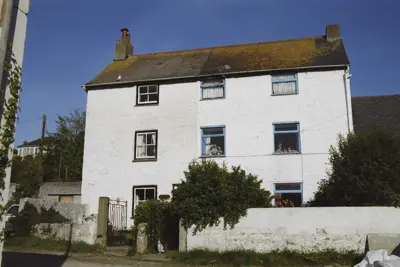
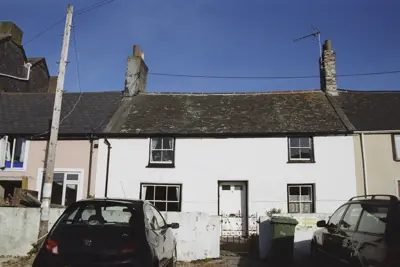
History of Old Hayle
compiled by Paul Mason
Shared Research, including Maps, Photographs, Postcards & the like...

Hayle, Cornwall c1902
from The Towans
Camden's Britannica map - 1789
includes reference to 'Heyl River' ('Heyl' meaning 'Estuary')
Ordnance Survey 1st edition one-inch map of area around 'Heyl Mouth' - 1809
('Heyl' meaning 'Estuary')
Manor of Trevethow (Trevethoe) Estate Plan 1820
[black markers point at local orchards]
1825 Estate Plan of the Hayle Estuary
showing the design for bridges, a turnpike road and an embankment causeway

Plan of the Iron Foundry, Foundry Hill & Plantantion, Hayle - c1841
Hayle Foundry area of St Erth Parish- Tithe map c1841
Foundry Square & Foundry Hill, Hayle, St Erth Parish - Tithe map c1841
~ ~ ~ ~ ~ ~ ~ ~ ~ ~ ~ ~ ~ ~ ~ ~ ~ ~ ~ ~ ~ ~ ~ ~ ~ ~ ~ ~
The Harveys of Hayle

John Harvey 1739-1803 in about 1779
Blacksmith, Engineer and Ironfounder from Carnell Green
John Harvey (1739-1803) married Joanna Ann Harvey - née Pearce (1733-1807) at Gwinear on 8th February 1756
* children *
- Joanna Harvey (1757-1836) married William West (1751-1832), the engineer/designer, at St Erth on 9th May 1784
children, Anne Nancy (1785-1866)
William II (1787-1852)
Jane Harvey (1792-1871
Anna (1794-1846)
Becky (1797-1817)
John (1800-1868)
(from January 1816 William West (1751-1832) becomes a director of Harvey & Co. Ltd)
- William Harvey (1758-1762)
- John Harvey (1760-1783) married Elizabeth Stapleton
son William Harvey
- William Harvey (1763-1768)
- Francis Harvey (c1765-1767)
- Jane Harvey (1772-1868) married Richard Trevithick (1771-1833), the inventor, at St Erth on 7th November 1797
children; Richard Trevithick (1798–1872)
Anne Ellis (1800–1877)
Elizabeth Banfield (1803–1870)
John Harvey Trevithick (1807–1877)
Francis Trevithick (1812–1877)
Frederick Henry Trevithick (1816–1883)
- Anne Harvey (1774-1808) married John Harvey (17**-1809) a well-to-do Cabinet Maker of Helston
survived by 6 children
- Henry 'Little Cap'n' Harvey (1775-1850) born at Gwinear, 3rd September 1775
Henry appears not to have married, but instead to have taken a mistress, a servant called Grace Tonkin, 24 yrs his junior, installed in a house just a few minutes walk away, Mellanear House.
children; John Tonking (1818-1838)
Edward Harvey Tonking (1821-1824)
William Harvey Tonking (1822-1843)
Francis Harvey Tonking (1823-1853)
Henry Harvey Tonking (1824-1844)
Richard Harvey Tonking (1825-1856)
Juliana Harvey Tonking (1828-1849), married John Polglase on 28th June 1848 at St Erth
Edward Harvey Tonking (1830-1831)
Edwin Harvey Tonking (1832-1869)
James Harvey Tonking (1833- ? ), married Eliza (Whitford) Trenerry, 15th May 1855 at Phillack
Charles Harvey Tonking (1837-1908)
>
It is said that in 1847 Henry Harvey had a stroke and could not walk unaided
Henry Harvey died 13th May1850
- Elizabeth 'Betsy' Harvey (1779-1848) unmarried, resided with her brother, Henry

'Harveys of Hayle' by Edmund Vale
cover picture of Henry Harvey (b.September 3rd 1775, d.May13th1850)
~ ~ ~ ~ ~ ~ ~ ~ ~ ~ ~ ~ ~ ~ ~ ~ ~ ~ ~ ~ ~ ~ ~ ~ ~ ~ ~ ~
Harvey & Co

Messrs. Harvey & Co, Hayle, Cornwall 23rd January 1848

Messrs Harvey & Co, Hayle, Cornwall 26th October 1850
Towards the end of the 19th century the fortunes of Harvey & Co declined, and in 1903 they announced the closing of their engineering works and Foundry, but the company continued to trade as a general and builders merchant, eventually merging with UBM to become Harvey-UBM (United Builders Merchants) in 1969.
In 1981, on the instructions of the UBM Group Limited, Hayle Harbour was offered for sale.
UBM was then acquired by Jewson Builders Merchants who continued to use the Harvey & Co site in Carnsew, Hayle.
In 2022 it was reported that the Jewson chain was being sold in a £740 million deal to the european building materials distributor Stark Group.
~ ~ ~ ~ ~ ~ ~ ~ ~ ~ ~ ~ ~ ~ ~ ~ ~ ~ ~ ~ ~ ~ ~ ~ ~ ~ ~
Foundry House, also known as Harvey House, facing 'Mill' and 'Swan Pool'
Harvey family residence
built c1780-90 on land leased by John Harvey from the Lower Trelissick estate
In 1812, Henry Harvey's sister, Betsy, inadvertently found herself involved in a dispute between Henry Harvey and a business partner, Hannibal Curnow Blewett, which Henry's brother-in-law, Richard Trevithick, took full advantage of:
"Blewett sent a handsome silver teapot to Miss Betsy Harvey, who kept her brother's house, called Foundry House. Trevithick was sitting with them when the box was brought in and opened. Mr. Henry Harvey was indignant at Mr. Blewett sending a bribe or make-peace to his sister, and threw the silver teapot under the fireplace. Trevithick, however, quietly picked it up, pointed out the dinge it had received, wrapped his pocket handkerchief around it, and saying, if it causes bad feeling here it will do for Jane, marched away home with the pot. The writer drank tea from it recently, and also laughed at the dinge.".
- 'Life of Richard Trevithick: With an Account of His Inventions Vol II' by Francis Trevithick, 1872 pp52-3
- from January 1816 Elizabeth Harvey became a director of Harvey & Co. Ltd
1841 Tithe apportionment 38, House, Garden and part of Stables - occupier Henry Harvey
1841 Census
Hayle Foundry,1,Henry Harvey,65,,Independant,In county,
,,Elizabeth Harvey,,60,Independant,In county,
,,Sophia Tredinick,,25,Female Servant,In county,
,,Agnes Troon,,25,Female Servant,In county,
1861 Census
88,,1,John West,Head,W,60,,Civil Engineer,St Erth Cornwall,,
,,,Nicholas James West,Son,U,21,,Civil Engineer,St Agnes Cornwall,,
,,,Elizabeth Harvey West,Dau,U,,17,[scholar],St Erth Cornwall,,
,,,Honor Burt,Antlaw,U,,63,Housekeeper,Phillack Cornwall,,
89,,1,John Vivian,Head,M,76,,Retired Shipmaster,Phillack Cornwall,,
Harvey House was demolished in 1885 to make way for the expansion of Harvey & Co's central erecting shop
~ ~ ~ ~ ~ ~ ~ ~ ~ ~ ~ ~ ~ ~ ~ ~ ~ ~ ~ ~ ~ ~ ~ ~ ~ ~ ~
Tremeadow Terrace - formerly called 'Mill Row'
built by Harvey & Co for employees
1841 Census
Book 12 Folio 30 Pages 2-7 - see Mill Row
link to census > > https://sites.rootsweb.com/~kayhin/40144.html
'Tremeadow Terrace was built in about 1819 and was originally called Mill Row. An unusually regular row of cottages and half-houses, built of rubble stone and granite with slate roofs, mostly replaced with mineral slate, and red brick stacks. Varied plots of 1 window and 2 window width, originally all sash windows, many now replaced. The rear elevation, despite some C20 extension, retains much of its original character, including a number of back-to-back sheds set within the shared courts of the cottage pairs. One of the main features of the row is the surviving series of front gardens, with rubble boundary walls capped with brick, and now with an impressive array of C20 sheds at their lower (south) ends; a municipal parking scheme at the north end of the row that has allowed access for garages is an intrusive feature . These gardens and the cottages are served by a common path bounding the Hammer Mills [24] to the south, doorways into these buildings lead off this path as well, indicating a common ownership and perhaps date for both sets of structures . '
http://www.hayle.net/council/documents/2000R058HayleHistoricalAssessmen…
~ ~ ~ ~ ~ ~ ~ ~ ~ ~ ~ ~ ~ ~ ~ ~ ~ ~ ~ ~ ~ ~ ~ ~ ~ ~ ~
Mill
built c1779 on land leased by John Harvey from the Lower Trelissick estate
- Hammer Mill - for crushing and grinding materials
'Harvey's hammer mills were water powered by the nearby pond. The site is now a public garden. Rubble stone walls with some brick dressings. The walls show the scars of demolished buildings, and the various stages of development and build are traceable. This and the attached grist mill complex (25] were when photographed in 1905 prominent buildings some 5 or 6 storeys high with a taller stack (The Old Days in Hayle, n.d., Packet Publishing, 21).'
http://www.hayle.net/council/documents/2000R058HayleHistoricalAssessmen…
- Boring Mill - for engineering
- Grist Mill - for grinding corn and making flour
'Grist mill. Built by Harvey's it passed to the Trevithick side of the family, and was for a long time known as Trevithick's Mill. (H.E.D. Vale, St Erth Parish Checklist, 1966, CA14, pg. 114). lt was extant in 1780 (W.H. Pascoe, Phillack Parish Checklist, 1976, CA15, pg. 100). Parts of the stabilised outer walls of the mill survive within the complex of walls surrounding the memorial gardens. The millpond seems not to have been used to drive this mill, which was at first operated by horsepower, and then from c.1830 onwards by steam. Extended 1879, milling ceased in the 1890s, when a mint humbug factory took over part of the building (B. Acton, A View from Trencrom, 1992, 75). The walls were reduced in height in 1940, reputedly to prevent this large building being used as a target in German bombing raids (pers. comm. B. Sullivan, May 2000) .'
http://www.hayle.net/council/documents/2000R058HayleHistoricalAssessmen…
Ropeworks
'Ropemaking was one of the first of John Harvey's diversified activities after setting up his foundry. lt seems to have commenced about 1796, and continued until 1916 (C. Noall, 1985, The Book of Hayle), but is first recorded in trade directories only in 1844 (Pigots Directory), when there were four other ropemakers recorded in Hayle. '
http://www.hayle.net/council/documents/2000R058HayleHistoricalAssessmen…
'Harvey’s Foundry started in the 1780s and this was the site of the boring and hammer mills, and a five-storey grist mill, which was still in use until the 1930s.'
'There were walls there from a brass foundry, which once made ship’s bells.'
'The Ropewalk dates from 1793 and was worked until 1916, when most of the men had gone to war.
There are the remains of a furnace where they used to boil tar for rope-making, and a pit where the rope was soaked.'
'The inner pond was originally an ornamental lake for the people living in the villas in Millpond Avenue. The outer pond powered the foundry. There’s a wheelhouse there housing three waterwheels... The outer pond is known as the swan pool'
- extracts from 'A conversation with warden Georgina Schofield', February 2011
http://cornishgardenstories.co.uk/a-former-foundry-site-has-become-a-tranquil-open-space-for-the-people-of-hayle/
~ ~ ~ ~ ~ ~ ~ ~ ~ ~ ~ ~ ~ ~ ~ ~ ~ ~ ~ ~ ~ ~ ~ ~ ~ ~ ~
Lane between 'Harvey House' & 'Pond House' leading to 'Foundry Stables'
'32
HAYLE, FOUNDRY HILL (Fig 15d) [reference key at foot of webpage]
WALL
SW55783701 PRN: 139005
This early 19th century wall is a surviving component of the Foundry Farm Yard complex and also
delineates a pathway that ran from the Yard to Foundry Hill (the dressed granite quoins of the entrance to
the yard survive). lt was associated with the Foundry House (1790-1885). Built of rubble stone and
granite, capped with pale buff coloured bricks, it is about 2-3 metres high. lt is shown on the Plan of Hayle
Foundry and Lands Adjoining dating to 1864 (GRH 148/1, CRO 214/3/2).'
http://www.hayle.net/council/documents/2000R058HayleHistoricalAssessmen…
the original lane became overgrown with trees, is now blocked off each end with electricity substations 
~ ~ ~ ~ ~ ~ ~ ~ ~ ~ ~ ~ ~ ~ ~ ~ ~ ~ ~ ~ ~ ~ ~ ~ ~ ~ ~
Bungalow
built between lane and Pond House, 1930s, and thought first to have housed Mother Superior of the Daughters of Liege order, St Michael's Hospital
'383
HAYLE, 2 FOUNDRY HILL (Fig 15d) [reference key at foot of webpage]
HOUSE
SW55773701 PRN: 139612
House, early C20. Rock-faced granite with rendered return elevations and slate roof, with red and white
brick stacks. Single storey with hipped roof and stacks to left and to right. Large windows to left and rght
and central door in gabled porch with bargeboards. Stands in the former grounds of the Foundry
Farmhouse. Its relationship to Harvey's is not known.'
http://www.hayle.net/council/documents/2000R058HayleHistoricalAssessmen…
~ ~ ~ ~ ~ ~ ~ ~ ~ ~ ~ ~ ~ ~ ~ ~ ~ ~ ~ ~ ~ ~ ~ ~ ~ ~ ~
Foundry Farmhouse, 9 Foundry Lane, facing Mill Pond, and formerly known as 'Pond House'
built c1799 on land leased by John Harvey from the Lower Trelissick estate
1841 Tithe apportionment 39, Dwelling House and Garden - Capt. John Vivian
Road adjoining
'384
HAYLE, FOUNDRY FARMHOUSE, FOUNDRY HILL (Fig 15d) [reference key at foot of webpage]
HOUSE
SW55753701 PRN: 140792
House. Late 18th/early 19th century. Rendered stonework with slate roof. Two storied, hipped symmetrical house with boundary walls related to the rest of the Foundry Lane. The roadside wall (to Foundry Hill) were originally swept up to Foundry Lane, and possibly had railings on them, but have been partially raised with early/mid C19 brickwork, in itself an indication of the probable late C18/early C19 date of house and walls. A house is represented here on the 1791-6 map of Hayle, and seems never to have been extensively altered or extended. Part of the complex attached to Harvey's Foundry (and owned separately from the Foundry by the family,) it does not seem to have been exclusively or even generally used as the farmhouse probably before the later C19 (on the split of the Harvey business in 1852 it was part of the Trevithick inheritance)- In 1842 (Tithe Award) it was the home of Capt. John Vivian, the man who steered Richard Trevithick's steam carriage engine along the streets of London in 1802 (Vale, 65), and an engineer/sailor, not a farmer.'
http://www.hayle.net/council/documents/2000R058HayleHistoricalAssessmen…
1841 Census
Hayle Foundry,1,John Vivian,55,,Mariner (Sea),In county,
,,Elizabeth Vivian,,50,,In county,
,,James Vivian,25,,Agent,In county,
,,Elizabeth Vivian,,15,,In county,
,,Cat Williams,,25,Female Servant,In county,
1851 Census
53,Foundery,John Vivian,Head,M,67,,Agent For Steam Vessls,Phillack Cornwall,,
,,Elizabeth Vivian,Wife,M,,64,,Gwinear Cornwall,,
,,Elizabeth Vivian,Dau,S,,26,At Home,Gwinear Cornwall,,
,,John Vivian,Grnson,,12,,Scholar,Clifton Gloucestershire,,
,,Mary Thomas Burall,Visitr,S,,18,Farmers Daughter,Crowan Cornwall,,
,,Catherine Williams,Servnt,S,,39,House Servant,Gwinear Cornwall,,
1861 Census
89,,1,John Vivian,Head,M,76,,Retired Shipmaster,Phillack Cornwall,,
,,,Elizabeth Vivian,Wife,M,,74,,Gwinear Cornwall,,
,,,John Vivian,Grnson,U,22,,Merchants Clark,Bristol Somerset,,
,,,Emma Williams,Servnt,U,,24,Housemaid,Phillack Cornwall,,
1871 Census
97,Foundry,1,Elizabeth Vivian,Head,W,,85,,Gwinear Cornwall,,
,,,Grace Stevens,Servnt,U,,22,Domestic Servant,Phillack Cornwall,,
>>>>>>>>>>>>>>
According to the 1881 census, 'Pond House' was then occupied by Richard Hawkins, Farm Bailiff.
1881 Census
61,Pond House,1,Richard Hawkins,Head,M,52,,Farm Bailiff,St Issey Cornwall,,
,,,Mary E. Hawkins,Wife,M,,44,,Gulval Cornwall,,
,,,Linda E. Hawkins,Dau,U,,18,,St Issey Cornwall,,
,,,Thomas S. Hawkins,Son,U,16,,Engin Fitter At Works,St Issey Cornwall,,
,,,Frances L. Hawkins,Dau,U,,14,Scholar,St Issey Cornwall,,
,,,William R. Hawkins,Son,,12,,Scholar,St Issey Cornwall,,
,,,Sidwell M. Hawkins,Dau,,,4,,St Erth Cornwall,,
,,,Infant Hawkins,Son,,1m,,,St Erth Cornwall,,Age under one month
,,,Albert Rogers,Nephew,U,18,,Drapers Apprentice,St Erth Cornwall,,
~ ~ ~ ~ ~ ~ ~ ~ ~ ~ ~ ~ ~ ~ ~ ~ ~ ~ ~ ~ ~ ~ ~ ~ ~ ~ ~
Q. So, who was Captain John Vivian????
A. John Vivian was born 17th January 1784 at Phillack, Cornwall, and baptized at Phillack on 11th March 1784.
Married to Elizabeth Rosewarne, born 13th October 1786 at Hayle, Cornwall. d. 24th December 1873
* children *
John Vivian 1809-1857
James Vivian 1811- ?
William Vivian 1813-70
Elizabeth Vivian 1824- ?
John Vivian died 7th January 1871 at Trenawen, Gwinear, Cornwall, England, aged 86 years old
Having driven the first successful steam passenger carrying locomotive, the 19-year old John Vivian became one of the very first Engine Drivers!
*Maybe the house where Captain John Vivian lived at that time merits a heritage Blue Plaque??*

'Trevithick's Common Road Passenger Locomotive, London, 1803'
Andrew Vivian (1759–1842) was a British mechanical engineer, inventor, and mine captain of the Dolcoath mine in Cornwall, England.
In partnership with his cousin Richard Trevithick, the inventor of the "high pressure" steam engine, and the entrepreneur Davis Giddy, Vivian financed the production of the first steam carriage and was granted a joint patent for high pressure engines for stationary and locomotive use in March 1802.
In 1801, Richard Trevithick completed his first full-sized road locomotive in Camborne, demonstrating it to the public on Christmas Eve with Vivian at the controls. The first day it ran about the streets and up the very steep Beacon Hill. The next day it went down to the village of Crane so that Vivian's family, who lived there, might see it. In a further trial, one week later, the machine overturned in a rut. It was dragged into a shed while Trevithick and Vivian had lunch at a nearby inn; on their return the boiler had run dry, setting fire to the machine's timber frame.
https://en.wikipedia.org/wiki/Andrew_Vivian
'Undismayed by this mishap, Trevithick ordered castings and a wrought iron boiler from West at Hayle Foundry for an improved road locomotive for demonstration in London. William Felton, a coachbuilder of Leather Lane, being entrusted with the bodywork. The carriage had one cylinder and three wheels, the two eight foot driving wheels placed behind with the boiler and engine between them. The small steering wheel at the front was controlled by a tiller, while the chimney was in the form of a negro, from whose mouth belched the smoke. It had accomodation for eight inside passengers.'
- 'The Book of Hayle' by Cyril Noall, Barracuda Books, 1984 p42
'This second locomotive, tried in Camborne in the latter part of 1802 or commencement of 1803, was sent to London in January, 1803. William West was then at Harvey's foundry in Cornwall, preparing the new cylinder; and still in February and March he was there preparing a new boiler, after which he was for five months in London, about the steam-carriage; and in August, Felton was paid for building the coach.
The London locomotive of 1803 was a great improvement on the former ones: it was not so heavy; and the horizontal cylinder, instead of the vertical, added very much to its steadiness of motion; while wheels of a larger diameter enabled it the more easily to pass over bits of bad road, which had brought the Camborne one to a standstill. The boiler was wholly of wrought iron, and, with the engine attached to it, was put together at or near Felton's carriage shop in Leather Lane; Trevithick, Andrew Vivian, and William West were with it; and Arthur Woolf (then in Trevithick's pay with the first high-pressure sent to London) came to see what was going on.
Andrew Vivian ran it, one day, from Leather Lane, Gray's Inn Lane, on to Lord's Cricket Ground, to Paddington, and home again by way of Islington - a journey of half a score miles through the streets of London. Trevithick was not on the engine on that occasion. Andrew Vivian was not an engineer, and would not have ventured on so long a run had there not been prior proof of what the engine could do; and the fact of an altered cylinder and boiler having been under construction in Cornwall after the locomotive had been sent to London, proves that several trials had been made, and changes found necessary.
"Captain Joseph Vivian recollects about 1803, his father, then a captain of a vessel, on his return from London told them that he and his nephew, John Vivian, had been invited to take a bit of a drive with Captain Trevithick and Captain Andrew Vivian on their steam-carriage: they went again for the next day; but Captain Vivian thought he was more likely to suffer shipwreck on the steam-carriage than on board his vessel and did not go a second time."
"Captain John Vivian, H.M.P.S., was, about the middle of 1803, on board his uncle's vessel in London, and often went to see the steam-carriage putting together at a coach-builders in Leather Lane. Captain Trevithick and Captain Andrew Vivian were there, and Mr. William West was the principal man in putting the engine together. Mr. Arthur Woolf frequently came in, he being engaged close by as an engineer in Meux's brewery.
"Thinks the engine had one cylinder, and three wheels; the two driving wheels behind were about 8 feet in diameter. The boiler and engine were fixed just between those wheels. The steering wheel was smaller, and placed in front. There were some gear-wheels to connect the engine with the driving wheels. The carriage for the passengers would hold eight or ten persons, and was placed between the wheels, over the engine, on springs. One or two trips were made in Tottenham Court Road, and in Euston Square. One day they started about four o'clock in the morning, and went along Tottenham Court Road, and the New Road, or City Road; there was a canal by the side of the road at one place, for he was thinking how deep it was if they should run into it. They kept going on for four or five miles, and sometimes at the rate of eight or nine miles an hour. I was steering, and Captain Trevithick and someone else were attending to the engine. Captain Dick came alongside of me and said, "She is going all right". "Yes" said I, "I think we had better go on to Cornwall". She was going along five or six miles an hour, and Captain Dick called out, "Put the helm down, John!' [likely meaning 'put the brake on'] and before I could tell what was up, Captain Dick's foot was upon the steering-wheel handle, and we were tearing down six or seven yards of railing from a garden wall. A person put his head from a window, and called out, "What the devil are you doing there! What the devil is that thing!"
"They got her back to the coach factory. A great cause of difficulty was the fire-bars shaking loose, and letting the fire fall through into the ash-pan.
"The waste steam was turned into the chimney, and puffed but with the smoke at each stroke of the engine. When the steam was up, she went capitally well, but when the fire-bars dropped, and the fire got out of order, she did not go well.
"I heard afterwards that the framing of the engine got a twist, and she was used to drive a mill for rolling hoop-iron; and also that she ran on a tramroad laid in Regent's Park."'
- 'Life of Richard Trevithick: With an Account of His Inventions Vol I' by Francis Trevithick, 1872 pp141-3

Trevithick's London "Bus"
- - - - - - - - - - - - - - - - - - - - - - - - - - - - -
John Vivian and the Napoleonic Wars
'.... the Post Office had engaged Little Catherine and appointed John Vivian as her captain on 13 March 1813. On 25 November the French frigates Sultane and Étoile captured Little Catherine as she was sailing from Passages.[a] The French took off Little Catherine's crew and abandoned her. On 28 November HMS Hotspur picked her up at sea.[b] Hotspur found her plundered, all but two of her guns thrown overboard, with her sails set, but her rudder free so that she drifted at the mercy of wind and waves. Captain the Honourable Jocelny Percy of Hotspur put a crew on board who took her into Penzance. A gale on the 30th upset her and put her on her beam ends, where she lay waterlogged.[13]
While Captain Vivian was on board Sultana a storm came up. Her crew consisted of untrained landsmen, many of whom were sea-sick. Sultana's captain appealed to Vivian for assistance. Vivian agreed that he and his men would navigate the frigate, handing back control when the weather moderated. In return, the frigate captain agreed to put the Englishmen aboard the next prize they took.
When the French captured the Falmouth packet Duke of Montrose on 12 December, they put Captain Vivian and Little Catherine's crew aboard Duke of Montrose. Captain Vivian was senior in the Packet Service to Captain John Forster of Duke of Montrose and so assumed command. The French also put on board their prisoners from some other vessels they had taken. The British reached Falmouth on 20 December. The commanders of both vessels assured the Packet Service's agent at Falmouth that they had sunk the Service's book of private (confidential) signals with the mails before the French had captured the vessels.
John Vivian’s grandfather was Captain John Vivian (senior); He was born at Phillack in 1784, and was a Captain in Her Majesty's Packet Service, He married in 1809 to Elizabeth Rosewarne.
Richard Trevithick’s friend, William West married Joanna Harvey. Richard Trevithick married Jane Harvey, a younger sister of Joannah Harvey. William West made the models of Richard Trevithick’s high pressure steam engine in 1796.
Captain John Vivian’s uncle was Captain Andrew Vivian; in 1802, Richard Trevithick, William West, and Andrew Vivian patented the high-pressure engine. In 1803, Captain John Vivian (senior), took the new engine on the LITTLE CATHERINE to London, and when there, drove Trevithick and West’s “locomotive” along New Road; At sea, he ran the Blockade and made a successful voyage to Cronstadt in 1811; 15th March 1813, he was in command of HMP LITTLE CATHERINE, returning from Corunna, the ship was captured by two French frigates; He retired from Packet service 1817;
In 1832, he became Commander of the HERALD, running between Hayle and Bristol, the first steamer used on the Cornish coast.
He also commanded the CORNWALL (1842-59)
and the COLOMBIA (1859-60). He died at Hayle in 1871.
https://freepages.rootsweb.com/~treevecwll/family/hharvey.htm

Cornubia, from an original drawing redrawn by Pete Joseph.
'Saturday 27 February 1858 saw the launch of the iron paddle steamer Cornubia at Hayle. The vessel was built by Harvey and Co to work the packet service between Hayle and Bristol. Her keel had been laid down a year earlier and the intention was that she should replace the wooden hulled steam paddler Cornwall. In 1858 the Cornwall was only 16 years old and she was to be sold to help the Hayle and Bristol Steam Packet Company to cover the costs of the Cornubia.'
'Cornubia was the first big iron paddler steamer built in Cornwall, she was designed at Harvey's probably by Jebus Bickle...'
'Cornubia had a overall length of 200 feet, 185 feet of keel, 241/2 feet beam and a 13 feet depth of hold. She had a gross tonnage of some 500 tons and was powered by a pair of oscillating engines of a nominal 230hp output which were fed by twin steam boilers. In service she could accommodate 55 to 60 saloon passengers plus an unknown number of second cabin and deck passengers. Fit out took four months and Cornubia underwent her first sea trial, under Captain Vivian, on 11th June 1858.'
https://www.penwithlocalhistorygroup.co.uk/on-this-day/?id=58
............................................................................................
Swan Pool
Swan Pool - Hayle c1900

Ordnance Survey map of c1881
Triumphal Arch
erected in 1843 by Harvey & Co. Ltd.

Triumphal Arch, Foundry Lane
possibly Sam Ellis?, car driver for Harvey's & Co. Ltd who lived closeby
'Listed building (No. 10/90). This triumphal arch was built in 1843 for Harvey and Company reputedly to celebrate the Leeghwater Engine contract for draining the Haarlemmer Meer in Holland. lt is constructed of granite ashlar with rectangular-plan abutments on either side of a fairly wide carriageway. Plinth, rusticated and vermiculated quoins and voussoirs, double impost bands, elliptical arch with projecting keystone, moulded cornice and tall ashlar blocking course. lt is part of the grandiose classicising and landscaping scheme undertaken by Henry Harvey in the 1840s.'
http://www.hayle.net/council/documents/2000R058HayleHistoricalAssessmen…
On 1 August 1837, King William I appointed a royal commission of inquiry; the scheme proposed by the commission received the sanction of the Dutch Parliament's Second Chamber in March 1839, and in the following May the work was begun.[5]
First, a canal was dug around the lake, called Ringvaart (Ring Canal), to carry the water drainage and boat and ship traffic which had previously gone across the lake. This canal was 61 kilometres (38 mi) long, and 2.40 metres (7.9 ft) deep, and the excavated earth was used to build a dike from 30 to 50 metres (98 to 164 ft) wide around the lake. The area enclosed by the canal was more than 180 square kilometres (69 sq mi), and the average depth of the lake 4 metres (13 ft). As the water had no natural drainage, it was calculated that probably 1000 million tons of water would have to be raised by mechanical means.[5]
All of the pumping was done by steam mills, an innovation contrasting with the historic practice of draining polders using windmills. Three Cornish beam engines were imported from Hayle: the Leeghwater, the Cruquius (the largest Watt-design reciprocal stroke steam engine ever built and now a museum), and the Lijnden. Pumping began in 1848, and the lake was dry by July 1, 1852; 800 million tons of water were actually discharged.
https://en.wikipedia.org/wiki/Haarlemmermeer
............................................................................................
 \
\
Hamilton Hawkins and Cyril Eddy at the Foundry Stables, Hayle
............................................................................................Carnsew Hillfort & Plantation
In 1852 the West Cornwall Railway decided to bring rail transport from up country to Hayle, driving track through Henry Harvey's Plantation at Carnsew

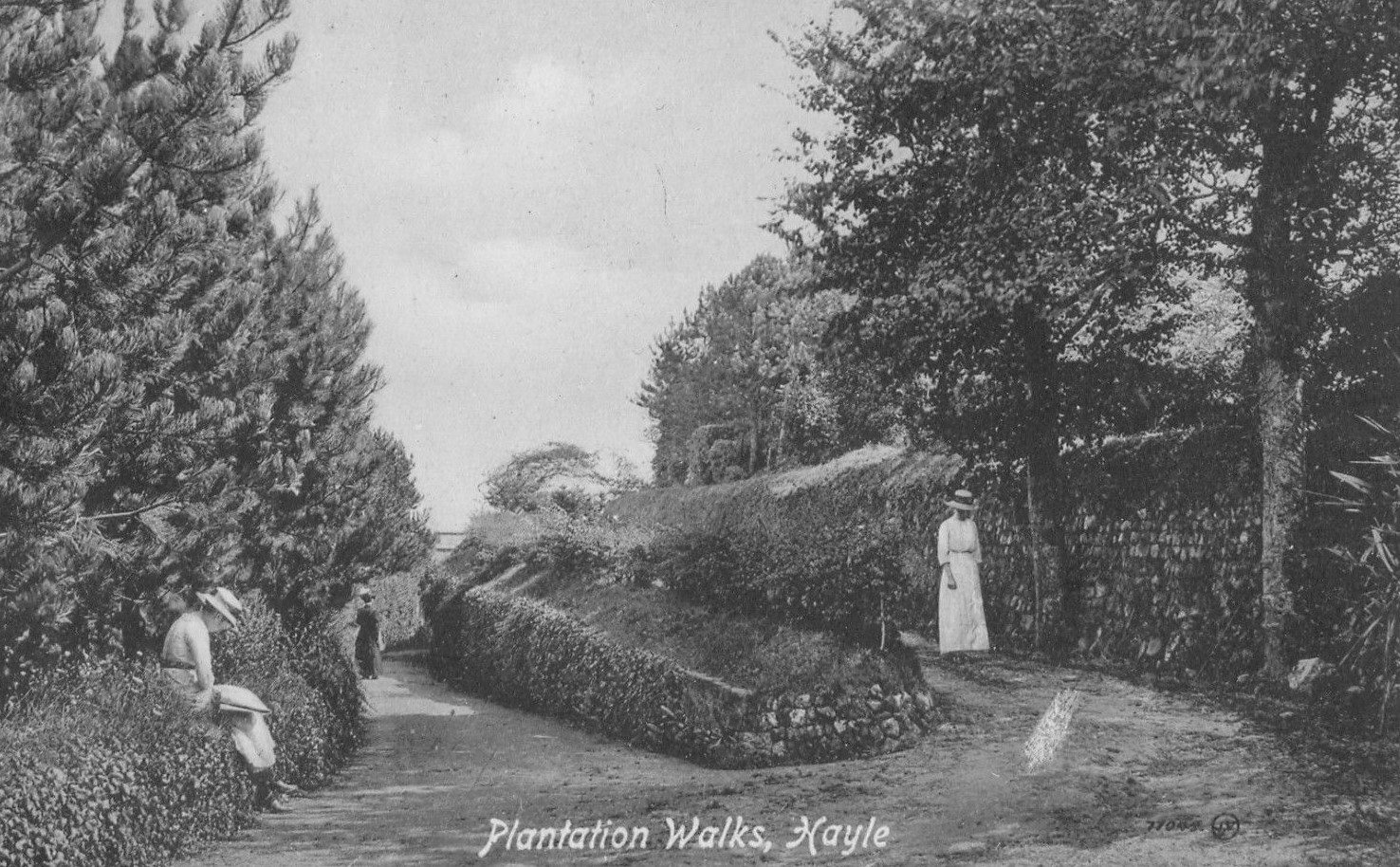
Plantation Walks, Hayle
postcard 77045
'345
HAYLE, CARNSEW (Fig 15d) [reference key at foot of webpage]
HILLFORT
SW55643713 PRN: 31934
The Victoria County History noted a semi-circular embankment at Hayle overlooking both estuaries. lt is shown on earlier OS maps as an earthwork. Thomas says that the earthwork at Camsew seems to have consisted of two ramparts, the outer surmounting the 50ft high cliff. Farming and the railway cutting have removed nearly all traces of a rampart on the west side, but this may be indicated by a change in slope.
The remaining ramparts were walled up and the paths cut along them by Henry Harvey in the construction of an ornamental park in 1845. There is an entrance in the north west with an enclosure to the east of it and a track leading from it to the shore. The fort was probably cnstructed to guard the Hayle estuary and a prehistoric trackway south of it. A field visit by the os in 1962 revealed that the surviving main rampart and annexe to the north are substantial but considerably mutilated by the construction of the park. There is no ground evidence of the earthwork having been completed by a rampart on the west side; it has probably been ploughed out. In its present condition the original entrance cannot be identified: that on the track leading from it (mentioned by Thomas) are probably modern. The earthwork appears to be a small hillfort rather than a cliff castle, with natural slopes defending the north and east sides. Wells says there are indications of a terrace on the western side, which may have been caused by the raising of the enterior. Altered and landscaped in the 1840s by Henry Harvey, who added a number of structures and ramped walks as part of a wider landscaping activity. See also [30] [33 -44) [59 -65] . '
http://www.hayle.net/council/documents/2000R058HayleHistoricalAssessmen…

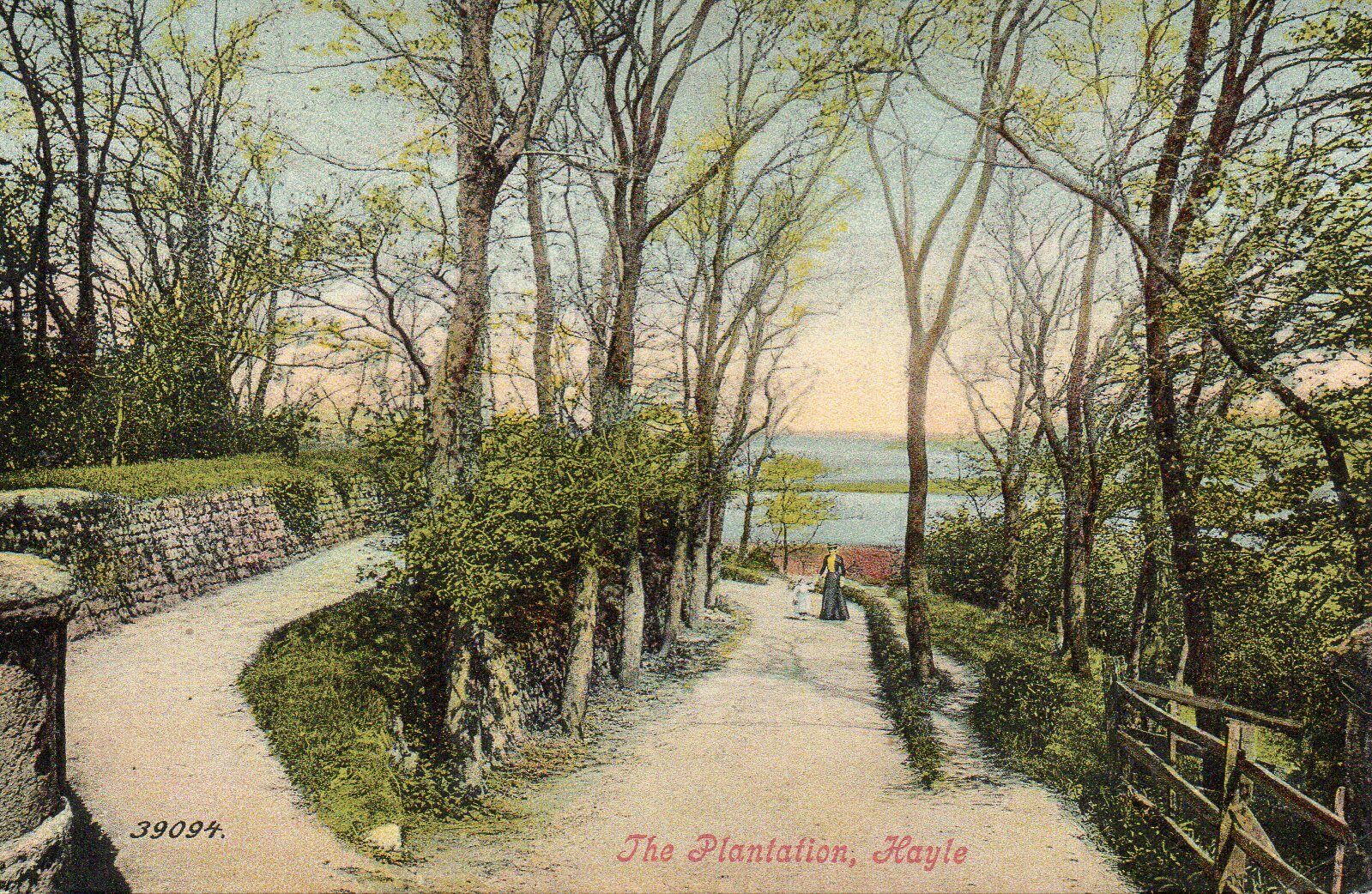
The Plantation, Hayle
Postcard 39094
'30
HAYLE, CUNAIDE STONE (Fig 15d) [reference key at foot of webpage]
INSCRIBED STONE
SW55643716 PRN: 31978 SM: 30 10749 LB: 11
Listed building (No. 10/113). A "stone" is marked at the location on current OS maps (1964 OS, 1:2500 Map). lt is now embedded in a bank in the park created on Camsew hillfort. Langdon says it was found in 1843 four feet below the ground surface near its present position. According to Langdon the inscription reads "hie (in pa) cem requievit .... Cunaide hie (in) tumulo iacit vixit annis xxxiii" (A.G. Langdon, Victoria County History 1, 420, PL 11, Fig. 10). Roman capitals are used throughout the inscription: Hencken dates the stone to the fifth and sixth century but it may be as earty as fourth century. Hencken's translation reads "here in the grave fell asleep ... Cunaide lies here in the grave. She lived 33 years" (H.O.N. Hencken, 1932, Archaeology of Cornwall and Scilly; 222, 225). Radford says the stone compares most closely with the late roman milestones of which there are five in Cornwall. The formula is Christian and can be paralleled in continental Christian cemeteries of the fourth and fifth centuries. Epigraphically a date before 400 is possible but the formulae and sequel show that some inscriptions should be dated to the middle of the late fifth century (C.A.R. Radford, 1975, Christian Inscriptions of Dunmonia (CAS Holbeche Corfield 1974). Macalister believes that the engraver made an error, hammered it out, and started over again. Hence "hie in tumulo requievit ..... Cunaide hie in tumulto iacit vixit annos xxxiii" (R.A.S. Macalister, 1945, Corpus Inscription. Ins. Celticarum I, No. 479, 457-8). A modem slate slab beside the stone has the inscription "hie cenui requievii cunat do. Hie tumulo iacit vixit annos xxxiii" and the translation "here cenui fell asleep who was born in 1500. Here in this tomb he lies. He lived 33 years" (1962, FV, G.H. Pitcher/OS). The inscribed stone was found in association with a cist grave (see PRN 31798. 01). '
http://www.hayle.net/council/documents/2000R058HayleHistoricalAssessmen…
~ ~ ~ ~ ~ ~ ~ ~ ~ ~ ~ ~ ~ ~ ~ ~ ~ ~ ~ ~ ~ ~ ~ ~ ~ ~ ~ ~
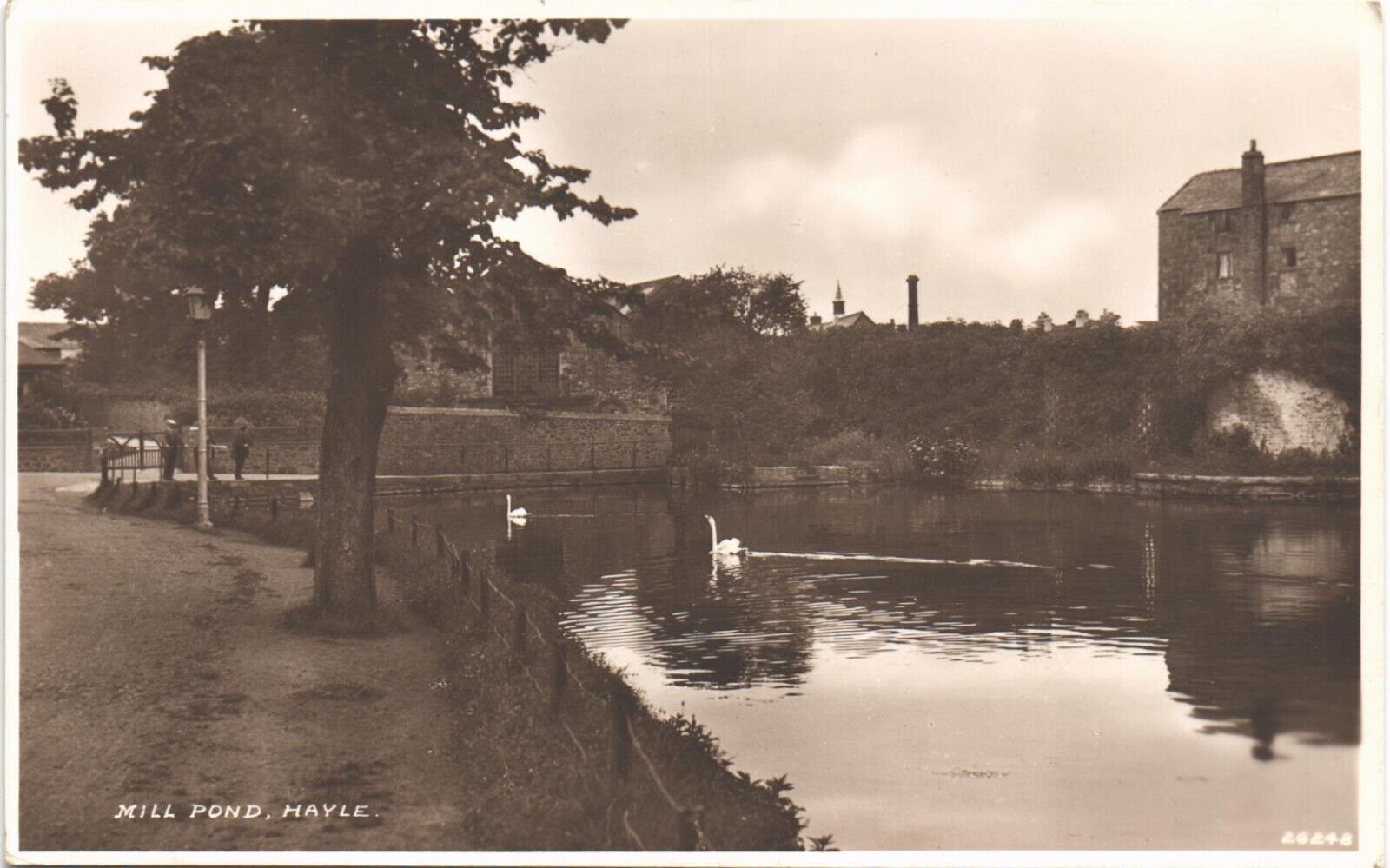
Hayle Millpond (formerly called 'Swan Pool')

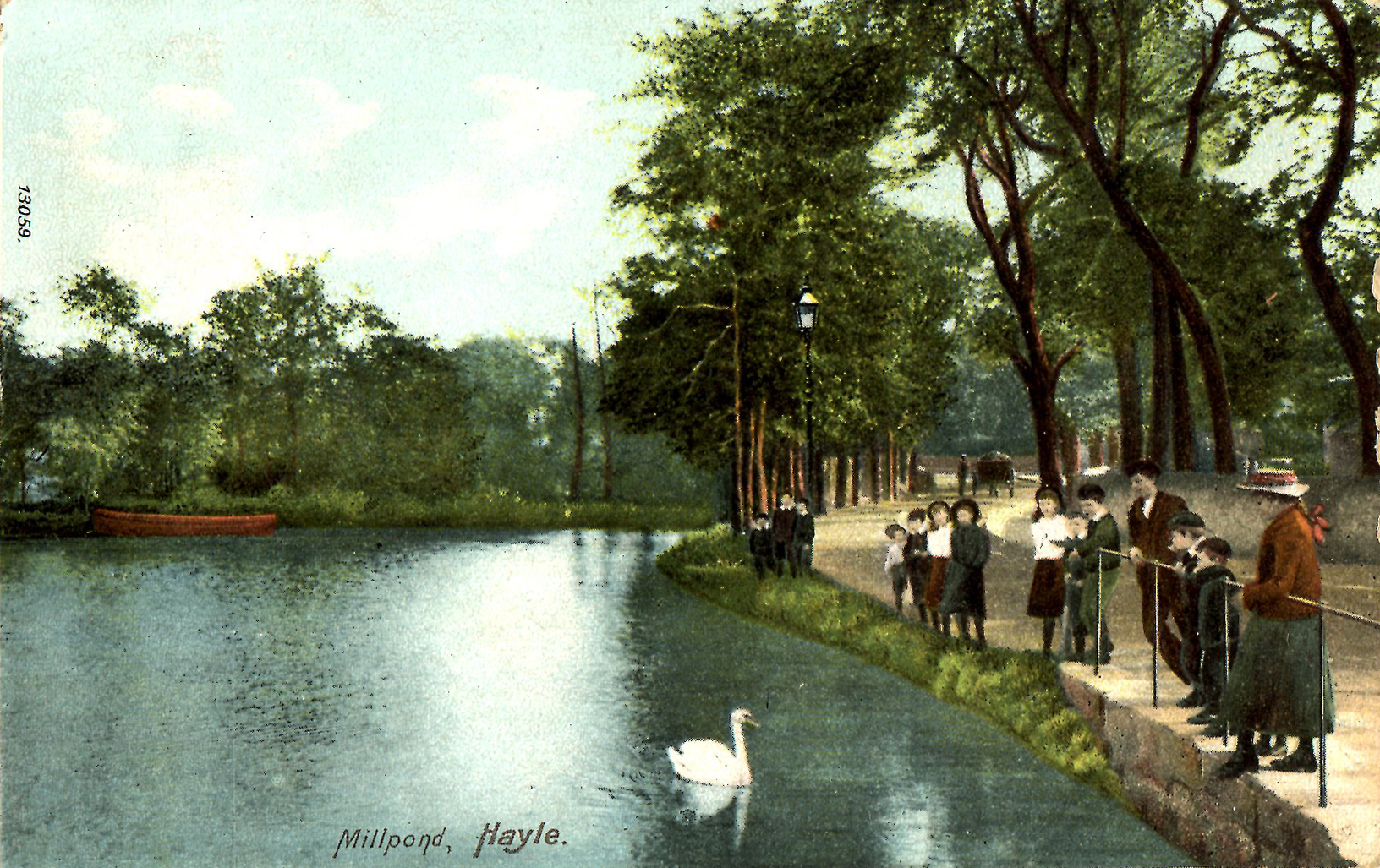
Millpond, Hayle
Wrench Series postcard 13059

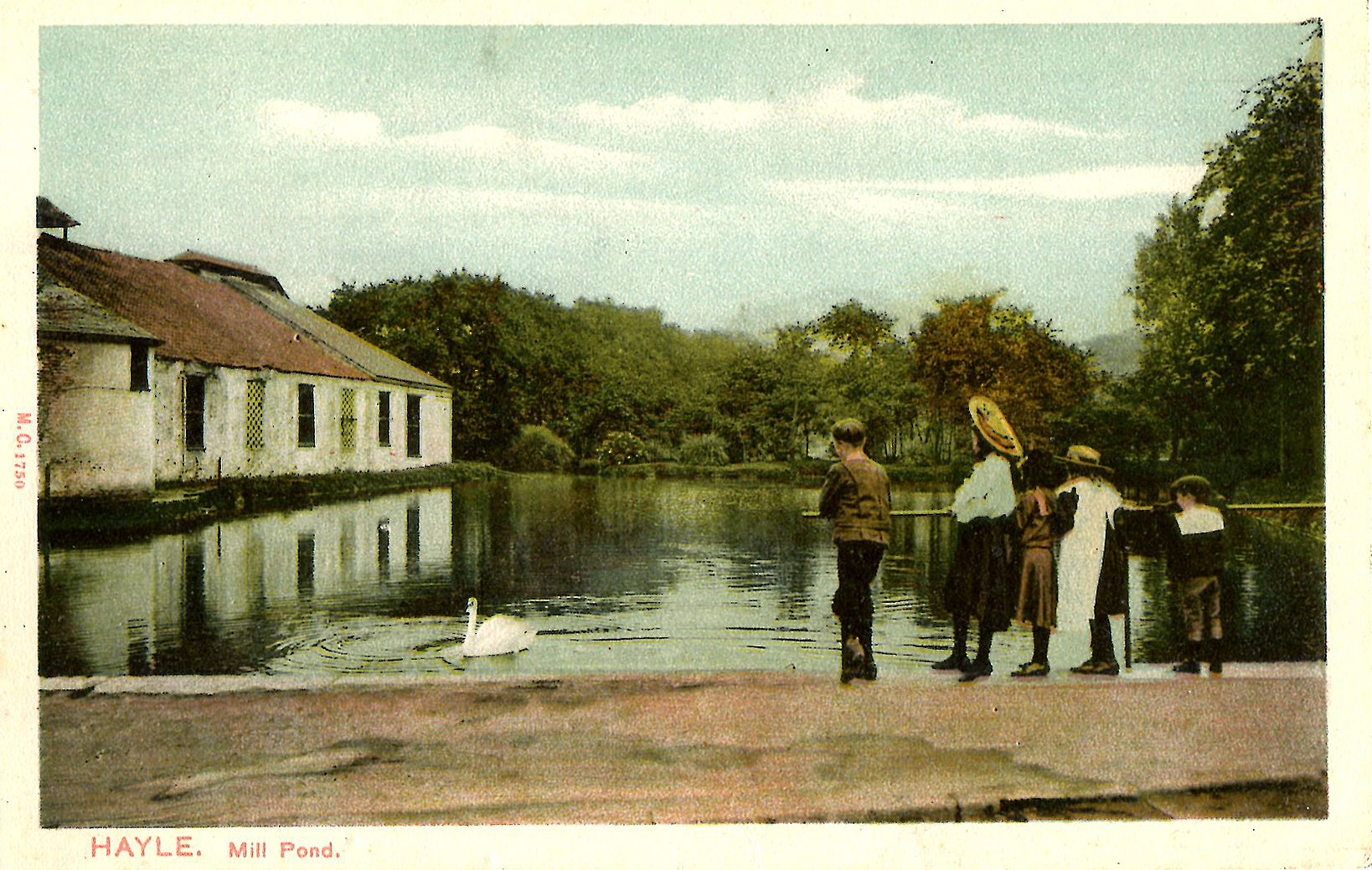
Hayle. Mill Pond. c1905
Peacock postcard M.C. 1750

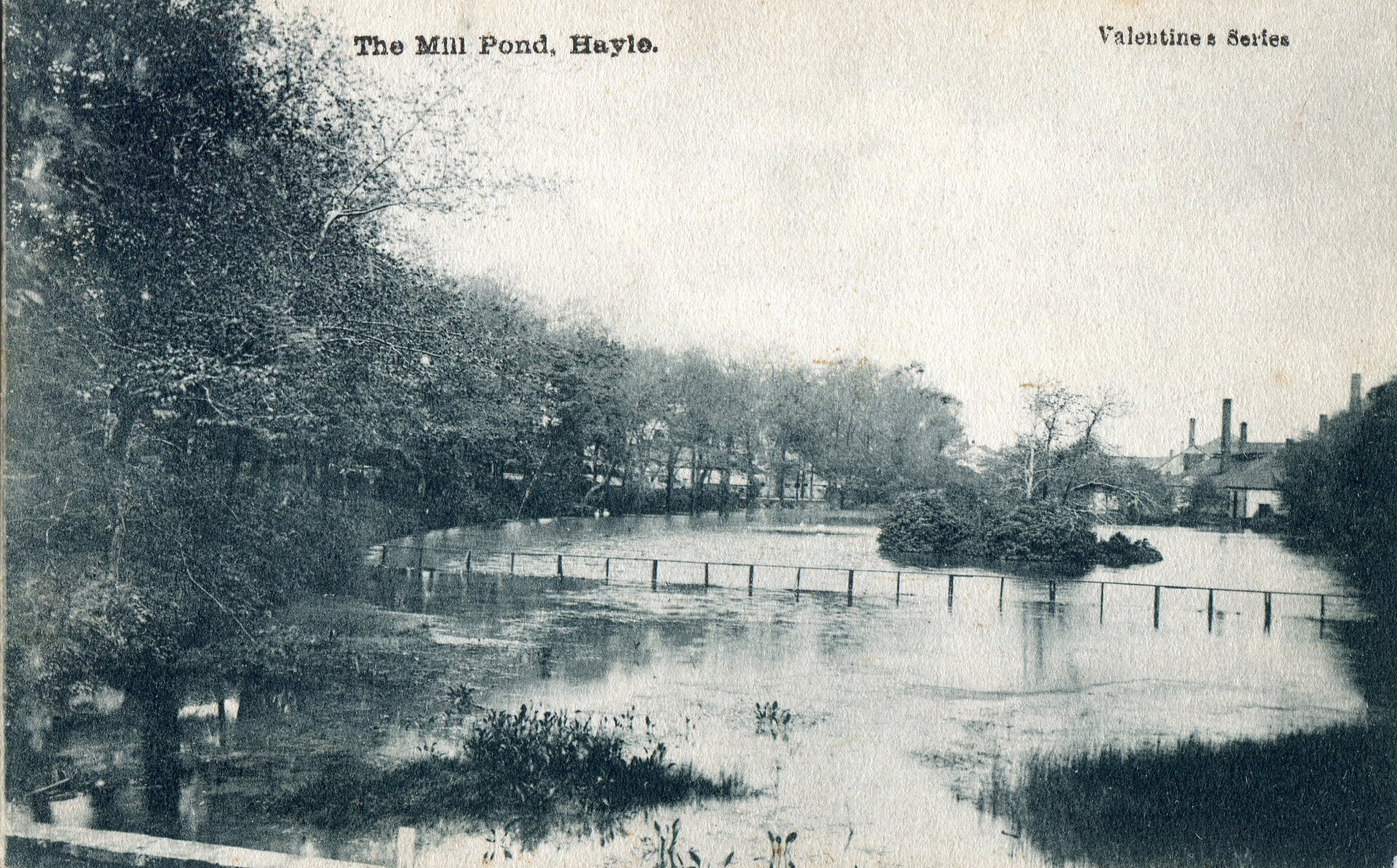
The Mill Pond, Hayle - Valentine postcard c1902
Ropewalk to the left, chimneys of Williams, Harvey & Co Ltd, Mellanear Smelting Works to back right
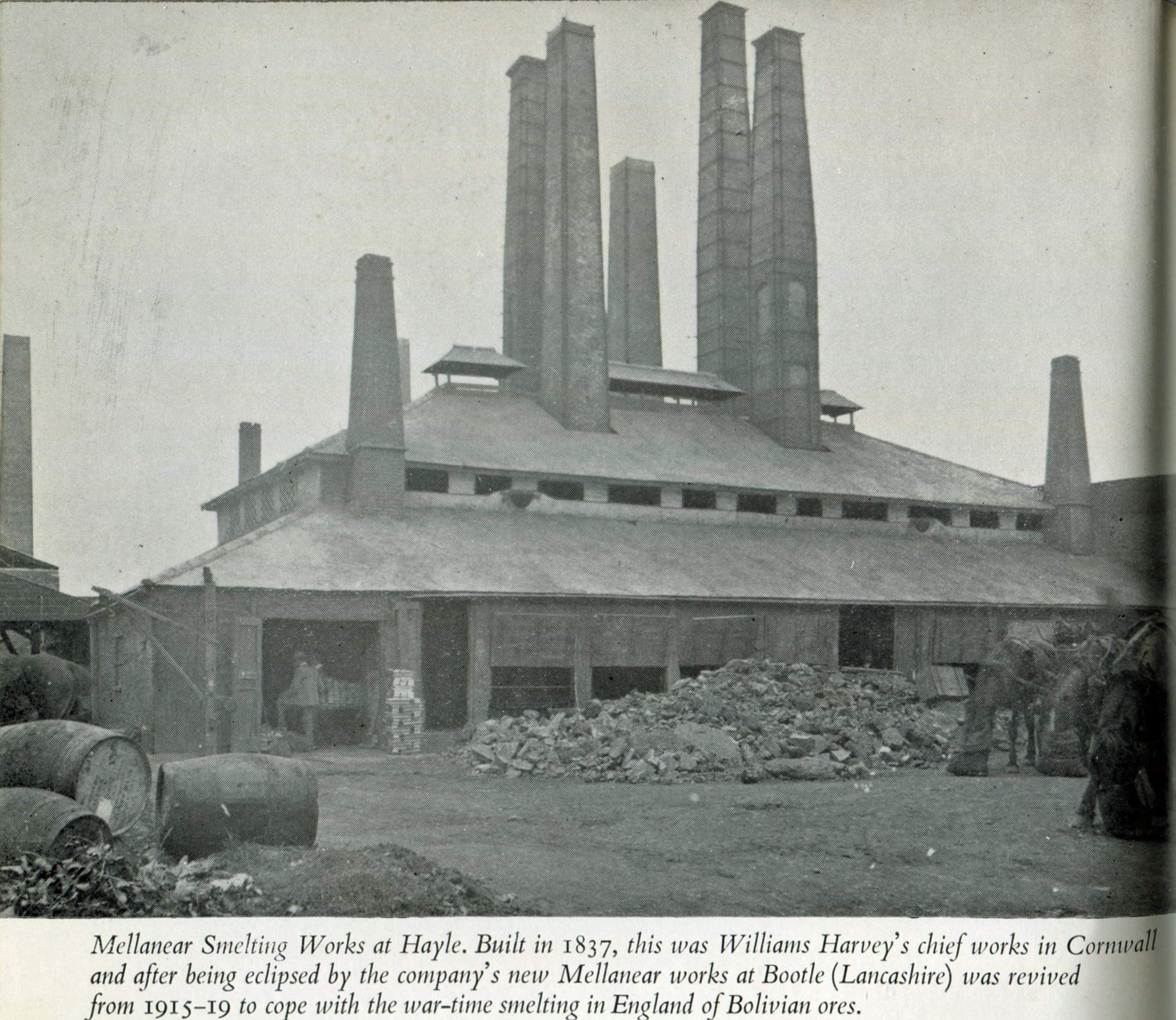
Williams, Harvey & Co Ltd, Mellanear Smelting Works
built 1837
1841 Tithe apportionment 209, leased by Trelissick Smelting House Company - House and Garden
1841 Tithe apportionment 210, leased by Trelissick Smelting House Company - Smelting House, Yard etc
1841 Tithe apportionment 211, leased by Trelissick Smelting House Company - Garden

illustration from 'A History of Tin Mining and Smelting in Cornwall' by D.B. Barton p216
to the right of photo stand 3 horses harnessed to wagon shafts, with heads in their nosebags


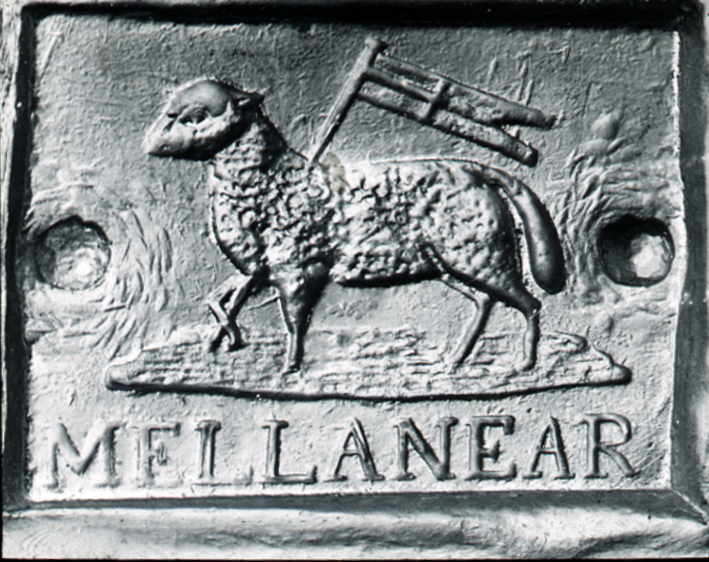
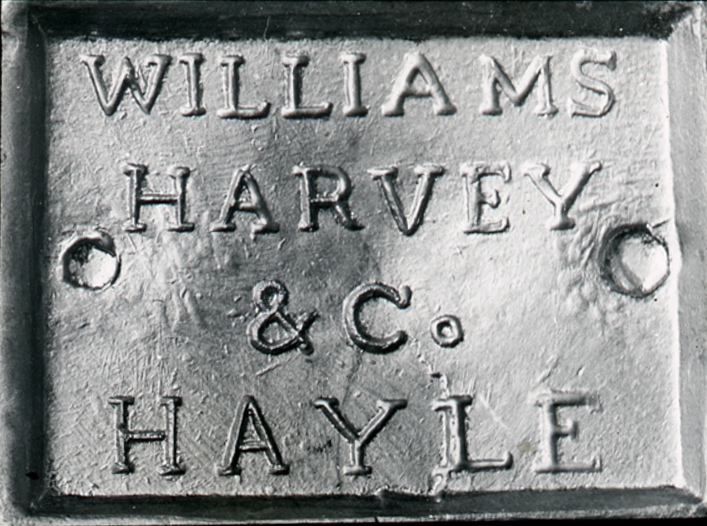
ingots of tin from Williams Harvey & Co, Mellanear, Hayle
the logo being Lamb & Flag
Mellanear Works demolished c1921
~ ~ ~ ~ ~ ~ ~ ~ ~ ~ ~ ~ ~ ~ ~ ~ ~ ~ ~ ~ ~ ~ ~ ~ ~ ~ ~ ~
Mellanear House (51 Mellanear Road)
'375
HAYLE, 51 MELLANEAR ROAD (Fig 15b) [reference key at foot of webpage]
HOUSE
SW55943635 PRN: 140111
House and walled garden. Circa 1800 and C20. Roughcast with concrete tiled roof. Two storeys to hipped roof with stacks at end left and end right. Symmetrical front of three sash windows in moulded surrounds on first floor, two on ground floor with central door. Stands back from the road in a walled plot with outbuildings, and a good early C20 moulded timber fence and gate on rendered wall. This house was reputed to be the home of Henry Harvey's mistress/housekeeper (pers comm Rob Lello).One of a number of smallholdings set within regular closes along Mellanear Road, and part of a group shown on the 1809 OS survey drawings (although the present building may be a mid C19 rebuild ol the original cottage), probably relating to the nearby mines on the Wheal Alfred set {especially Mellanear or West Wheal Alfred) rather then the industrial development in Hayle itself. The regular block ot fields to the east was called 'Tin Closes' in the St Erth 1842 Tithe Award .'
http://www.hayle.net/council/documents/2000R058HayleHistoricalAssessmen…
home of Grace Tonkin, allegedly the mistress or common-law wife of Henry Harvey
Grace Tonkin - born 9th December 1799, St Just, Penzance (mother Jane Nicholls, father Thomas Tonkin)
said to have given birth to at least 9 children, William, Francis, Henry, Richard, Juliane, John, Edwin, James and Charles, all given the middle name Harvey and all but one the surname Tonking.
died 11th October 1895
more info about Grace Tonkin and her children at https://freepages.rootsweb.com/~phillack/genealogy/tonkin.htm
1841 Census
Millenear,1,Grace Tonkin,,40,Ind,In county,
,,William Tonkin,19,,,In county,
,,Henry Tonkin,16,,,In county,
,,Richard Tonkin,15,,,In county,
,,Edwin Tonkin,10,,,In county,
,,Francis Tonkin,8,,,In county,
,,Charles Tonkin,4,,,In county,
,,Jane Trounce,,24,F.S.,In county,
1851 Census
89,Millanear,Grace Tonking,Head,S,,52,Annuitant,Penzance Cornwall,,
,,James Tonking,Son,S,17,,Assistant Draper,St Erth Cornwall,,
,,John Polglase,Grnson,,2,,,Phillack Cornwall,,
,,Sarah Saundry,Servnt,S,,66,House Servant,Cury Cornwall,,
1861 Census
42,Mellenare,1,Grace Tonking,Head,U,,61,Proprietor Of Houses,Penzance Cornwall,,
,,,Ann Sanders Lawrey,Servnt,U,,25,House Servant,St Erth Cornwall,,
~ ~ ~ ~ ~ ~ ~ ~ ~ ~ ~ ~ ~ ~ ~ ~ ~ ~ ~ ~ ~ ~ ~ ~ ~ ~ ~ ~

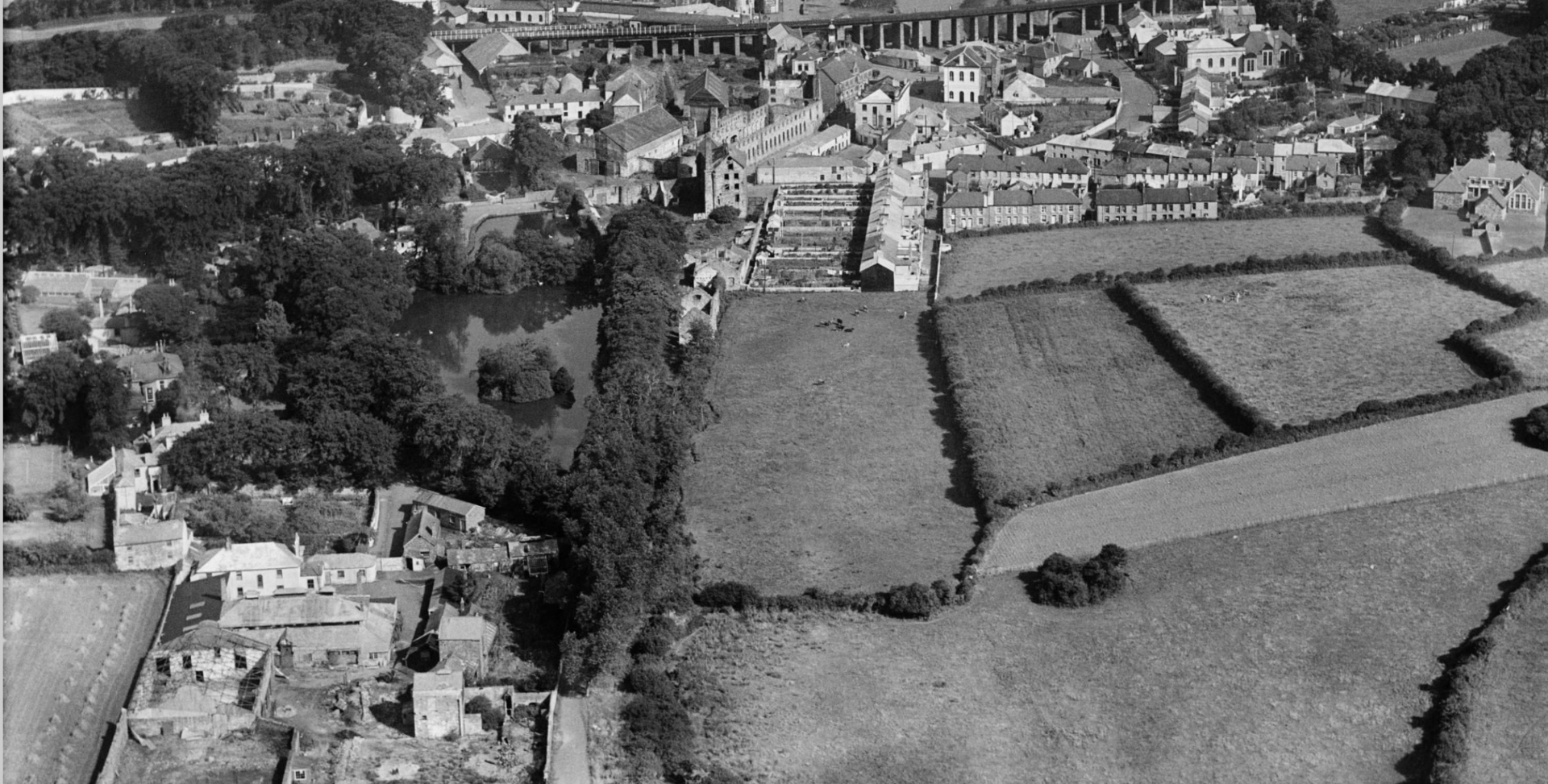
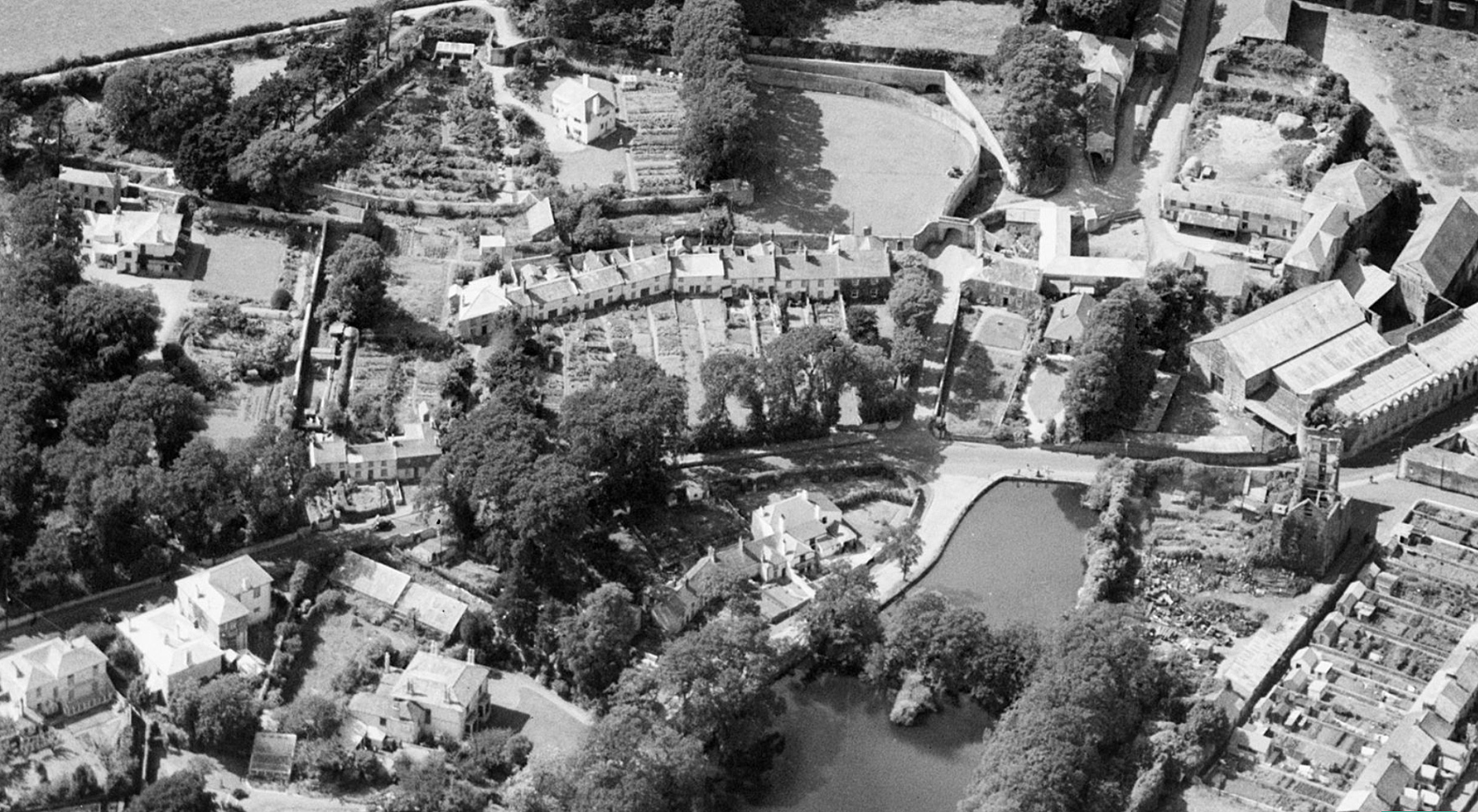
Mill Pond, Hayle c1935

Aerial photograph of Millpond and old Foundry Buildings etc 1932

Aerial photograph of Millpond, old Foundry Buildings and Foundry Hill c1950
Foundry Hill
'68
HAYLE, DROVERS ROW, (4-32 FOUNDRY HILL,EVEN) (Figs 15b, d) [reference key at foot of webpage]
ROW
SW55723698 PRN: 31970
Built as foundry worker's housing. Circa 1830. A row of 2 storey cottages, mixed double and single fronted. Granite and sandstone, mostly rendered or painted, slate and mineral slate roofs. Most windows and doors have been replaced, a few timber sashes survive. Set behind long front garden plots, all with mature planting, and sheds at the street end, the houses are almost totally obscured from the street. A private path gives access to the plots, with granite gate piers and granite flags at the two entrances off the pavement. The main access is now by the back lane; each house has a small backyard, with a good series of early outhouses and extension surviving. The end house at the north-east end is larger than the others, and was known as 'The Foreman's House' (see item [589]; The most westerly house (no. 34) is separately itemised [366]. The Row is not shown on a map of 1828, but about that time, Harvey's expanded their stables to accommodate 52 draught horses, divided into 13 teams of four for each for the heavy wagons used to transport goods, each team with its own driver '
http://www.hayle.net/council/documents/2000R058HayleHistoricalAssessmen…
Some say the terrace of cottages on Foundry Hill was at one time known as 'Drivers Row' ('drivers' being those who drive wagons or similar), even 'Drovers Row' ('drovers' being a term that refers to those who herd cattle, sheep or pigs), but though the occupants here seem to have had diverse occupations, such as director, accountant, civil engineer, draughtsman, ship builder, seaman, schoolmaster, dress maker, grocer, pattern maker, moulder, stone mason, builder, labourer, groom, gardener, and all manner of metal workers (smith, blacksmith, white smith & hammer smith), there are no sheep herders nor wagon drivers amongst those listed for these dwellings in early censuses. But in the early part of the 20th Century a Sam Ellis, chauffeur to the Harveys, lived on the terrace, so perhaps other drivers lived here too? Interestingly, it has sometimes been the way with terraced houses in these parts. that they get referred to by the profession of a sample of the residents, such as with 'Captains Row' in Mellanear.
~ ~ ~ ~ ~ ~ ~ ~ ~ ~ ~ ~ ~ ~ ~ ~ ~ ~ ~ ~ ~ ~ ~ ~ ~ ~ ~
6 Foundry Hill (formerly 1 Foundry Hill until 1st May 1973)
built c1800
1841 Tithe apportionment 40,
House and Garden - John West
'589
HAYLE, 6 FOUNDRY HILL (DROVERS' ROW) (Figs 15b, d) [reference key at foot of webpage]HOUSE
SW55743699 PRN: 140960
House. Circa 1800. Rendered with slate roof. Two storeys, 2 window bays, long front garden, Part of Drovers Row, see item [68]. At some time (late C19) the home of John Harvey, foreman of the foundry (M & M Rew, 1998, Hayle, 72), and in 1842 (Tithe Award), that of John West, foreman, and later Director of Harvey's. lt may be the house referred to in 1807 as Mr. West's (William West, engineer, manager of the Foundry, and son-in-law of John Harvey) .'
http://www.hayle.net/council/documents/2000R058HayleHistoricalAssessmen…
1841 Census
Hayle Foundry,1,William West,25,,Engineer,WLS,
,,Jemima West,,25,,LND,
~ ~ ~ ~ ~ ~ ~ ~ ~ ~ ~ ~ ~ ~ ~ ~ ~ ~ ~ ~ ~ ~ ~ ~ ~ ~ ~
8 Foundry Hill (formerly 2 Foundry Hill until 1st May 1973)
built c1820-5 on land leased by John Harvey from the Lower Trelissick estate
1841 Tithe apportionment 41, House and Garden - Miss West
1841 Census
Hayle Foundry,1,Ann West,,50,Independant,In county,
,,Elizabeth Philips,,65,Female Servant,In county,
1851 Census
51,Foundery,Ann West,Unmar,,,64,Gentlewoman Annuitant,Helston Cornwall,
1861 Census
90,,1,Ann West,Head,U,,75,Fundholder,Helston Cornwall,,
,,,Honor Rapson,Servnt,W,,50,House Servant,Uny Lelant Cornwall,,

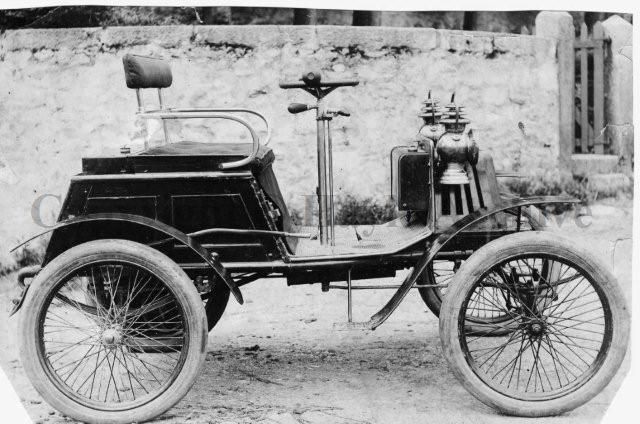
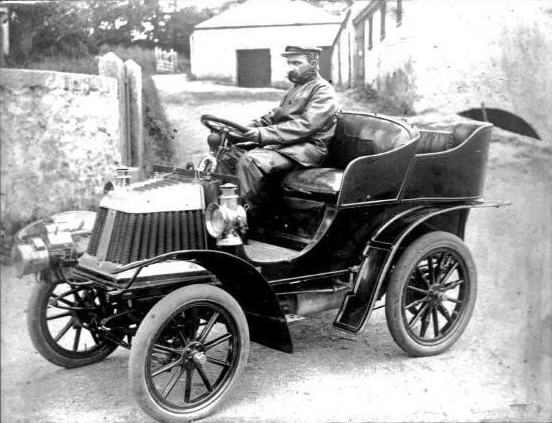
Harvey's Argyll car, parked at foot of Cows House Hill, Foundry, Foundry, Hayle c1902

Sam Ellis seated in Harvey's Argyll car, at foot of Cows House Hill, near Foundry Stables, Hayle c1902
'.. images relating to Tony Ellis's Great Grandfather Sam Ellis who was a driver for Harveys in the early 1900's. Sam lived at 2 Foundry Hill formerly known as Drivers Row and worked as a driver for Harveys until he retired aged 55. Tony advised that Harveys was the owner of the first car in Hayle and also in Cornwall.'
~ ~ ~ ~ ~ ~ ~ ~ ~ ~ ~ ~ ~ ~ ~ ~ ~ ~ ~ ~ ~ ~ ~ ~ ~ ~ ~ ~
10 Foundry Hill (formerly 3 Foundry Hill until 1st May 1973)
built c1820-5 on land leased by John Harvey from the Lower Trelissick estate
1841 Tithe apportionment 42, House and Garden - John Williams
1841 Census
Hayle Foundry,1,John Williams,45,,Hammer Smith,Not in county,
,,Elizabeth Williams,,45,,Not in county,
,,Mary Williams,,25,,Not in county,
,,Charlott Williams,,20,,In county,
,,Seleena Williams,,18,,In county,
,,John Williams,15,,,In county,
~ ~ ~ ~ ~ ~ ~ ~ ~ ~ ~ ~ ~ ~ ~ ~ ~ ~ ~ ~ ~ ~ ~ ~ ~ ~ ~ ~12 Foundry Hill (formerly 4 Foundry Hill until 1st May 1973)
built c1820-5 on land leased by John Harvey from the Lower Trelissick estate
1841 Tithe apportionment 43
, House and Garden - Richard Oliver
1841 Census
Hayle Foundry,1,Richard Oliver,34,,Grocer,In county,
,,Sarah Oliver,,32,,In county,
,,Mary Philps,,24,,In county,
,,Charles Philps,17,,Smith,In county,
~ ~ ~ ~ ~ ~ ~ ~ ~ ~ ~ ~ ~ ~ ~ ~ ~ ~ ~ ~ ~ ~ ~ ~ ~ ~ ~ ~
14 Foundry Hill (formerly 5 Foundry Hill until 1st May 1973)
built c1820-5 on land leased by John Harvey from the Lower Trelissick estate
1841 Tithe apportionment 44, House and Garden - Thomas Polkinghorne
1841 Census
Hayle Foundry,1,Thos Polkinghorne,30,,Accountant,In county,
,,Lidya Polkinghorne,,25,,In county,
,,Mary Polkinghorne,55,,,In county,
,,Elizth Hosking,,75,Independant,In county,
~ ~ ~ ~ ~ ~ ~ ~ ~ ~ ~ ~ ~ ~ ~ ~ ~ ~ ~ ~ ~ ~ ~ ~ ~ ~ ~ ~
16 Foundry Hill (formerly 6 Foundry Hill until 1st May 1973)
built c1820-5 on land leased by John Harvey from the Lower Trelissick estate
1841 Tithe apportionment 45, House and Garden - John Shakerly
1841 Census
Hayle Foundry,1,John Shackley,28,,Schoolmaster,In county,
,,Ruth Shackley,,27,,In county,
,,Honour Leicher,,32,Female Servant,In county,

Foundry Hill c1905

Foundry Hill cottages - c1905
~ ~ ~ ~ ~ ~ ~ ~ ~ ~ ~ ~ ~ ~ ~ ~ ~ ~ ~ ~ ~ ~ ~ ~ ~ ~ ~ ~
18 Foundry Hill (formerly 7 Foundry Hill until 1st May 1973)
built c1820-5 on land leased by John Harvey from the Lower Trelissick estate
1841 Tithe apportionment 46, House and Garden - Oliver Hosking
1841 Census
Hayle Foundry,1,Oliver Hosking,50,,Builder,In county,
,,Mary Hosking,,55,,In county,
,,Elizabeth Hosking,,25,,In county,
,,Oliver Hosking,24,,Drafsman,In county,
,,Mary Hosking,,20,,In county,
,,Richard Hosking,17,,,In county,
,,Jane Hosking,,15,,In county,
,,Elizabeth Symons,,45,Female Servant,In county,
1851 Census
46,Foundery,Oliver Hosking,Head,,63,,Builder,Paul Cornwall,,
,,Mary Hosking,Wife,,,66,,St Erth Cornwall,,
,,Elizabeth Hosking,Dau,S,,35,Dress Maker,Phillack Cornwall,,
,,Mary Hosking,Dau,S,,31,At Home,Phillack Cornwall,,
,,Richard Hosking,Son,S,27,,Pattern Maker,Phillack Cornwall,,
Land facing rear of 18 Foundry Hill
1841 Tithe apportionment 47, Garden - Oliver Hocking
~ ~ ~ ~ ~ ~ ~ ~ ~ ~ ~ ~ ~ ~ ~ ~ ~ ~ ~ ~ ~ ~ ~ ~ ~ ~ ~ ~
20 Foundry Hill (formerly 8 Foundry Hill until 1st May 1973)
built c1820-5 on land leased by John Harvey from the Lower Trelissick estate
1841 Tithe apportionment 48 House and Garden - Palk Thomas
1841 Census
Hayle Foundry,1,Thomas Palk,30,,Labourer,In county,
,,Elizabeth Palk,,40,,In county,
,,William Wearne,12,,,In county,
,,Stepn Wearne,10,,,In county,
,,Elizabeth Wearne,,7,,In county,
,,Susan Wearne,,4,,In county,
,,Thos Palk,1,,,In county,
,,Ann Bess,,18,,In county,
1851 Census
45,Foundery,Thomas Polk,Head,M,43,,Labourer,Tavistock Devon,,
,,Elizabeth Polk,Wife,M,,50,,Phillack Cornwall,,
,,Stephen Wearne,Sonlaw,S,19,,Moulder,St Erth Cornwall,,
,,Elizabeth Wearne,Daulaw,S,,16,Servant At House,St Erth Cornwall,,
,,Susan Wearne,Daulaw,S,,14,Servant At House,St Erth Cornwall,,
,,Thomas Polk,Son,,11,,Scholar,St Erth Cornwall,,
,,John Polk,Son,,8,,Scholar,St Erth Cornwall,,
1861 Census
98,,1,Thomas Palk,Head,M,54,,Gassman,Tavistock Devon,,
,,,Elizabeth Palk,Wife,M,,61,,Phillack Cornwall,,
,,,Thomas Palk,Son,U,21,,Pattern Maker,St Erth Cornwall,,
,,,John Palk,Son,U,18,,Blacksmith,St Erth Cornwall,,
~ ~ ~ ~ ~ ~ ~ ~ ~ ~ ~ ~ ~ ~ ~ ~ ~ ~ ~ ~ ~ ~ ~ ~ ~ ~ ~ ~
22 Foundry Hill (formerly 9 Foundry Hill until 1st May 1973)
built c1820-5 on land leased by John Harvey from the Lower Trelissick estate
1841 Tithe apportionment 49, House and Garden - Moses Symons
1841 Census
Hayle Foundry,1,Moses Symons,45,,Labourer,In county,
,,Cath Symons,,45,,In county,
,,Wm Couch,30,,Miller,In county,
,,John Hammon,20,,Labourer,In county,
,,Peter Bargwanath,15,,Ship Builder,In county,
,,Sarah Mills,,65,,In county,
~ ~ ~ ~ ~ ~ ~ ~ ~ ~ ~ ~ ~ ~ ~ ~ ~ ~ ~ ~ ~ ~ ~ ~ ~ ~ ~ ~
24 Foundry Hill (formerly 10 Foundry Hill until 1st May 1973)
built c1820-5 on land leased by John Harvey from the Lower Trelissick estate
1841 Tithe apportionment 50, House and Garden - Joseph Sleep
1841 Census
Hayle Foundry,1,Joseph Sleep,65,,Groom,In county,
,,Alice Sleep,,55,,In county,
,,Joseph Sleep,20,,Whitesmith,In county,
,,John Sleep,15,,Pattern Maker,In county,
,,William Francis,13,,Smith,In county,
,,John Ance,35,,Stone Mason,In county,
~ ~ ~ ~ ~ ~ ~ ~ ~ ~ ~ ~ ~ ~ ~ ~ ~ ~ ~ ~ ~ ~ ~ ~ ~ ~ ~ ~

Foundry Hill - c1978
26 Foundry Hill (formerly 11 Foundry Hill until 1st May 1973)
built c1820-5 on land leased by John Harvey from the Lower Trelissick estate
1841 Tithe apportionment 51, House and Garden - Joseph Sleep
1841 Census
???? perhaps Crowl????
Hayle Foundry,1,John Crowl,25,,Gardener,In county,
,,Mary Crowl,,20,,In county,
,,William Crowl,7m,,,In county,
~ ~ ~ ~ ~ ~ ~ ~ ~ ~ ~ ~ ~ ~ ~ ~ ~ ~ ~ ~ ~ ~ ~ ~ ~ ~ ~ ~
28 Foundry Hill (formerly 12 Foundry Hill until 1st May 1973)
built c1820-5 on land leased by John Harvey from the Lower Trelissick estate
1841 Tithe apportionment 52, House and Garden - Robert May
1841 Census
Hayle Foundry,1,Robt May,30,,Labourer,In county,
,,Elizabeth May,,35,,In county,
,,Emma May,,6,,In county,
,,Charles May,5,,,In county,
,,Susanna May,,3,,In county,
,,Samuel May,1,,,In county,
,,Saundry Service,20,,Labourer,In county,
~ ~ ~ ~ ~ ~ ~ ~ ~ ~ ~ ~ ~ ~ ~ ~ ~ ~ ~ ~ ~ ~ ~ ~ ~ ~ ~ ~
30 Foundry Hill (formerly 13 Foundry Hill until 1st May 1973)
built c1820-5 on land leased by John Harvey from the Lower Trelissick estate
1841 Tithe apportionment 53, House and Garden - William Williams
1841 Census
Hayle Foundry,1,William Williams,38,,Labourer,In county,
,,Philipa Williams,,39,,In county,
,,William Williams,5,,,In county,
~ ~ ~ ~ ~ ~ ~ ~ ~ ~ ~ ~ ~ ~ ~ ~ ~ ~ ~ ~ ~ ~ ~ ~ ~ ~ ~ ~
32 Foundry Hill (formerly 14 Foundry Hill until 1st May 1973)
built c1820-5 on land leased by John Harvey from the Lower Trelissick estate
1841 Tithe apportionment 54, House and Garden - William Williams
1841 Census
????
Hayle Foundry,1,William Nancollins,25,,Labourer,In county,
,,Elizabeth Nancollins,,25,,In county,
,,Jane Nancollins,,6,,In county,
,,Mary Nancollins,,4,,In county,
,,Martha Nancollins,,1,,In county,
~ ~ ~ ~ ~ ~ ~ ~ ~ ~ ~ ~ ~ ~ ~ ~ ~ ~ ~ ~ ~ ~ ~ ~ ~ ~ ~ ~
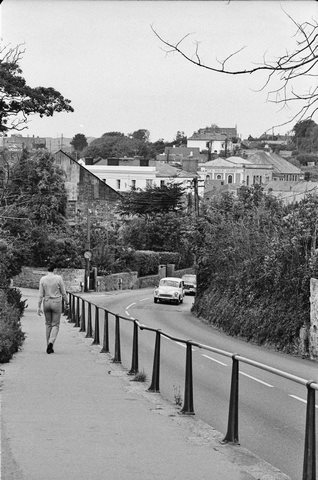
'Trethowa' 34 Foundry Hill (at one time known as 'Ivy Cottage' and formerly numbered 15 Foundry Hill, until 1st May 1973)
built c1820-5 on land leased by John Harvey from the Lower Trelissick estate
1841 Tithe apportionment 55, House and Garden - William John Rawlings
'366
HAYLE, 34 FOUNDRY HILL (Fig 15b) [reference key at foot of webpage]
HOUSE
SW55713687 PRN: 139625
House. Pre 1842. Granite, with slate roof. Two storeys to hipped roof with stacks to left and right. Two sash windows to each floor and central door. Although predating 1842, and at the southern end of Drovers Row [68], this appears to be slightly later than the rest of the row, and somewhat different and grander in form, and in 1842 (Tithe Award) it is the home of W.J. Rawlings, an official in Harvey's, and in 1854 made a partner. He had Downes house and gardens built for himself in 1868 -9 [77].'
http://www.hayle.net/council/documents/2000R058HayleHistoricalAssessmen…
1841 Census
Hayle Foundry,1,Giles Gudge,50,,Seaman,In county, [possibly Master of the vessel 'The Elizabeth' ]
,,W J Rawling,25,,Accountant,In county,
,,Susana Rawling,,55,,In county,
,,Mary Ann Rawling,,20,,In county,
1851 Census
38,Foundery,William Jas Rawlings,Head,M,36,,Cashier To A Firm Of,Marazion Cornwall,,
,,Catherine Rawlings,Wife,M,,29,,Phillack Cornwall,,
,,Eliza Williams,Servnt,S,,21,,Crowan Cornwall,,

39,Foundery,Susanna Rawlings,Head,W,,74,Annuitant,Marazion Cornwall,,
1861 Census
95,Hayle Foundry,1,Susanna Rawling,Head,W,,79,Annuitant,Marazion Cornwall,,

106,Hayle Foundry,1,William John Rawling,Head,M,46,,Iron Merchant,Marazion Cornwall,,
,,,Catherine Rawling,Wife,M,,39,,Phillack Cornwall,,
,,,Kitty Be Rawling,Dau,,,7,Scholar,St Erth Cornwall,,
,,,Edith May Giddy Rawling,Dau,,,4,Scholar,St Erth Cornwall,,
,,,Caroline Simons,Servnt,U,,30,Houseservant,Cury Cornwall,,
,,,Harriet R Williams,Servnt,U,,24,Houseservant,Sithney Cornwall,,
1871 Census
82,Hayle Foundry,1,Jabus Bickle,Head,M,49,,Civil Engineer,Polgooth Cornwall,,
,,,Catherine Bickle,Wife,M,,42,,Padstow Cornwall,,
,,,Henrietta Bickle,Dau,U,,23,,St Erth Cornwall,,
,,,Catherine Bickle,Dau,U,,21,,St Erth Cornwall,,
,,,Jabus Bickle,Son,U,18,,Mechanical Draughtsman,St Erth Cornwall,,
,,,Thomas Edwin Bickle,Son,,13,,Scholar,St Erth Cornwall,,
1881 Census
46,Ivy Cottage Foundry Hill,1,Jebus Bickle,Head,M,59,,Civil Engineer,St Austle Cornwall,,
,,,Catherine Bickle,Wife,M,,53,,Padstow Cornwall,,
,,,Henrietta Bickle,Dau,U,,32,,St Erth Cornwall,,
,,,Thomas E. Bickle,Son,U,22,,Draughtsman At Factory,St Erth Cornwall,,
1891 Census
67,Foundry Hill,1,Jabus Bickle,Head,M,69,,Mining & Marine Engin,Employed,St Austel Cornwall,,
,,,Catherine Bickle,Wife,M,,63,,,Padstow Cornwall,,
,,,Henrietta Bickle,Dau,S,,43,,,St Erth Cornwall,,

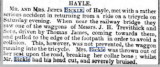
6th July 1883 newspaper cutting
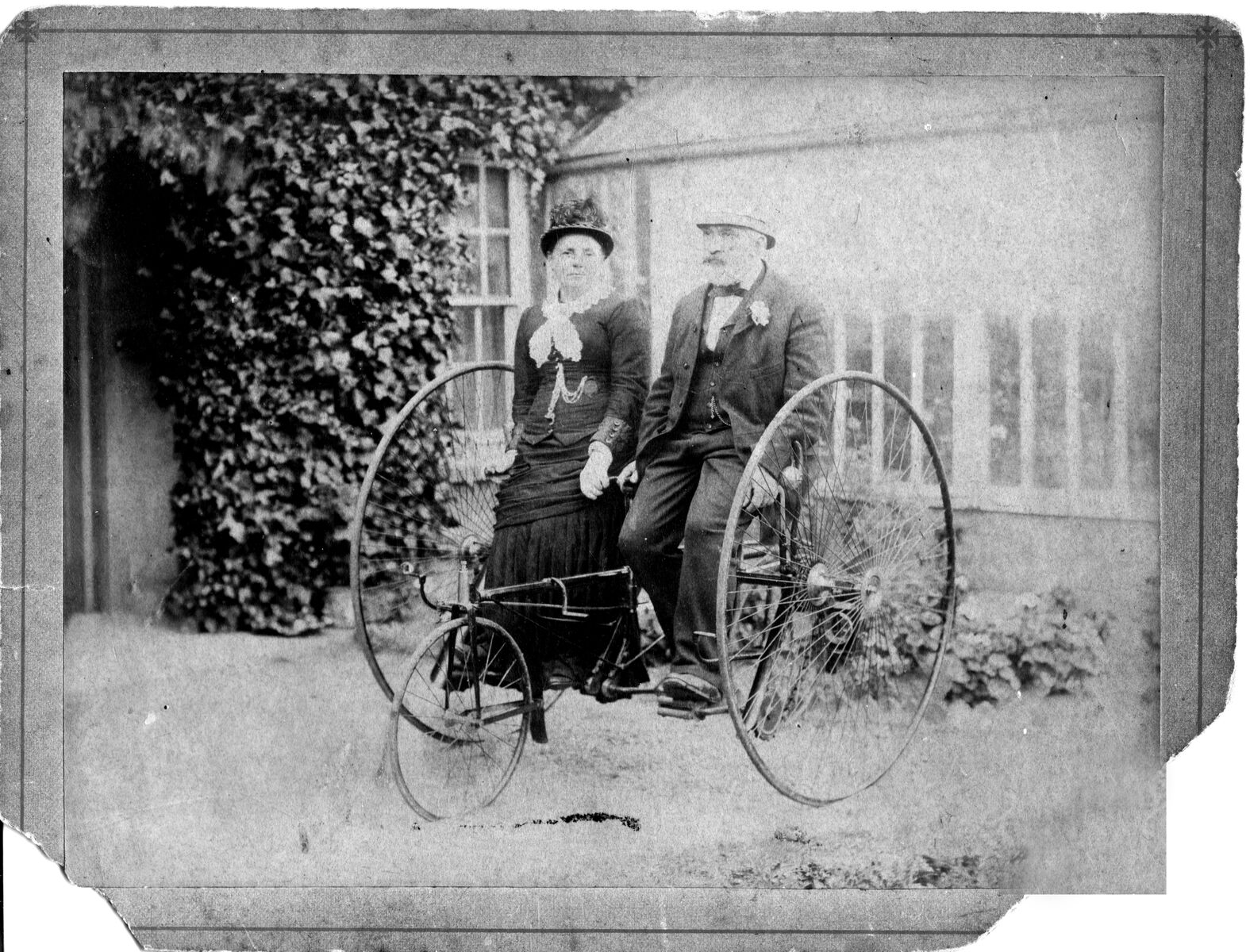
relating to cycling accident of Mr & Mrs Bickle

Mr & Mrs Jebus Bickle on 2-seater tricycle outside Ivy Cottage, Foundry Hill, 1883

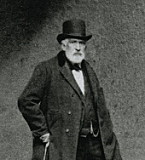
Jebus Bickle (1822-1902)

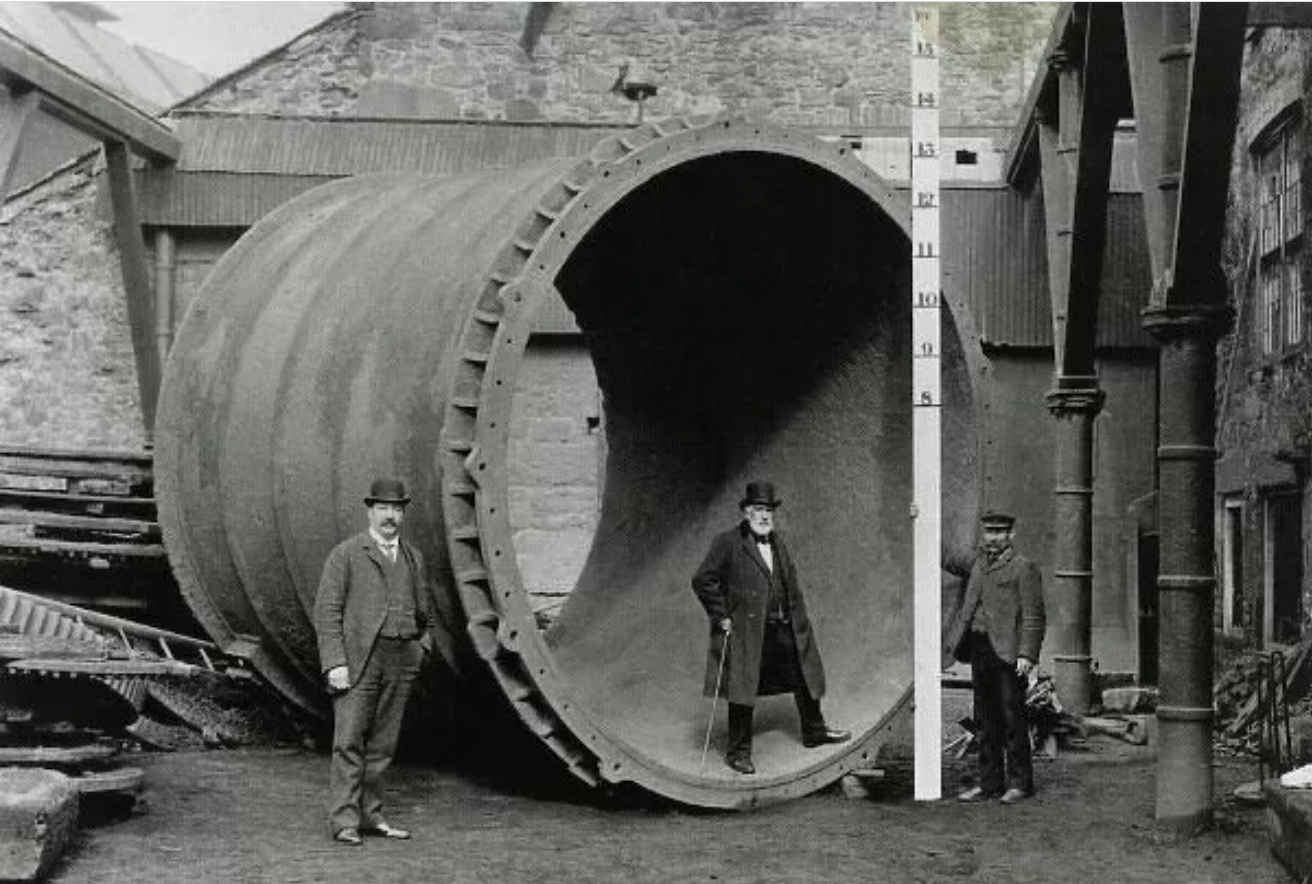
Jebus Bickle stood inside cyclinder cast at Harvey's Iron Foundry, Hayle 1894
Jebus Bickle, Engineer of Hayle, born c1822, died on February 7th 1902, aged 80
Catherine Bickle, wife of Jebus Bickle, born November 4th 1829, died September 13th 1907
Henrietta Bickle, born 1848
Jebus Bickle, born 1853 Steam Engine Maker, died 1941
Thomas Edwin Bickle, Engineer, born at Hayle December 4th 1857, died at Plymouth February 9th 1898 aged 41 years.
Publications of Jebus Bickle


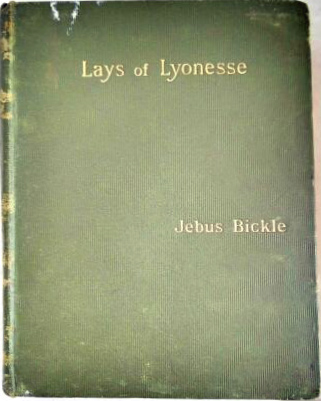
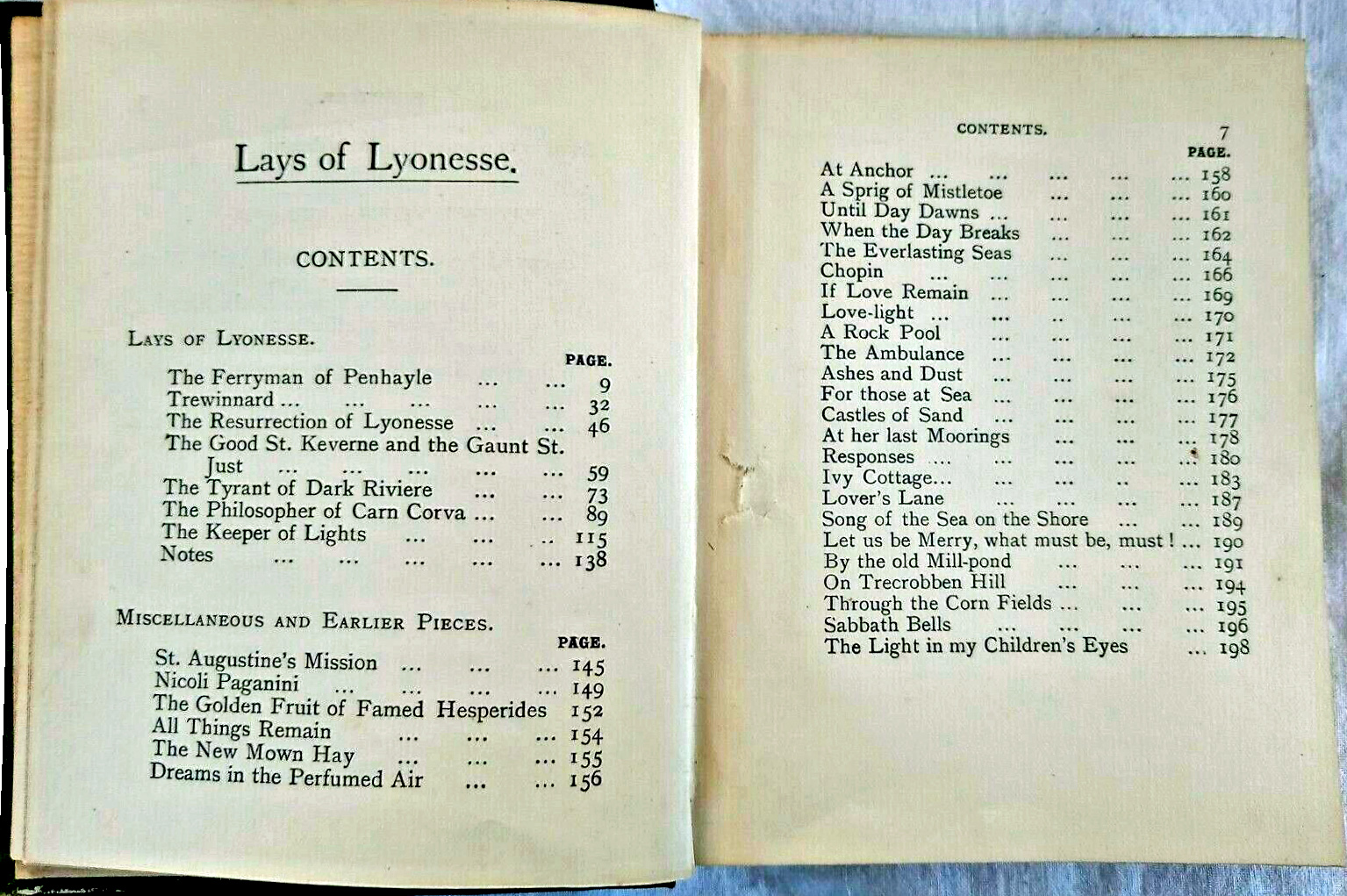
'Lays of Lyonesse' by Jebus Bickle, Camborne 1900
also
'Sonnets' by Jebus Bickle, Camborne, 1921
~ ~ ~ ~ ~ ~ ~ ~ ~ ~ ~ ~ ~ ~ ~ ~ ~ ~ ~ ~ ~ ~ ~ ~ ~ ~ ~ ~
Q. What is known about W J Rawling, Susana Rawling and Mary Ann Rawling of 34 Foundry Hill?
A. Well here are a few facts...
On 12 October 1805 in St Hilary an Abraham Rawlings married Susanna Roskilly, and also in St Hilary, where they were both residents, they had the following children: Thoms Roskilly 1806, Susannah Roskilly 1807, Jane Shorland 1810, William John 1812, William John 1815, and Mary Ann Charlotte 1820, all baptised in St Hilary/Marazion.
information obtained 16 November 2021 from Rebecca Noall tidybex@sky.com
Abraham Shorland Rawlings
|
|
Birthdate:
|
September 25, 1784
|
|
Birthplace:
|
Truro, Cornwall, England
|
The Life Summary of Susanna
When Susanna Roskilly was born in 1776, in Marazion, Cornwall, England, United Kingdom, her father, Thomas Roskilly, was 31 and her mother, Susanna, was 20. She married Abraham Shorland Rawlings Grandfather of Admiral Sir Henry Bernard Hughes Rawlings 2nd in Command of the British Fleet WW2 on 12 October 1805, in St Hilary, Cornwall, England. They were the parents of at least 4 sons and 3 daughters. She lived in St Erth, Cornwall, England, United Kingdom in 1851. She died on 26 February 1870, in Foundry, Cornwall, England, United Kingdom, at the age of 94, and was buried in St Hilary, Cornwall, England, United Kingdom.
W J Rawlings marries Catherine Hambly, 6th January 1848
|
West Briton
|
14 Jan 1848
|
RAWLINGS - HAMBLY - At Hayle, on 6th instant, Mr. W.J. Rawlings, to Miss Catherine Hambly.
|
Birth of Katherine Lee Rawlings 16th September 1853
|
West Briton
|
16 Sep 1853
|
RAWLINGS - At Hayle on Tuesday last, the wife of Mr. W. J. Rawlings, a daughter.
|
'The partners of Harveys of Hayle were then Nicholas Harvey, William Harvey, William West and John West; William John Rawlings became a partner in 1854.'
W. Rawlings is named as one of those principally responsible for forwarding the Hayle lifeboat project - the Isis, which was launched 24th April 1866.
The Book of Hayle'. Cyril Noall, Barracuda 1985 p105
Just up the road from 34 Foundry Hill is a grand house, Downes, erected for Harveys director W J Rawlings.
Various dates have been suggested for the erection of this building, but it is believed the Rawlings took up residence in 1867-8.
...........................................................
'Mrs. W. J. Rawlings (née Hambly) of Hayle, who died in 1879 at the age of fifty-seven, had learnt to repeat the Lord's Prayer and Creed in Cornish when she was a child at school at Penzance, but unluckily had quite forgotten them in later life.'
...........................................................
No mention has been found as to whether as to whether Susanna Rawlings was still living at 32 Foundry Hill or had moved to Downes.
Susanna Rawlings died in Foundry on 26 February 1870
https://ancestors.familysearch.org/en/LZZ1-KK9/susanna-roskilly-1776-1870
...........................................................
'I believe WJ Rawling's second wife to be Marion Florence Hughes. They married in St Georges Hanover Square in September quarter of 1882 (Volume: 1a, Page: 730). The 1891 Census states that she was born in Middlesex, London, so that would tie in with the marriage location. I've found the births of the two sons listed on the census, and the maiden name of their mother is Hughes. All ties in nicely.
Births - Sept Qtr 1888, John Claude Rawlings, Penzance District, Vol: 5c, Page: 237, Mother's Maiden Name: Hughs.
- June Qtr 1889, Henry Bernard Rawlings, Penzance District, Vol: 5c, Page: 238, Mother's Maiden Name: Hughes.'
...........................................................
William John Rawlings
Father of Admiral Sir Henry Bernard Hughes Rawlings 2nd in Command of the British Fleet WW2 1815-1890 - K2RX-WBR
...........................................................
Penzance Natural History and Antiquarian Society
|
William J. Rawlings
|
Hayle
|
1885–89 (d. 1890)
|
...........................................................
|
RAWLINGS
|
William John
|
75
|
Downs St Erth
|
16-Aug
|
1890
|
|
RAWLINGS William John 75 Downs St Erth 16-Aug 1890
~ ~ ~ ~ ~ ~ ~ ~ ~ ~ ~ ~ ~ ~ ~ ~ ~ ~ ~ ~ ~ ~ ~ ~ ~ ~ ~ ~
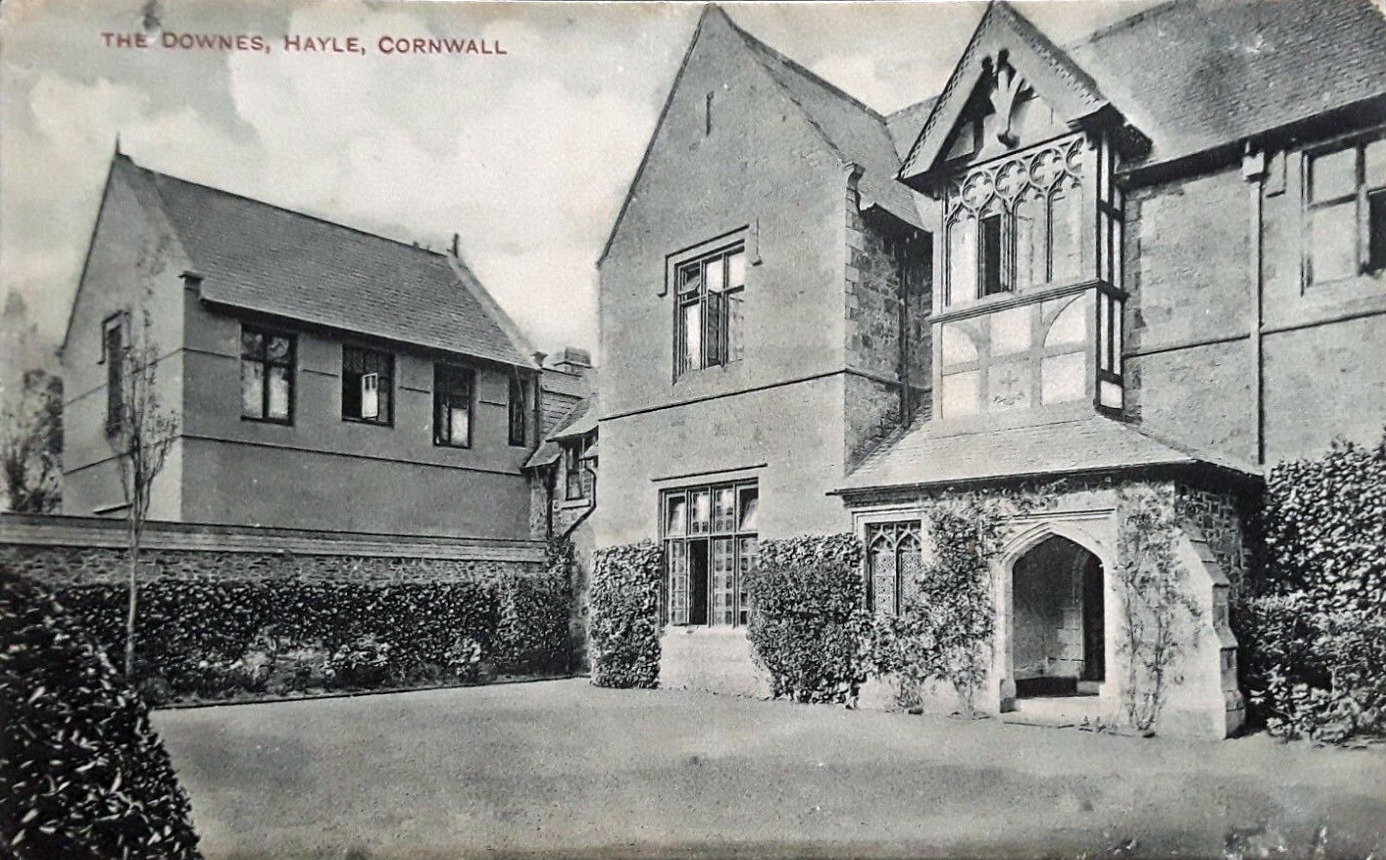
Downes
Grade II listed
'77
HAYLE, DOWNES (Figs 15a, b) [reference key at foot of webpage]
COUNTRY HOUSE
SW55553672 PRN: 139086 LB: 11*
Listed building (No. 12/158). Built 1867-8 for W. J. Rawlings, an antiquarian and director of Harvey and Co. Edmund Sedding, architect, the grounds designed by his brother J. D. Sedding [78). Downes country house is now a Roman Catholic Convent. The house was extended in 1902 by Miss Francis Ellis for use as a convent, and St Teresa's convent founded in 1913 subsequently founded St Michael's Hospital on land bought in 1904. The first (nursing) sisters came in 1902, and from their efforts, a new hospital was built 1913 - see [361]. The interior has a wealth of Tudor Gothic detail and is virtually unaltered since builtSee list description) and D. E. Pett, The Parks and Gardens of Cornwall, 1998, 62.'
http://www.hayle.net/council/documents/2000R058HayleHistoricalAssessmen…
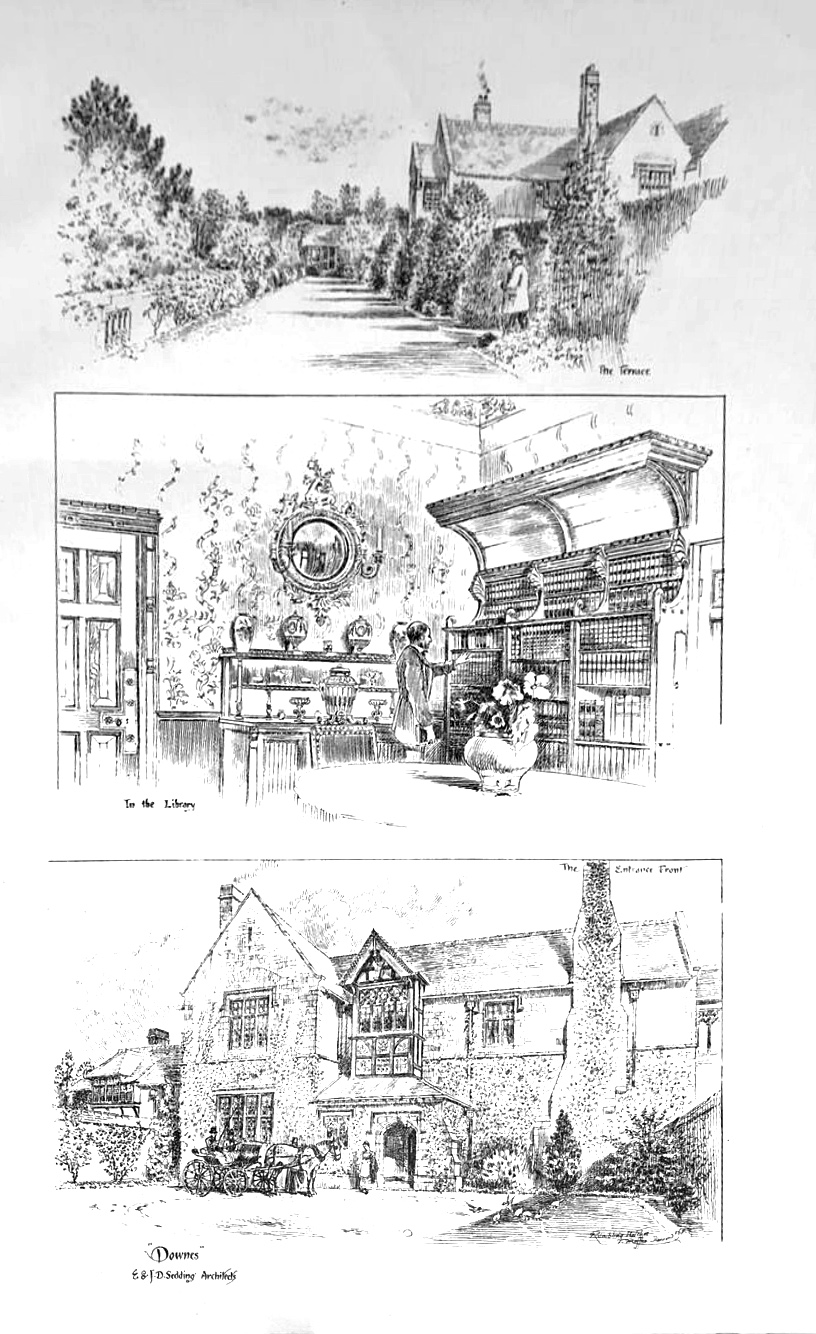
Built 1867-8 for W. J. Rawlings, an antiquarian and director of Harvey and Co. Edmund Harold Sedding (1863-1921), architect, the grounds of 6-7 acres including the driveways by designed by his brother John Dando Sedding FRIBA (1838-91) author of 'Garden-Craft Old and New', published in 1891.
...........................................................
The British Architect, December 16th 1887
description of Downes on pages 480-482
including 'Down the the Land's End ' by T Raffles Davison Pages 478-482
Plates 15, 16, 17 are engravings of Downes by T Raffles Davison

1871 Census
20,Foundry Hill,1,William John Rowlings,Head,M,56,,Merchant,Marazion Cornwall,,
,,,Catherine Rowlings,Wife,M,,49,,St Erth Hayle Cornwall,,
,,,Kitty Lee Rowlings,Dau,,,17,(Scholar),St Erth Hayle Cornwall,,
,,,Edith Mary Giddy Rowlings,Dau,,,14,Scholar,St Erth Hayle Cornwall,,
,,,Mary Hawke,Servnt,U,,40,Cook - Domestic Servant,Phillack Cornwall,,
,,,Mary Firstbrook,Servnt,U,,24,Housemaid - Domestic Servant,St Erth Cornwall,,
,,,Ellen White,Servnt,U,,19,Housemaid - Domestic Servant,St Erth Cornwall,,

21,Foundry Hill,1,John Crowl,Head,M,58,,Gardener Dom.,Redruth Cornwall,,
,,,Mary Crowl,Wife,M,,53,,Redruth Cornwall,,
1881 Census
92,Trelissick Downs,1,William J. Rowlings,Head,W,66,,Timber Merchant,Marazion Cornwall,,
,,,Edith M.S. Rowlings,Dau,U,,24,,St Erth Cornwall,,
,,,Lucy Gibson,Niece,U,,22,,Bromsgrove Worcestershire,,
,,,Sarah Dolly,Servnt,U,,35,Parlour Maid Domestic Servant,Wendron Cornwall,,
,,,Charity Liddicoat,Servnt,U,,23,Cook Domestic Servant,Phillack Cornwall,,
,,,Philippa Woolcock,Servnt,U,,36,Housemaid Domestic Servant,Crowan Cornwall,,
1891 Census
26,The Downs,1,Marion F Rawlings,Head,W,,39,Living On Her Own Means,,London Middlesex,,
,,,Edith M. G. Rawlings,Stpdau,S,,34,,,St Erth Cornwall,,
,,,John C Rawlings,Son,S,2,,,,St Erth Cornwall,,
,,,Harry B.H. Rawlings,Son,S,1,,,,St Erth Cornwall,,
,,,Ann B Nicholls,Servnt,S,,22,Housemaid,,St Just Cornwall,,
,,,Whilmetta Smitham,Servnt,S,,21,Cook,,St Erth Cornwall,,
,,,Bessie Pope,Servnt,S,,40,Nurse,,Padstow Cornwall,,

The Downes, Hayle, Cornwall
postcard~ ~ ~ ~ ~ ~ ~ ~ ~ ~ ~ ~ ~ ~ ~ ~ ~ ~ ~ ~ ~ ~ ~ ~ ~ ~ ~ ~
Katherine Rawlings
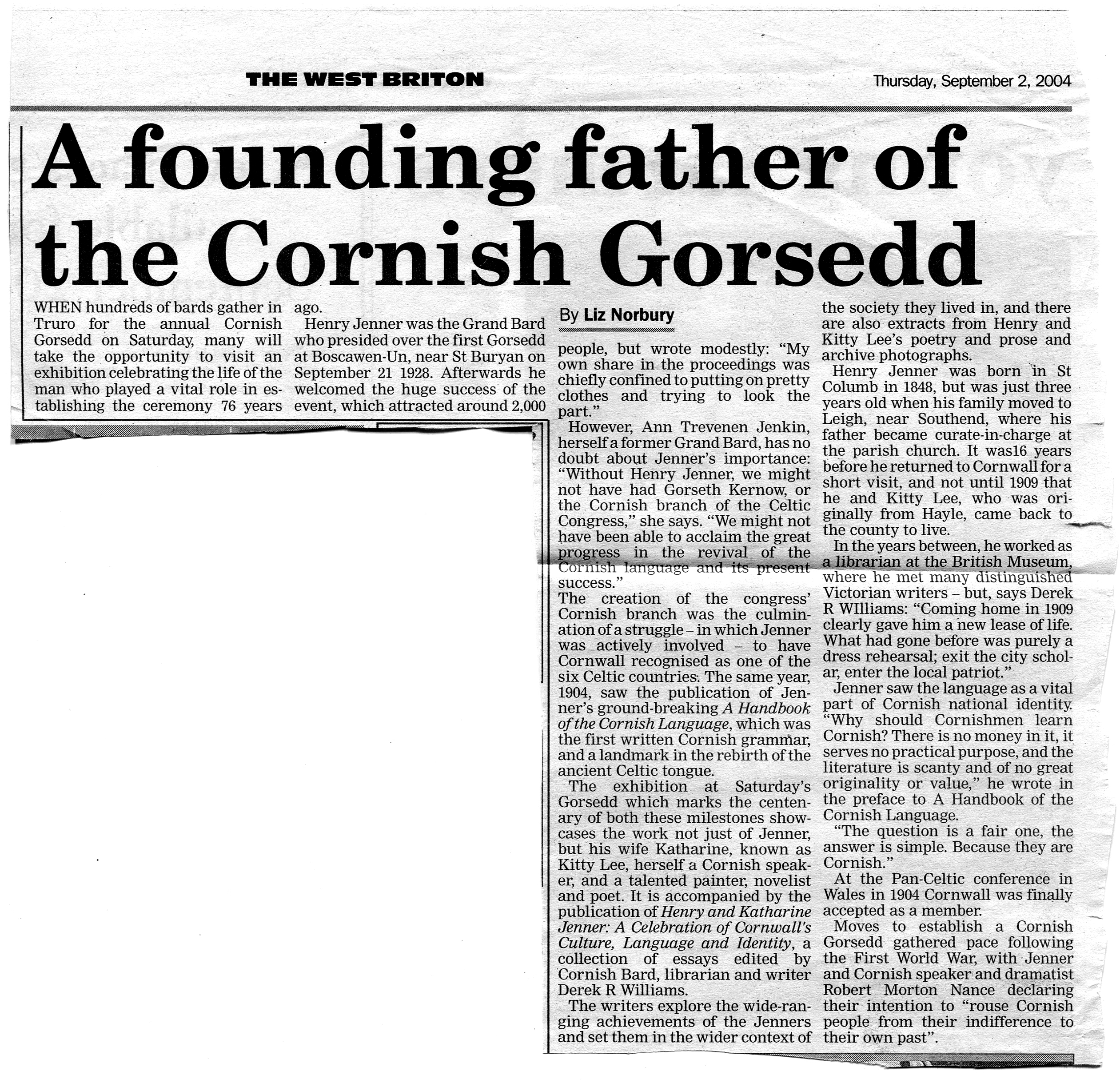
Kitty Lee Jenner (12 September 1853 – 21 October 1936) was an English artist and writer. She grew up in Cornwall and having studied art in London, she became a writer. She published six novels under the name Katharine Lee, as well as writing books on Christian symbolism. She was also known as Mrs Henry Jenner and Katharine Jenner following her marriage to Henry Jenner in 1877. To begin with, she was the more famous person in the relationship. The couple had one child together.
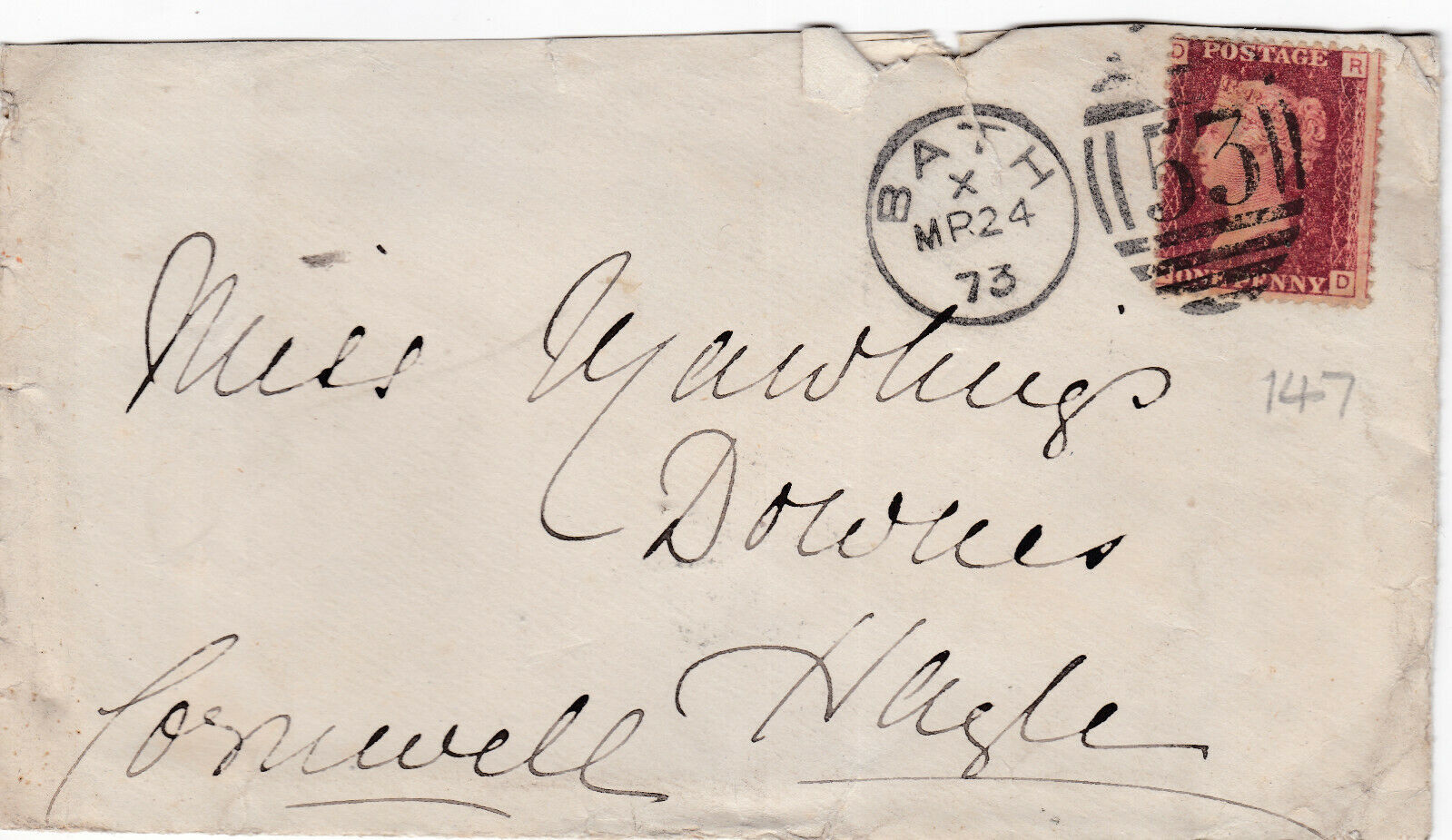
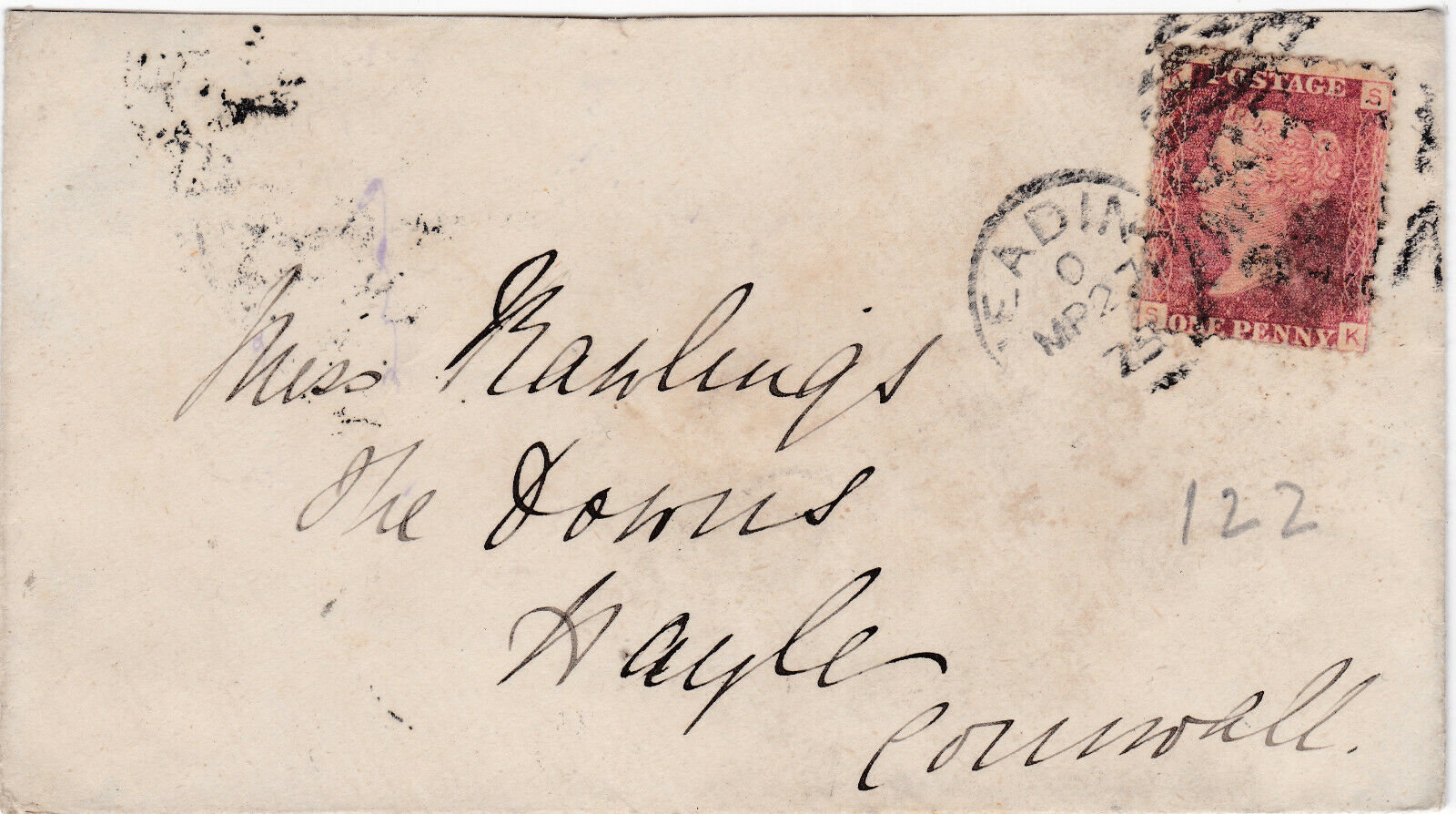
Rawlings married Henry Jenner on 12 July 1877 and became known as Kitty Jenner or Mrs Henry Jenner. Her husband had corresponded with her since 1873, after he interviewed her father about the Cornish language, which later became a major research interest for the couple. They honeymooned in Europe and on 21 June 1878 Jenner gave birth to their only child, Cecily Katharine Ysolt Jenner.[1]
Jenner published her first novel in 1882. It was entitled A Western Wildflower and she used the pseudonym Katharine Lee. She was to publish five more novels, the last being When Fortune Frowns: Being the Life and Adventures of Gilbert Coswarth, a Gentleman of Cornwall; How he Fought for Prince Charles in the years 1745 and 1746, and What Befell Him Thereafter (1895). Until her husband's fame grew in his old age, her writing career made her the better known of the two.[1][2] It was published by Horace Cox at the price of 6 shillings.[3] Jenner retold the story of the Jacobite rising of 1745 and the Battle of Culloden, The Times review remarking "she acquits herself with credit".[2]
In 1904, Jenner had become a bard, being given the name Morvoren at Gorsedd Cymru.[1] In August 1928, ten Cornish people were initiated as bards at a Gorsedd at Treorchy and planned to set up a Cornish Gorsedh to promote Cornish language and culture. Jenner and her husband joined the group to form the Council of Gorsedh Kernow. The first Gorsedh was held at the Boscawen-Un stone circle in September 1928.[4]
In the 1900s, Jenner published three works on the use of symbols in Christianity. Referring to her Christian Symbolism (1910), D. H. Lawrence wrote "It is necessary to grasp the Whole. At last I have got it".[5] After reading the book, he began to use the phoenix as his emblem.[6] Jenner had explained the phoenix's symbolic meaning in her book as the "resurrection of the dead and its triumph over death", commenting that "the Phoenix in itself was a recognised emblem of the resurrection of Christ".[7]
Jenner wrote and illustrated In the Alsatian Mountains: A Narrative of a Tour in the Vosges (With a Map) (1883) which gave an account of a European tour made in 1882 and was dedicated to her daughter Ysolt.[8] She released a book of poetry entitled Songs of the Stars and the Sea in 1926.[1]
Jenner died at home from myocarditis on 21 October 1936. She left around £23,000 in her will (equivalent to £1,600,000 in 2019). She is buried together with her husband at Lelant in west Cornwall.[1]
Williams, Derek R., ed. (2004). Henry and Katharine Jenner: A celebration of Cornwall's culture, language and identity. Francis Boutle. ISBN 9781903427194.
.................................................................................
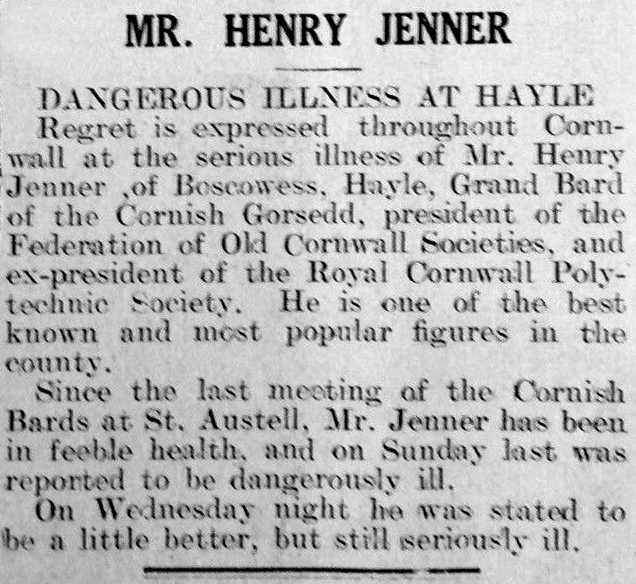
Jenner married Katharine Lee Rawlings in 1877 (she was a novelist and author of non-fiction under the name Katharine Lee).[10] A biography of Henry and Kitty, including much information about the context in which their work appeared, was published in 2004 by Derek R. Williams.[11]
After working at the British Museum for more than forty years,[1] in 1909 Jenner and his wife Kitty[12] retired to Hayle, his wife's home town, and in January 1912 he was elected as the Librarian of the Morrab Library, a post he held until 1927. He also served as President of both the Royal Cornwall Polytechnic Society and of the Royal Institution of Cornwall.[13]
He died on 8 May 1934 and is buried in St. Uny's Church, Lelant. Before he died, he said: "The whole object of my life has been to inculcate into Cornish people a sense of their Cornishness."
https://en.wikipedia.org/wiki/Henry_Jenner
.................................................................................
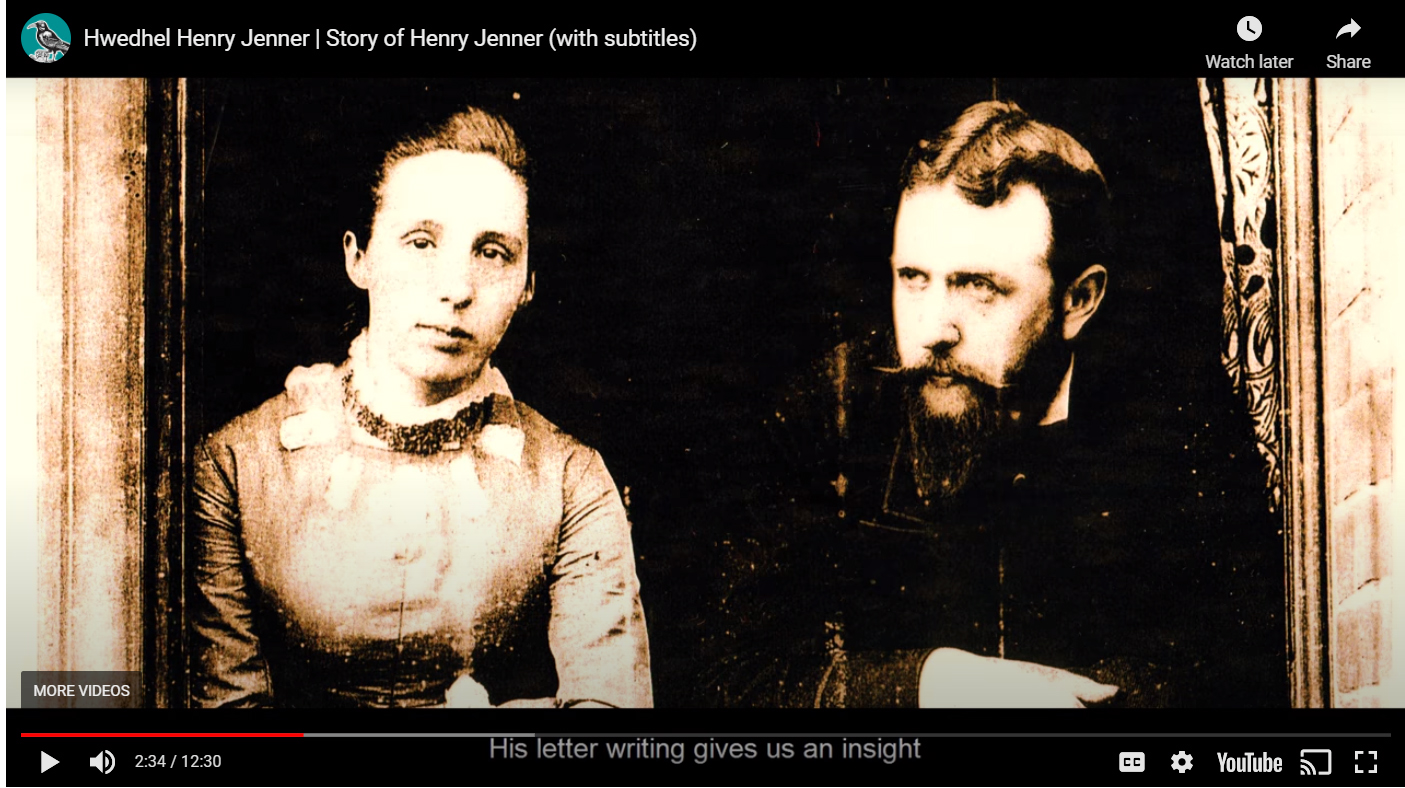
'Hwedhel Henry Jenner' - 'The Story of Henry Jenner'
(narrated in Cornish with subtitles in English)
A short documentary film in Cornish about Henry Jenner (1848-1934)
who campaigned to get Cornwall recognised as a Celtic nation and prove Cornish is a living language.

Kitty Rawlings (1853-1936) & Henry Jenner (1848-1934)

'A founding father of the Cornish Gorsedd' - West Briton Thursday September 2, 2004.................................................................................
Katherine Jenner (aka Katharine Lee, Mrs Henry Jenner) - A Bibliography
'A Western Wildflower', Katharine Lee, a novel, 3 volumes,
published by Richard Bentley and Son, 1882
'In the Alsatian Mountains: A Narrative of a Tour in the Vosges', Katharine Lee,
published by Richard Bentley and Son, 1883
'In London Town'. a novel, 3 volumes, Katharine Lee,
published by Richard Bentley and Son, 1884
'Katharine Blythe' a novel, 3 volumes, Katharine Lee,
published by Richard Bentley and Son, 1886
'An Imperfect Gentleman' a novel 3 volumes, Katharine Lee,
published by Longmans, Green, and Co. 1888
'Love or Money'. a novel, 3 volumes, Katharine Lee,
published by Richard Bentley and Son, 1891
'When Fortune Frowns: Being the life and adventures of Gilbert Coswarth, a gentleman of Cornwall, how he fought for Prince Charles in the years 1745 and 1746, and what befell him thereafter', Katherine Lee,
published by Horace Cox, 1895
'Christ in Art', Mrs Henry Jenner, published by Methuen & Company, 1906
'Our Lady in Art', Mrs Henry Jenner, published by Methuen & Company, 1908
'Christian Symbolism', Mrs Henry Jenner, published by Methuen & Company, 1910
.................................................................................
Henry and Katharine Jenner: A Celebration of Cornwall's Culture Language and Identity Paperback – 30 Sept. 2004 by Derek R. Williams (Editor)
.................................................................................
Daughter - Cecily Katharine Ysolt Jenner - b1878?
(later Sister Mary Beatrix Jenner of the Order of the Visitation)
~ ~ ~ ~ ~ ~ ~ ~ ~ ~ ~ ~ ~ ~ ~ ~ ~ ~ ~ ~ ~ ~ ~ ~ ~ ~ ~ ~
Bospowes (formerly known as 'Crofthill')
Stone-built house
'363
HAYLE, CROFTHILL (ST MICHAELS HOSPITAL) (Figs 15a, b) [reference key at foot of webpage]
HOUSE
SW55613684 PRN: 139623
House. Early C19, extended mid C20. Granite rubble and dressed granite with slate roofs and brick stacks. Two storeys with hipped roofs, with projecting hipped early C20 wing to left, and single storey hipped extension to right. Five glazing bar sashes on first floor, the left 2 in projecting wing, and four on ground floor with central half-glazed door. A slate plaque to the right of the door records that this was the house.'
http://www.hayle.net/council/documents/2000R058HayleHistoricalAssessmen…
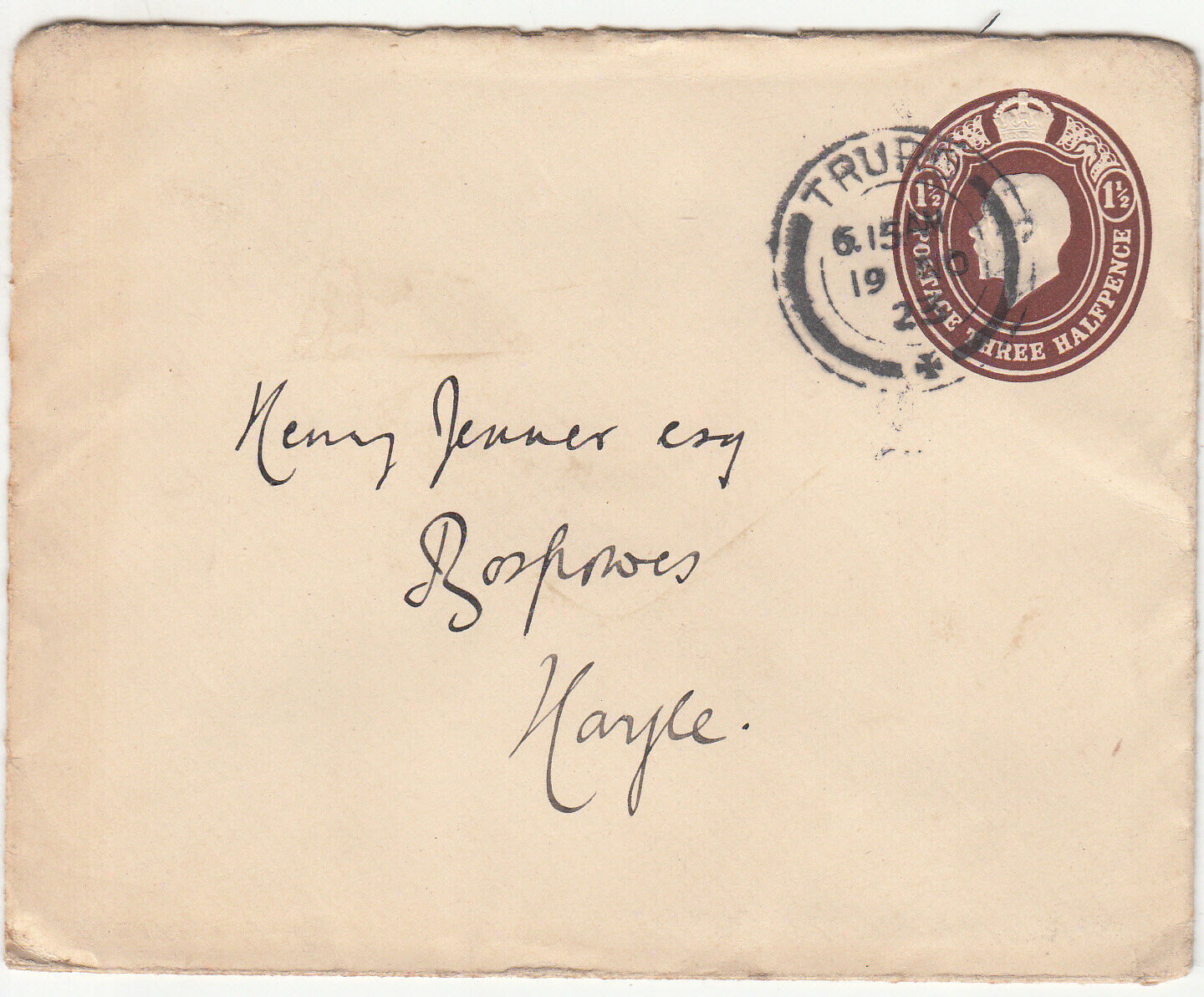
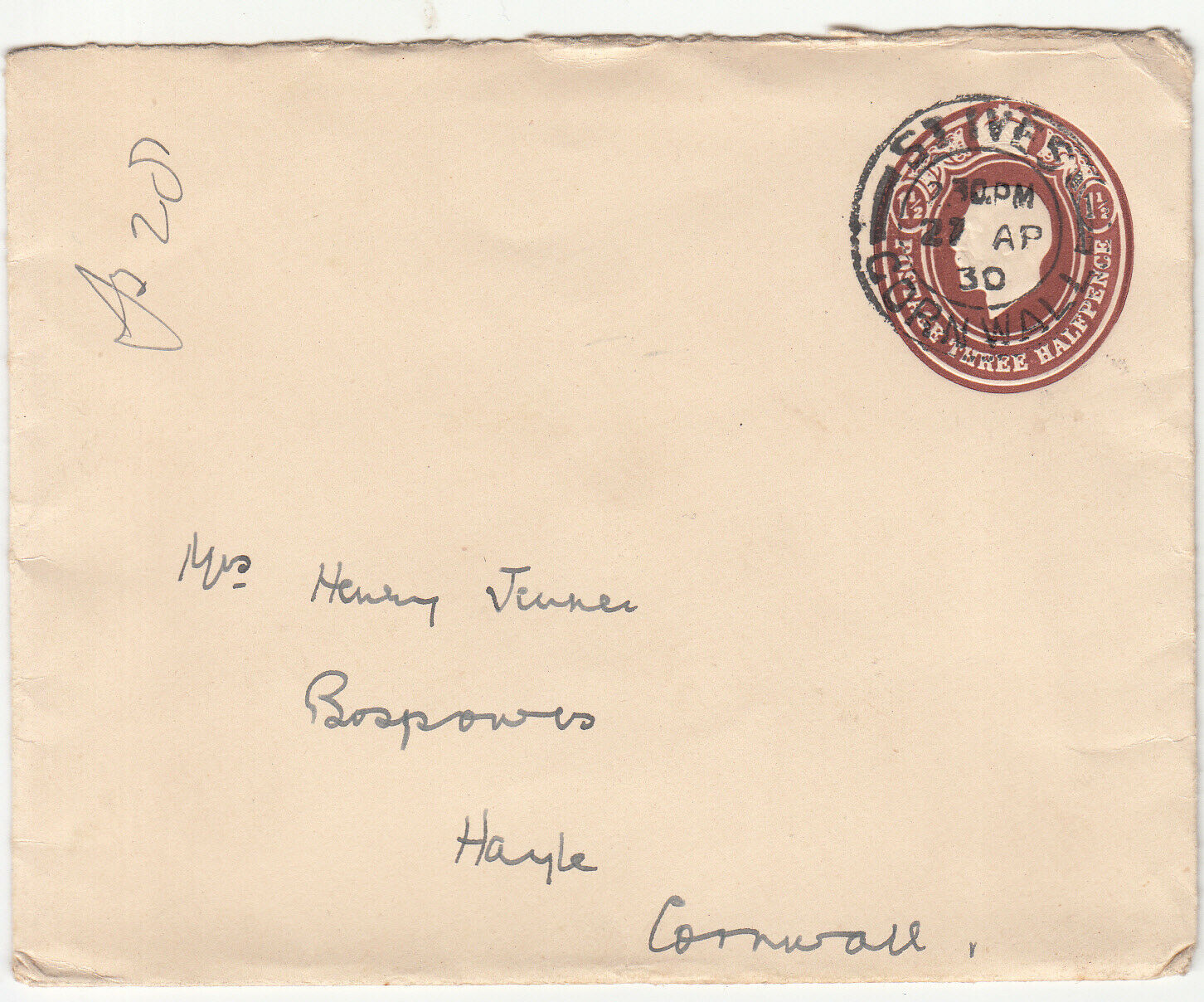
Bospowes, the house in Hayle where Kitty Jenner lived with her husband, Henry Jenner, from 1909 onwards
From 1945 Bospowes becomes nurses home.
~ ~ ~ ~ ~ ~ ~ ~ ~ ~ ~ ~ ~ ~ ~ ~ ~ ~ ~ ~ ~ ~ ~ ~ ~ ~ ~ ~
Richard Trevithick & Family
Richard Trevithick
'BORN 13 April 1771
DIED 22 April 1833
Richard Trevithick, was born in Illogan, Cornwall, in 1771.
Richard was educated at Camborne School but he was more interested in sport than academic learning. Trevithick was six feet two inches high and was known as the Cornish giant. He was a very strong lad and by the age of eighteen he could throw sledge hammers over the tops of engine houses and write his name on a beam six feet from the floor with half a hundredweight hanging from his thumb. Trevithick also had the reputation of being one of the best wrestlers in Cornwall.'
https://cornishstuff.com/2018/04/26/who-was-richard-trevithick-here-is-the-great-mans-story/
'When the writer was a young man, Kneebone, a strong Cornish wrestler, working in the tin-smelting works at Hayle, lifted him from the ground with one hand, at arm’s length; he then raised two- blocks of tin, each of them three hundred weight, from the ground,- remarking, “ Captain Dick Trevithick could lift three blocks as easy as I can two; and he also lifted an old piston-rod, seven or eight hundredweight, with a man sitting on each end of it.”'
'Life of Richard Trevithick: With an Account of His Inventions Vol I' by Francis Trevithick, 1872 p56


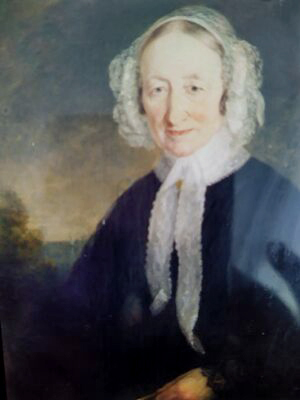
Jane Trevithick (1772-1868) c1850
sister of Henry Harvey (1775-1850), wife of Richard Trevithick (1771-1833)Richard Tevithick born 13th April 1771 (d. 22nd April 1833)
Jane Trevithick born 25th June 1772
married Richard Trevithick on 7th November 1797 at St Erth
* children *
Richard Trevithick II (1798–1872)
Anne Ellis (1800–1877)
Elizabeth Banfield (1803–1870)
John Harvey Trevithick (1807–1877)
Francis Trevithick (1812–1877)
Frederick Henry Trevithick (1816–1883)
In 1816 Richard Trevithick was all set to work as a mine consultant overseas.
"On the 20th October, 1816, Capt. Trevithick sailed for Lima in the 'Asp,' South Sea whaler, Capt. Kenny, accompaned by Mr. Page, a gentleman of London, and James Saunders, of Camborne, an engine maker; and on the 6th February, 1817, they arrived at Lima, where Capt. Trevithick was immediately introduced to the Viceroy by Don P. Abudia. and he received the most marked attention from the inhabitants (vide ' Lima Gazette' of 12th February).
"Perhaps you think it proper to notice the furnaces which Captain Trevithick took out in the 'Asp' to Lima for the purpose of purifying the silver by sulphur. A great expense will be saved by these means. ...'
'Life of Richard Trevithick: With an Account of His Inventions Vol II' by Francis Trevithick, 1872 p231
And... after a protracted absence, Trevithick's homecoming caused something of a stir ...:
'Trevithick was welcomed home at Hayle as if he were a conquering hero, and not a penniless adventurer,
"by all the neighbourhood by ringing of bells, and entertained at the tables of the county and borough members, and all the first-class of gentlemen in the west of Cornwall, with a provision about to be made for me for the past services that his county has received from my inventions just before I left for Peru, which they acknowledge to be a saving in the mines since I left of above 500,000l. [another way of writing '£500,000'], and that the present existence of deep mines is owing to my inventions. I confess that this reception is gratifying, and have no doubt but that you will also feel a pleasure in it.'"
- Letter to J.M. Gerard, dated Hayle Foundry, 1827, Nov. 15th.
'Richard Trevithick' by Arthur Tilley p209

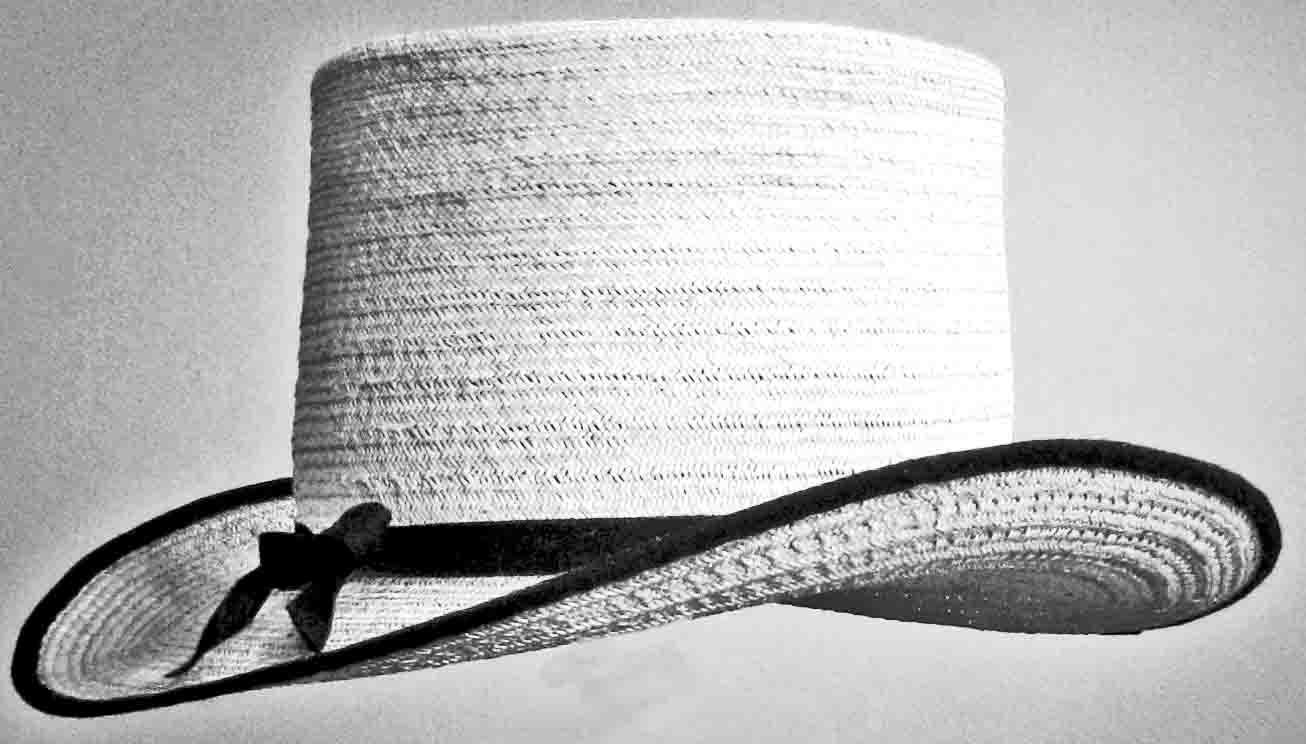
'In the early part of October, 1827, the writer, then a boy at Bodmin school, was asked by the master if any particular news had come from home. Scarely had the curiousity of the boys subsided, when a tall man with a broad-brimmed Leghorn hat on his head entered at the door, and after a quick glance at his whereabouts, marched towards the master's desk at the other end of the room. When about half-way, and opposite the writer's class, he stopped, took his hat off, and asked, if his son Francis was there. Mr Boar, who had watched his approach, rose at the removal of the hat, and replied in the affirmative. For a moment a breathless silence reigned in the school, while all eyes were turned on the gaunt sun-burnt visitor; and the blood, without a defined reason, caused the writer's heart to beat as though the unknown was his father, who eleven years before had carried him on his shoulder to the pier-head steps, and the boat going to the South Sea whaler.'
'Life of Richard Trevithick: With an Account of His Inventions Vol II' by Francis Trevithick, 1872 p276
But not everyone was enamoured with Richard Trevithick, as can be seen by this extract from a letter from his former mentor, Davies Giddy, an MP who is noteable for his extreme opposition to mass education [see quote below].:
"I must add that on last Tuesday [i.e. Oct. 9th 1827] Capn Richard Trevithick, after an absense of eleven years, during the whole of which he has not held any communication whatever with his Family, arrived suddenly at Hayle".
'Richard Trevithick' by Arthur Tilley p208
Davies Gilbert FRS (born Davies Giddy, 6 March 1767 – 24 December 1839) was an Cornish engineer, author, and politician. He was elected to the Royal Society on 17 November 1791 and served as President of the Royal Society from 1827 to 1830.[1][2] He changed his name to Gilbert in 1817.[3]
Davies Gilbert was opposed to mass education during his time in parliament. When the Parochial Schools Bill of 1807 was debated in the Commons, Tory MP Davies Gilbert warned the House that:
"However specious in theory the project might be of giving education to the labouring classes of the poor, it would, in effect, be found to be prejudicial to their morals and happiness; it would teach them to despise their lot in life, instead of making them good servants in agriculture and other laborious employments to which their rank in society had destined them; instead of teaching them the virtue of subordination, it would render them factious and refractory, as is evident in the manufacturing counties; it would enable them to read seditious pamphlets, vicious books and publications against Christianity; it would render them insolent to their superiors; and, in a few years, the result would be that the legislature would find it necessary to direct the strong arm of power towards them and to furnish the executive magistrates with more vigorous powers than are now in force. Besides, if this Bill were to pass into law, it would go to burthen the country with a most enormous and incalculable expense, and to load the industrious orders with still heavier imposts. (Hansard, House of Commons, Vol. 9, Col. 798, 13 July 1807, quoted in Chitty 2007:15–16)"
https://en.wikipedia.org/wiki/Davies_Gilbert

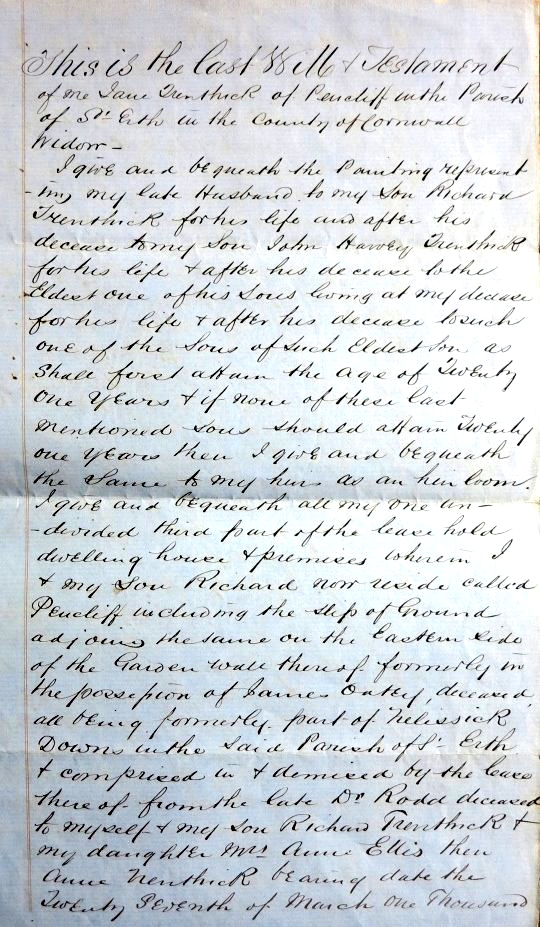
Last Will & Testament (27th March 1863) of Jane Trevithick (1772-1868)
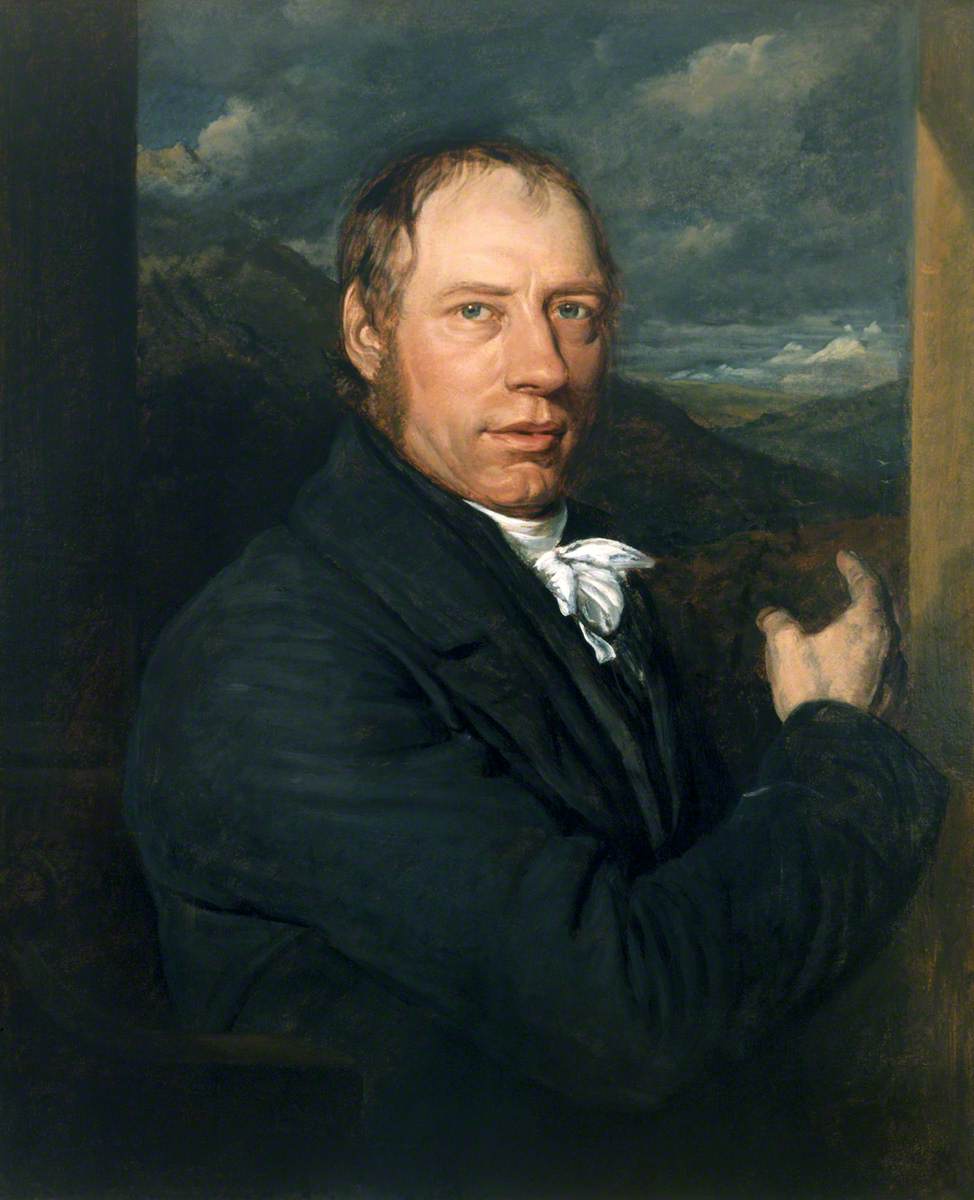
Whilst in London in 1816, preparing for his departure for South America, his portrait—a good likeness—was taken by Linnell. This half-length oil-painting (24 by 20 inches) has lately been presented to the South Kensington Museum, where it is suspended among the portraits of distinguished men—a painted copy and a photographic copy having been given in exchange for it. From this picture, and from a post-mortem plaster cast, Mr. Neville Burnard, the Cornish sculptor, has made a marble bust, plaster copies of which adorn various institutions.
'Contributions to the Biography of Richard Trevithick - Richard Edmonds, 1859'
http://camborne.wikidot.com/edmonds

Plaster bust of Richard Trevithick
after Neville Northey Burnard, about 1859

Jane Trevithick & Family
seated: Richard Trevithick Jr., Anne Trevithick, Jane Trevithick, Elizabeth Trevithick,
standing: John Harvey Trevithick, Francis Trevithick and Frederick Henry Trevithick
~ ~ ~ ~ ~ ~ ~ ~ ~ ~ ~ ~ ~ ~ ~ ~ ~ ~ ~ ~ ~ ~ ~ ~ ~ ~ ~ ~
Charlotte House - 52 & 54 Foundry Hill (since 1st May 1973) - formerly known as 'Pencliff'
built c1804, Grade II listed
'67
HAYLE, 52,54 FOUNDRY HILL (Figs 15b, c, d) [reference key at foot of webpage]
HOUSE
SW55633690 PRN: 139071 LB: 11
Listed building (No. 12/262). This house is shown on the 1842 Tithe Map when it is called Pencliff and appears to be one residence. Dating to about 1804 and remodelled -in the early C19 and later C19 . Charlotte House, as it was later called, is stuccoed or possibly rendered replacing stucco. lt has asbestos slate hipped roofs with projecting eaves and cast-iron ogee gutters. Partly external stack at left-hand side with rendered brick chimney over; pair of octagonal stuc90ed chimney shafts over right-hand side and brick chimney over original end of wing towards rear on right. lt has a double depth plan plus C20 extensions. Two reception rooms at the garden front; stair hall behind left-hand room, probably original kitchen behind right-hand room. lt is two storeys high with regular two window garden front with granite plinth. The left-hand bay is bowed and there is a canted bay window to the ground floor of each bay. In front of the ground floor to a mid-late C19 four-bay veranda with ornate cast-iron stanchions, the veranda returns at either end both to cover the entrance doorway and for a distance at the other side. The transomed ground floor windows are probably contemporary with the veranda and have diagonal and square patterned glazing to the casements. First floor windows have similar glazing to the top lights only. The entrance front (left-hand wall) has a doorway with a pair of C19 panelled doors and overlight with diamond panes all within an early C19 moulded doorcase with corner blocks. The parts of the interior that have been inspected all have their early C19 carpentry and joinery details and plaster work including; dogleg stair with open string; cornice with modillions in the stair hall; cornices with trailing bands and six-panel doors. Charlotte House was the home of Jane Trevithick (nee Jane Harvey) wife of Richard Trevithick, the famous engineer. '
http://www.hayle.net/council/documents/2000R058HayleHistoricalAssessmen…
1841 Tithe apportionment 63, Lawn and Garden
1841 Tithe apportionment 64, Dwelling House, Courlage etc
1841 Census
Hayle Foundry,1,Richd Trevithick,45,,Agent,In county,
,,Jane Trevithick,,70,,In county,
,,Ann Trevithick,,41,,In county,
,,Ann Shugg,,18,Female Servant,In county,
,,Fanny Shay,,20,Female Servant,In county,
1851 Census
34,Pen Cliff,Jane Trevithick,Head,W,,78,Land & House Proprietor,Gwinear Cornwall,,
,,Richard Trevithick,Son,S,52,,Agent Iron Trae,Camborne Cornwall,,
,,Eliza Ralph,Servnt,S,,27,House Servant,Crowan Cornwall,,
,,Fanny Burton,Servnt,S,,22,House Servant,Phillack Cornwall,,
1861 Census
113,,1,Richard Trevithick,Head,U,62,,Gentleman,Camborne Cornwall,,
,,,Jane Trevithick,Mother,W,,88,,Gwinear Cornwall,,
,,,Elizabeth Banfield,Sister,M,,58,,Camborne Cornwall,,
,,,Eliza Jane Dourick,Servnt,U,,23,Houseservant,Gluvias Cornwall,,
,,,Martha Orchard,Servnt,U,,25,Houseservant,Crowan Cornwall,,
1871 Census
78,Hayle Foundry,1,Richard Trevithick,Head,U,72,,Land Owner,Camborne Cornwall,,
,,,Mary Luke,Servnt,W,,49,General Servant,St Erth Cornwall,,
,,,Elizabeth Polkinghorne,Servnt,U,,40,General Servant,Phillack Cornwall,,
1881 Census
42,Pen Clift Foundry Hill,1,Charles Trevithick,Head,M,42,,Corn Merchant,Phillack Cornwall,,
,,,Elizabeth B. Trevithick,Wife,M,,43,,St Erth Cornwall,,
,,,Eleanor C.M. Mills,Sislaw,M,,48,Merchants Wife,St Erth Cornwall,,
,,,Samuel H. Mills,Nephew,U,12,,Scholar,Wadebridge Cornwall,,
,,,Charles V. Mills,Nephew,,3,,,Wadebridge Cornwall,,
,,,Elizabeth A. George,Servnt,U,,42,Cook Domestic Servant,St Erth Cornwall,,
,,,Hannah Harris,Servnt,U,,18,Housemaid Domestic Servant,Kings Lynn Norfolk,,
1891 Census
63,Pencliffe,1,Elizabeth B Trevithick,Head,M,,53,,,Hayle Cornwall,,
,,,Eliza Bowden,Servnt,S,,36,Cook Domestic,,Phillack Cornwall,,
,,,Mary Thomas,Servnt,S,,27,House Maid,,St Erth Cornwall,,

'Charlotte House', formerly 'Pencliff', home of Jane Trevithick & Family
Foundry Hill School
Private boarding school
'1
HAYLE, 5 FOUNDRY HILL (Fig 15b) [reference key at foot of webpage]
SCHOOL
SW55733683 PRN: 138970 LB: 11
Listed building (No. 12/173). School for foundry workers' children. 1838, enlarged mid-late C19. Built for
Henry Harvey. Symmetrical 2 storey 3 window front to road, glazing bar sashes. Entrance on left return
(later C19 entrance at first floor level with porch). Granite and killas rubble with granite dressings,
slatehanging to walls of rear wing. Hipped slurried scantle slate roof with wide eaves and ventilator holes
drilled into the soffits. Cast-iron ogee-section gutters. Large rectangular schoolroom each floor, school
master's accommodation in rear wing. Harvey's continued to support the school financially until 1903,
when the new Education Act came into force. Now subdivided and used as a house. (List description; The
Book of Hayle, C. Noall, 1984, 129) '
http://www.hayle.net/council/documents/2000R058HayleHistoricalAssessmen…
1851 Census
33,Foundery Hill,James Hocking,Head,S,29,,Teacher Of Mathematics,Perranuthnoe Cornwall,,
,,Mary Hocking,Mother,W,,69,,Fishguard Pembrokeshire,,
,,John Hocking,,S,24,,Teacher/ancient & Modern Lang.,Perranuthnoe Cornwall,,
,,Christian Burgan,Visitr,S,,37,,Perranuthnoe Cornwall,,
,,Thomas Field,,,13,,Scholar & Boarder,Marylebone London,,
,,James Field,,,9,,Scholar & Boarder,Marylebone London,,
,,Arthur Thomas,,,13,,Scholar & Boarder,Breage Cornwall,,
,,William Barry,,,12,,Scholar & Boarder,Bath Somerset,,
,,Edward Winsley,,,12,,Scholar & Boarder,Bristol Gloucestershire,,
,,John Vivian,,,11,,Scholar & Boarder,Crowan Cornwall,,
,,Charles Corin,,,11,,Scholar & Boarder,Penzance Cornwall,,
,,Arthur Corin,,,8,,Scholar & Boarder,Redruth Cornwall,,
,,Nugent Cosley,,,12,,Scholar & Boarder,Truro Cornwall,,
,,John Penberthy,,,11,,Scholar & Boarder,St Ives Cornwall,,
,,Tho's Stephens,,,9,,Scholar & Boarder,Hayle Cornwall,,
,,Ann Sincock,Servnt,S,,24,House Servant,Crowan Cornwall,,
,,Mary Floyd,Servnt,S,,18,House Servant,Crowan Cornwall,,
......................................................................................
Ordnance Survey 1908
Ordnance Survey 1965
Foundry Square, Hayle

Hayle, The Square. c1902
Peacock postcard M.C. 1751
in background to right of hotel can be seen the 5-storey Mill next to Swan Pool
sited directly opposite to Henry Harvey's home, known both as 'Foundry House' & 'Harvey's House'
8, 9, Foundry Square, formerly the original White Hart Hotel
2-storey building, built 1824
'109
HAYLE, 8, 9, FOUNDRY SQUARE (Fig 15d) [reference key at foot of webpage]
FREEMASONS HALL
SW55873707 PRN: 139145 LB: 11
This was fomerly the original White Hart Hotel built by Henry Harvey, to support his sister Jane, wife of Richard Trevithick 1771 - 1833, the famous engineer. lt has rendered walls, and a hipped, almost pyramidal, grouted scantle slate roof. Chimneys that once stood over the side walls were removed in the C20. Of a double depth plan it has two equally sized reception rooms at the front flanking a central entrance hall leading to a rear stair hall between two service rooms, (possibly remodelled in the C20). There are later extensions behind. Two storeys high and on the northern front are three windows set symmetrically with a central C20 doorway. They have original hornless sashes. The window to the right of the doorway is a complete sixteen-pane sash but the others have had their secondary glazing bars removed to leave four-panes in each. There are internal window shutters to the ground floor rooms. This building has important historical interest Jane Trevithick was the hostess of the premises during Richard Trevithick's long period of absence in South America, where he travelled initially to supervise the installation of nine of his engines in Peru. While he was in South America, engaged in many daring and some ill-fated ventures, Richard sent Jane no money, and when he returned to the port of Falmouth in October 1827 he had (according to Francis Trevithick) only the clothes he wore, a gold watch, a drawing compass, a magnetic compass, and a pair of silver spurs. The hotel is also an interesting relic of Hayle's prosperity. For the ceremonial first opening of the sluices, to clear the sand from the river, on 27 December 1834, the occasion was celebrated by a breakfast at the White Hart for the mine adventurers, customers and four captains who had been employed in the work.'
http://www.hayle.net/council/documents/2000R058HayleHistoricalAssessmen…
When John Harvey set up his iron foundry in Carnsew in 1780, there were no shops or inns in the immediate vicinity. The area had since become a town, a thriving industrial hub with many visitors, workers and there families living close by, so it was just a matter of time before someone established an inn. Henry's invited his sister, Jane Trevithick (1772-1868), to run the new inn he was having built on an area of ground designated on the estate plan as 'THE POOL', close by 'THE GREEN', just yards up the road from Henry Harvey's own house, Foundry House {marked 23} and, the hotel opened in 1824.

Penpol Pool, Carnsew (Hayle)
from Manor of Trevethow (Trevethoe) Estate Plan 1820
'He wished his life to be insured for the benefit of his wife and family, but never thought of paying the yearly insurance premium, leaving it for his wife to pay, whom he had left, as far as he knew, penniless in England.
On his sailing from Penzance, he told his wife that he had paid the house-rent for a year in advance, mentioning the sum. At the end of that time a demand was made on Mrs. Trevithick for a year's rent, being a larger sum than her husband had mentioned as the proper rent. It turned out that Trevithick had taken and paid for the house at six-monthly periods, instead of yearly periods. It was in the same street, and but three or four houses from that occupied by the parents of the eminent Sir Humphry Davy.'
- 'Life of Richard Trevithick: With an Account of His Inventions Vol I' by Francis Trevithick, 1872 p242
Anyway, after Richard's business overseas was concluded, in October 1827 he returned to Hayle.
'Trevithick seems, for the time being, to have settled down at Hayle to a life very like that which he led before his departure for South America. He lived at the White Hart Hotel, which was managed by his wife, and seems once more to have been persona grata at the Foundry, where he was working on some new ideas.'
- 'The Harvey's of Hayle' by Edmund Vale, The Trevithick Sociey p169
'The first thing to which Trevithick applied himself on his return from South America, was to replenish his purse. Justly considering himself entitled to remuneration from his country, he furnished my late father (his solicitor) with instructions for a petition to the House of Commons for that purpose. The petition was prepared accordingly in December, 1827.'
The letter from Trevithick, enclosing the instructions for this petition, was dated the 20th of December, 1827, and contained the following postscript:—"I was at Dolcoath account on Monday, and made known to them my intention of applying to Government, and not to individuals, for remuneration. They are ready to put their signatures to the petition, and so will all the county."
Soon after the petition had been prepared, Trevithick met with a partner, who supplied him with the money he required for perfecting his never-ceasing inventions. This being all he wanted, the petition was never presented, and he gladly resumed the kind of life which he had pursued for so many years with so much success in Camborne, when in partnership with Mr. Vivian.'
Jane continued to run the hotel, even after her husband's death in April 1833, but in March 1837, at 64 years of age she retired, and responsibility for the hotel was taken over by a William Crotch, who is said to have prevailed upon Henry Harvey to build a much larger hotel next door.
1841 Tithe apportionment 15 - Old White Hart Premises - Francis Wyatt
1841 Census
Hayle Foundry,1,Francis Wyatt,25,,Tailor,In county,
,,Jane Wyatt,,25,,In county,
,,Isabela Stevens,,22,,In county,
,,Ann Stevens,,15,,In county,
,,Elizth Stevens,,12,,In county,
,,Mary Jones,,19,,In county,
,,Mary Jones,,4w,,In county,
,,Caroline Jones,,22,,In county,
,,Josiah Philip,18,,Engineer,In county,
1851 Census
10,Hayle Foundry,1,Francis Wyatt,Head,M,43,,Mercer And Tailor,Cury Cornwall,,
,,,Jane Wyatt,Wife,M,,44,,Lelant Cornwall,,
,,,Mary Jones,Sister,M,,39,Wife Of A Labourer,Lelant Cornwall,,
,,,Elizth. Gregory,Visitr,U,,29,Tailoress,Lelant Cornwall,,
,,,Richd. H. Mollard,Visitr,M,50,,Shipmaster Merchant Service,St Ives Cornwall,,
,,,Ben Mollard,Visitr,M,48,,Mariner Merchant Service,Padstow Cornwall,,
,,,Mary M Chelew,Visitr,M,,24,Wife Of A Labourer,St Ives Cornwall,,
The new, much larger 3-storied White Hart Hotel was built 12-13 years later next door to the orginal building.
~ ~ ~ ~ ~ ~ ~ ~ ~ ~ ~ ~ ~ ~ ~ ~ ~ ~ ~ ~ ~ ~ ~ ~ ~ ~ ~
White Hart Hotel
built on site of Penpol Pool next door to old White Hart Hotel, and opened in 1838
'It was supposedly fear for public health that led Henry Harvey to acquire and drain Penpol Pool in the 1837, although since he went on to build the new White Hart on the site, commercial interest may have had a significant role to play.'
- Hayle Historical Assessment - 7.5.1.5 Community facilities - p56
White Hart Hotel, Hayle 1840s
with West Cornwall Railway station to right
'108
HAYLE, WHITE HART HOTEL, FOUNDRY SQUARE (Fig 15d) [reference key at foot of webpage]
PUBLIC HOUSE
SW55853709 PRN: 139144 LB: 11*
Listed building (No. 10/96). Dating to about 1838 this was built for Henry Harvey, the brother-in-law of Richard Trevithick as the new White Hart Hotel (which replaced the original one [109]). lt has stuccoed walls and a scantle slate roof behind a stuccoed parapet. There are stuccoed chimneys over the left side walls. Rectangular in plan it is two rooms wide and three rooms deep. lt has two equally sized reception rooms that flank a central entrance hall that leads to a large stair hall behind the right-hand room . Classical style. Three storeys high the elevations are stuccoed with dassical detail. There are rusticated courses at ground floor level with stucco flat arches. The northern front entrance has the central doorway within a panelled stucco porch. The doors are original with latticed glazing and the original fanlight with scrolled detail. The corners of the front of the building are panelled pedestals carrying a giant order of clasping square fluted columns, the antae to the three bays of the upper floors with four engaged giant round columns, the whole being surmounted by a Tuscan entablature and a parapet with an open pediment at the middle with a central round plaque. The columns are a kind of debased Roman Doric with an Egyptian influence to the design of the capitals. The first floor windows have moulded hoods on carved consoles. The side elevations have eared architraves to the first floor windows with aprons under the sills . All the windows (excepting the ground floor left one on the eastern elevation) are original hornless sashes with glazing bars. The west elevation has a tall round headed stair window. The interior of the building has been partially inspected. The entrance hall and stair hall have their original architectural details, including arches, plaster cornices and fine open well stair with mahogany handrail curving down to form the newel post. This building is erected on the site of the former Penpol pool (blamed by Henry Harvey for the spreading of cholera in the town) .'
http://www.hayle.net/council/documents/2000R058HayleHistoricalAssessmen…
1841 Census - Phillack - HO107/143 pt. 9 ED2 Book 12 Folio 29 p. 1
White Hart Hotel,1,William Crotch,57,,Inn Keeper,Not in county,
,,Margarette Crotch,,52,Wife (Crossed Out),In county,
,,Amelia Crotch,,19,Daughter,Not in county,
,,William Jnr. Crotch,16,,Son (Crossed Out),Not in county,
,,Mr. Stubbs,45,,Merchant,Not in county,
,,Mr. Johnson,40,,Merchant,Not in county,
,,Mr Werry,57,,Traveller,Not in county,
,,Mr Jackson,30,,Traveller,Not in county,
,,John Winnan,27,,Servant,In county,
,,Fras. Godolphin,49,,Servant,In county,
,,Nanny Ward,,22,Servant,In county,
,,Fanny Thomas,,25,Servant,In county,
,,Mary Wearne,,19,Servant,In county,
,,Mary Cutty,,46,Servant,In county,
,,Susan Petengile,,46,Servant,In county,
,,Eliz. Ann Rowe,,17,Servant,In county,
,,Grace Hicks,,24,Servant,In county,
,,Matilda Hicks,,21,Servant,In county,
1851 Census (unavailable)
1861 Census - Phillack
31,Hayle Foundry (Crotch Hotel),1,William Crotch,Head,M,69,,Hotel Keeper,Okehampton Devon,,Surname uncertain; might be CRUTCH
,,,Margaret Crotch,Wife,M,,73,,Perranuthnoe Cornwall,,
,,,William James Crotch,Son,U,36,,Chemist,Eardsley Herefordshire,,
,,,Elizabeth A Olver,Servnt,U,,26,General Servant,St Columb Cornwall,,
,,,Mary Bawden,Servnt,U,,30,General Servant,Breage Cornwall,,
,,,Jane Richards,Servnt,U,,26,General Servant,Phillack Cornwall,,
,,,Mary Jennings,Servnt,U,,22,General Servant,Gwennap Cornwall,,
,,,Jane H Bawden,Servnt,U,,22,General Servant,Phillack Cornwall,,
,,,Elizabeth A Berriman,Servnt,U,,26,General Servant,Crowan Cornwall,,
,,,Hester Ann James,Servnt,U,,18,General Servant,Mawgan Cornwall,,
,,,Mark Kempthorne,Servnt,U,19,,General Servant,Newlyn East Cornwall,,
'24 June 1871 Death of Mr. Crotch'
- Royal Cornwall Gazette
https://www.opc-cornwall.org/deaths/phillack_death_crotch_mr_1871.pdf
~ ~ ~ ~ ~ ~ ~ ~ ~ ~ ~ ~ ~ ~ ~ ~ ~ ~ ~ ~ ~ ~ ~ ~ ~ ~ ~

former White Hart Hotel (left), & 'new' White Hart Hotel, Hayle (right)
roof of 5-storey Mill to far right was demolished in 1940, allegedly to avert the building being targeted for bombing in WWII
~ ~ ~ ~ ~ ~ ~ ~ ~ ~ ~ ~ ~ ~ ~ ~ ~ ~ ~ ~ ~ ~ ~ ~ ~ ~ ~
Lloyd's Bank Building formerly Hayle Public Hall
established in 1869 - with Market House in basement
Foundry Square, Hayle c1904
Foundry Square, Hayle
with West Cornwall Railway station to front of viaduct
Foundry Square, Hayle c1920
Post Office to left, The Cinedrone Cinema & Market Hall building, centre, and West Cornwall Railway station to right
(old station demolished c1948)
'115
HAYLE, 3,4 FOUNDRY SQUARE {LLOYDS BANK) {Fig 15d) [reference key at foot of webpage]
MARKET HOUSE
SW55873714 PRN: 139151 LB: 11
Listed building (No. 10/93). Former market house with public hall over (sometime cinema) that is now used as a Lloyds Bank. 1868-8, built by a limited liability company under the aegis of Harvey & Co. Originally 2 floors with a market on the ground floor and public hall on the first, reconstructed after a fire in 1935 with only the lower floor (C. Noall, The Book of Hayle, 1984, 130). Stuccoed walls and a hipped dry Delabole slate roof with slightly projecting eaves. The building is an L-shaped plan being two rooms wide and three rooms deep. There is a central through passage and originally there was an axial passage in front of the rear (south) rooms. A small C20 extension can be found at the back. The building has Classical style details. Although now only a single storey there were originally two. Stucco detail is similar on all sides with textured granite ashlar plinth, chamfered rustications to impost string level and round arches with alternate rustications to the voussoirs. The quoins and the piers, punctuating the bays of the north and west fronts, are also rusticated. Above the level of the pier shafts and the tall keystones of the arches is an entablature with moulded architraves, plain frieze and moulded eaves cornice. Symmetrical 1 :1:1 bay north and south entrance fronts both with central doorways (north front is wider). The north doorway has a moulded stucco arch over responds with moulded imposts. Original panelled doors. Over the south doors is the original geometric and spoked fanlight. The west front has an early C20 shop window to the lefthand side of the middle bay. This window has a pair of round-headed lights with glazed spandrels within a square-headed opening .'
http://www.hayle.net/council/documents/2000R058HayleHistoricalAssessmen…
'Destructive fire at Hayle'
- West Briton newspaper 1935
West Briton newspaper - 1935
Foundry Square, Hayle 1950s?
Lloyds building to right
Foundry Square / Penpol Terrace shops
It appears that Harvey & Co. had something like a monopoly locally, insofar as workers would, after he set up a shop in 1830 to sell general grocery and hardware, likely have had to source their goods from the company's Emporium (that is until The Truck Acts of 1831 and 1887, Acts which limited the potential for employers to exploit their workers by paying in goods rather than cash, or/& selling them goods at inflated prices). It was not until after 1887 that shops started to spring up around Foundry Square, and along Penpol Terrace in what used to be garden space.
The Square, Hayle c1905
Valentines postcard 39091
The Square, Hayle c1905
postcard
Penpol Terrace, Hayle
railway track to quays visible
Penpol Terrace, Hayle
oil painting by Stanhope A Forbes (1857-1947)
......................................................................................
Ferry from Lelant to The Spit, Hayle c1904
Valentines Real Photo postcard S1345
'On his retirement in 1932 ex-sailor Mr John Couch, a colourful and well-remembered personality, took over the ferry, which he ran for about 27 years until six months before his death at the age of 83.'
- 'The Book of Hayle' by Cyril Noall, Barracuda Books, 1984, p112
This ferry point has quite a bit of history attached, not least in recent times when the famous artist John Miller (1931-2002) lived at the Ferryman's Rest painting his iconic seascapes, and talented musician and songwriter Justin Hayward of The Moody Blues lived down there, writing such compositions as 'Nights in White Satin' and 'Voices in the Sky' on that very beach.
“What a magical part of the world. It still is. It’s gorgeous, and there’s something about that. I can remember when big steamers were coming in there, and a power station opposite that they took down in almost one day. We were at the Ferryhouse, right on the beach, terribly impractical, with a beach café opposite....'
- Justin Hayward, interviewed by Malcolm Wyatt, posted April 27th 2018
https://writewyattuk.com/2018/04/27/a-question-of-life-balance-the-justin-hayward-interview/
Pity no one is offering a ferry service these days..!
Thanks!
grateful acknowledgements for help and inspiration received from those interested in local history who shared their passion for Hayle's heritage, particularly Bill Martindale, Chris Quick, Trevor Smitheram, Kingsley Rickard, John Daniels, Chris Ryan, Rebecca Noall, Malcolm Burkett, Daren King, Sharon Johnson and John Lloyd.
~~~~~~~~~~~~~~~~~~~~~
This page is updated as and when new material comes to hand
If you have any additional information or/& images, please send to Paul Mason at the following email > buryanpaul@yahoo.com


 1920s-1930s: Hayle Silver Band (Photo: Stephen Anstis – Nostalgic Hayle)
 1930s Hayle Town Band with Bill Nancarrow in the second row next to the drum and Henry Kessell front row without uniform (Photo: Diane Donohue)
 Hayle Salvation Army probably 1930s (Photo: Henry Philp)
 Hayle Town Band for what is thought to be an Anzac Day Parade (Photo: Fb Stephen Anstis)
 Hayle Band 1940s – Henry Kessell not in uniform (Photo: Stephen Anstis)
 The re-formed Hayle Town Band
 Alan Toy MD
 (Courtesy British Bandsman 27th December 1986)
 (Courtesy British Bandsman 14th December 1991)



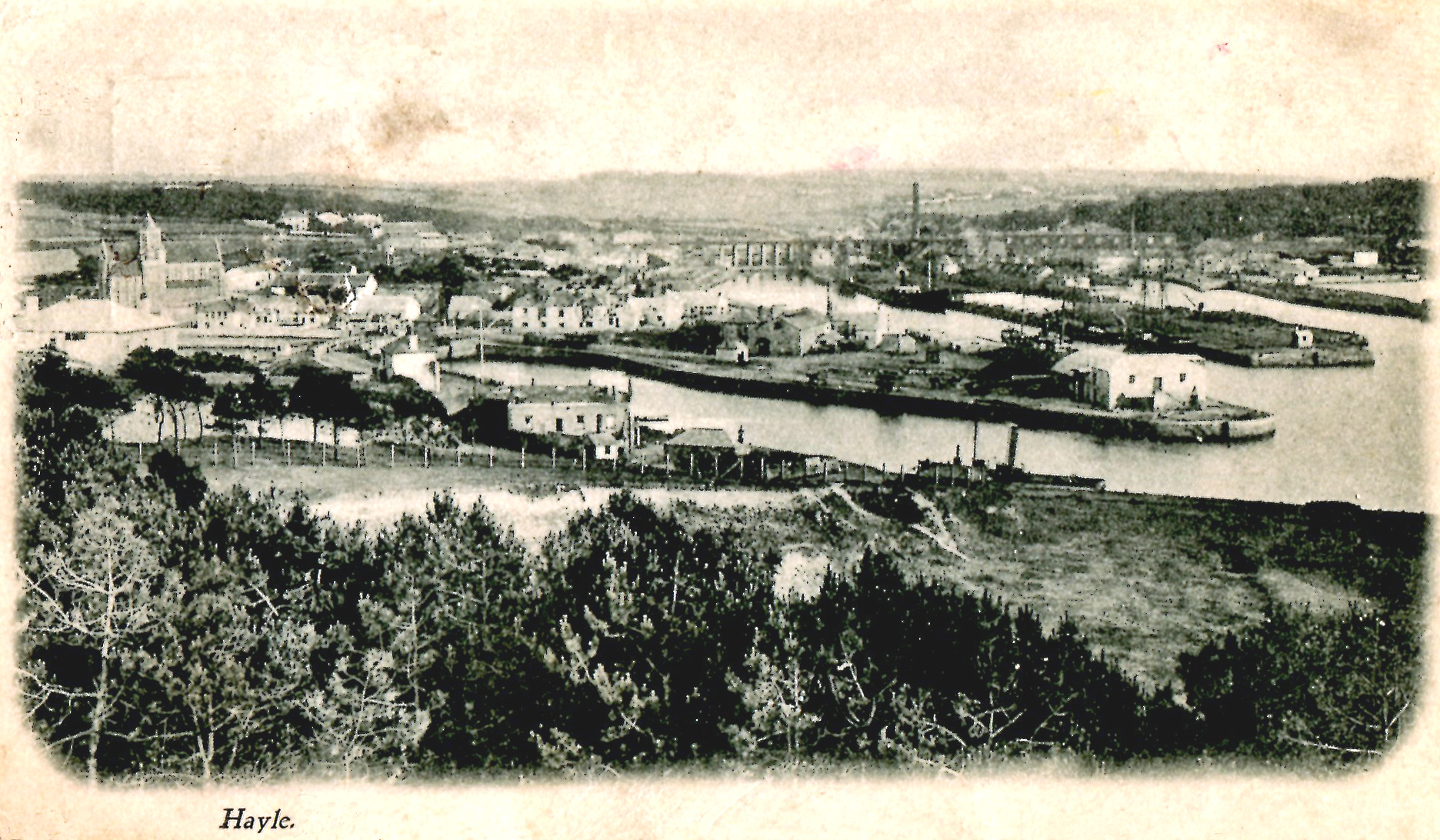
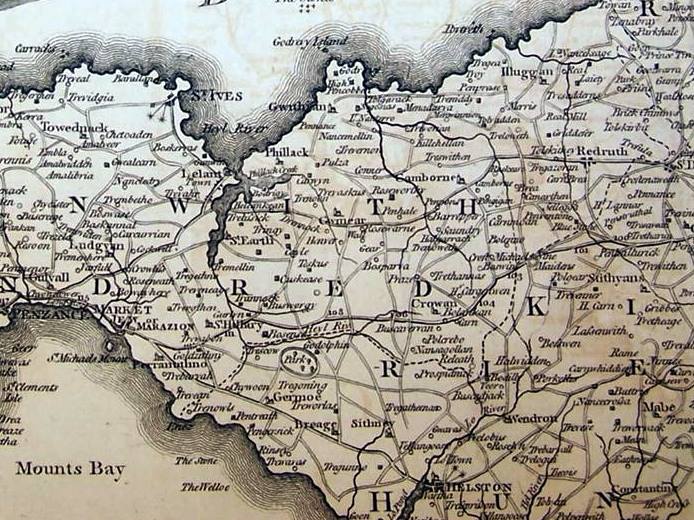
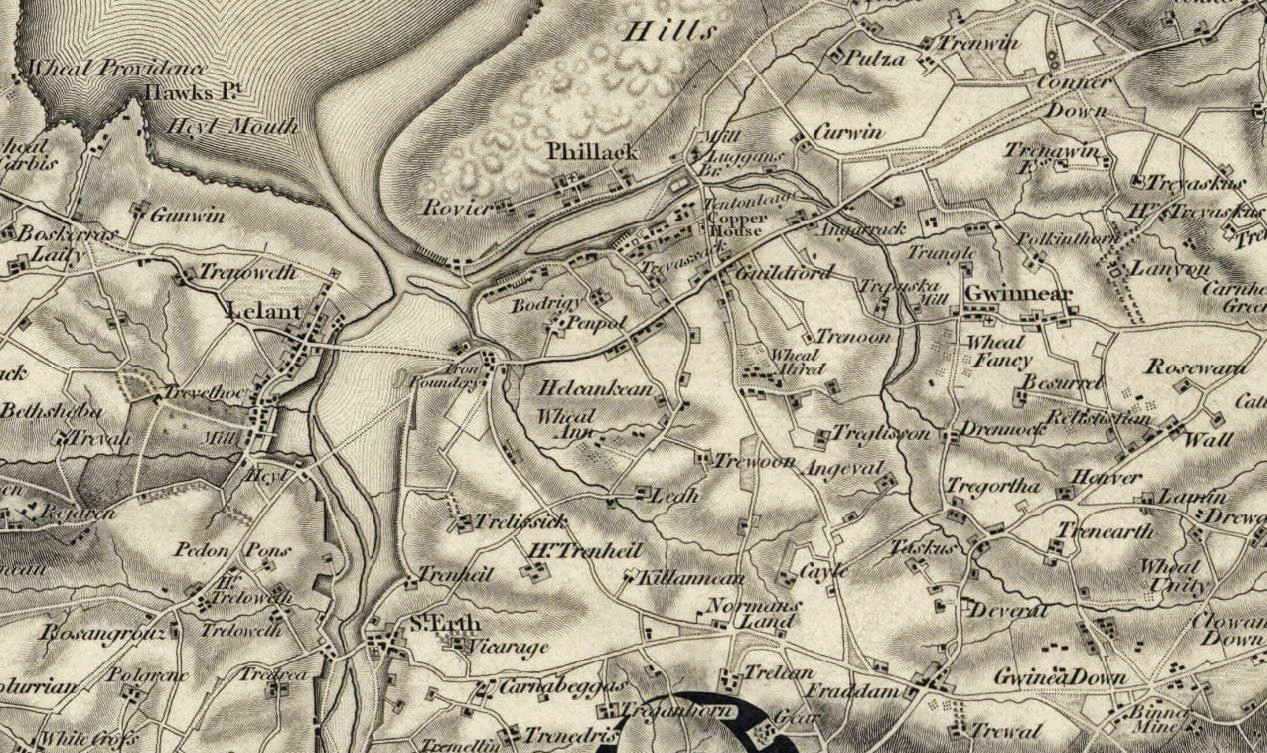
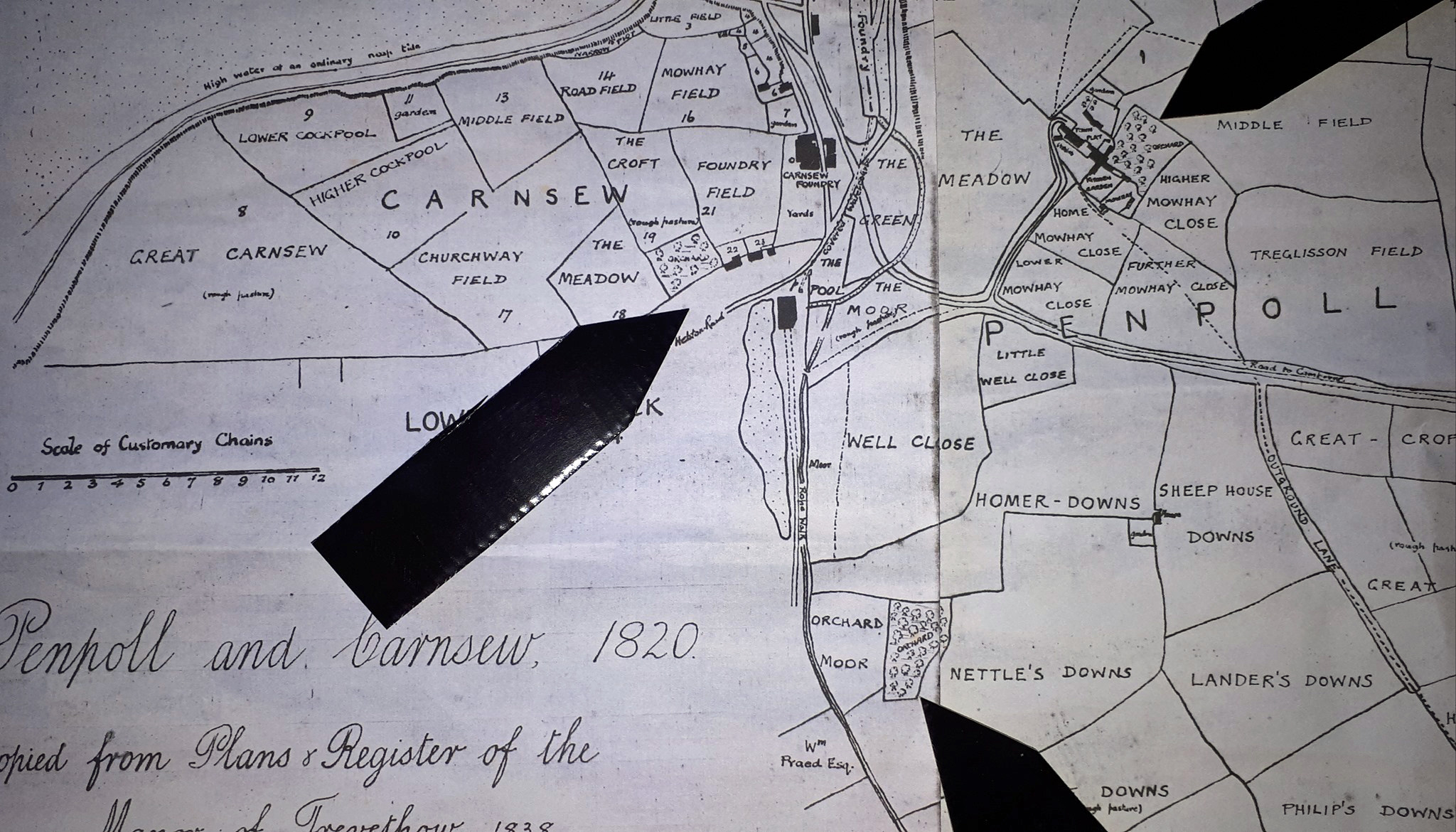
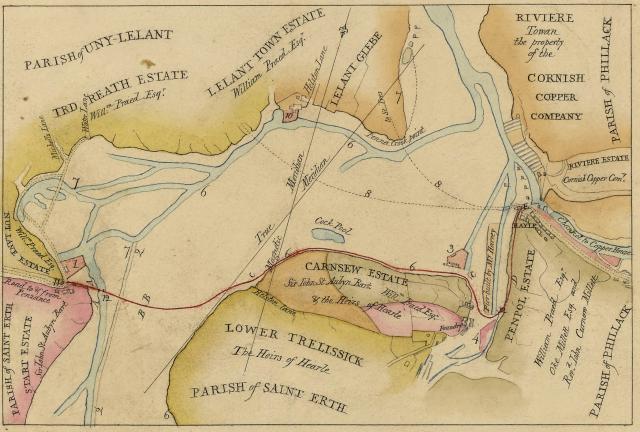
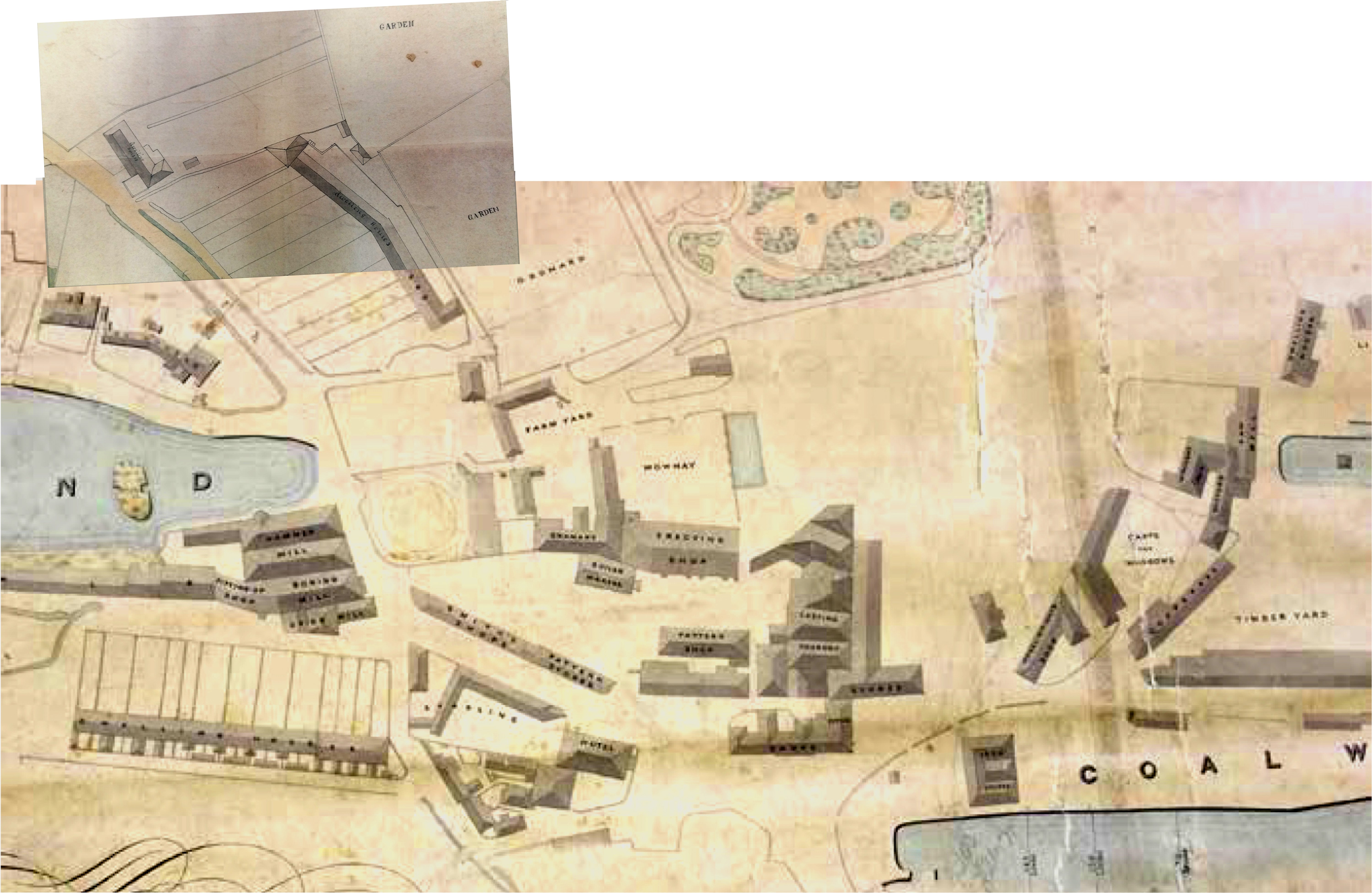
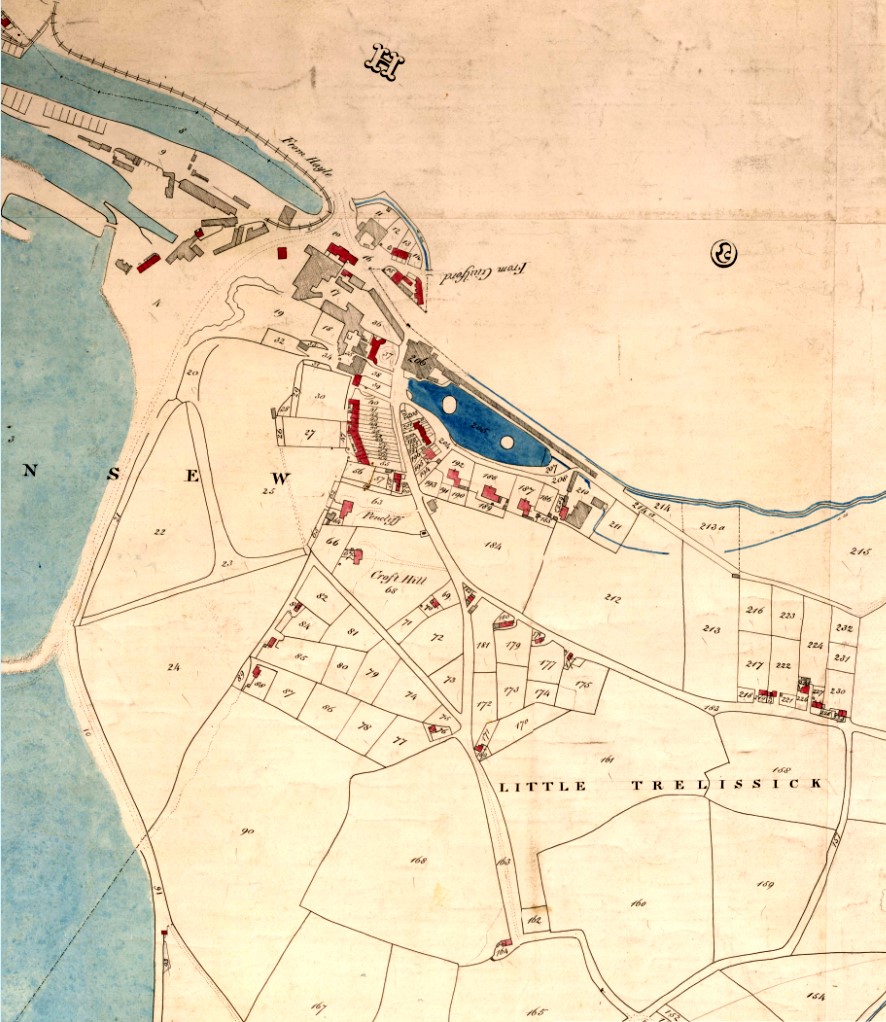
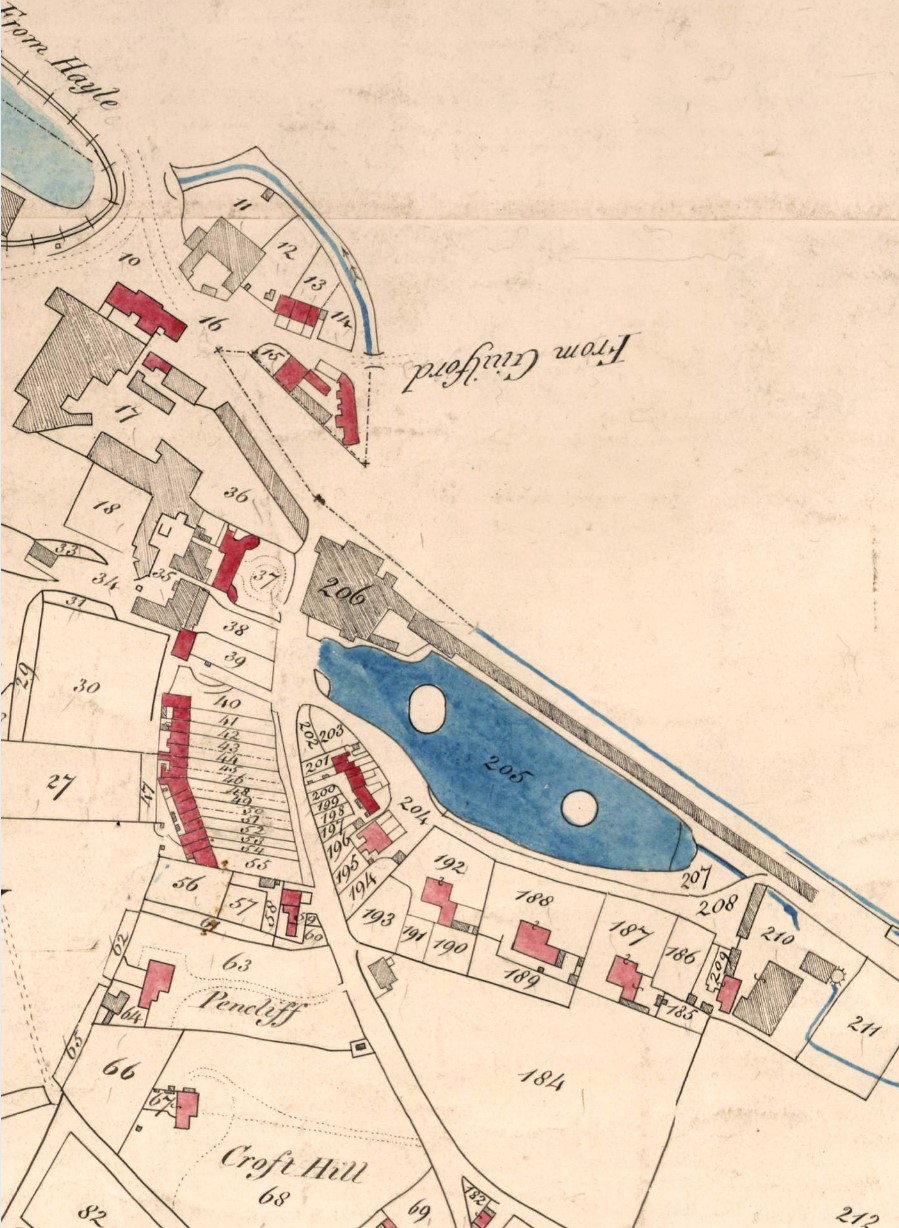
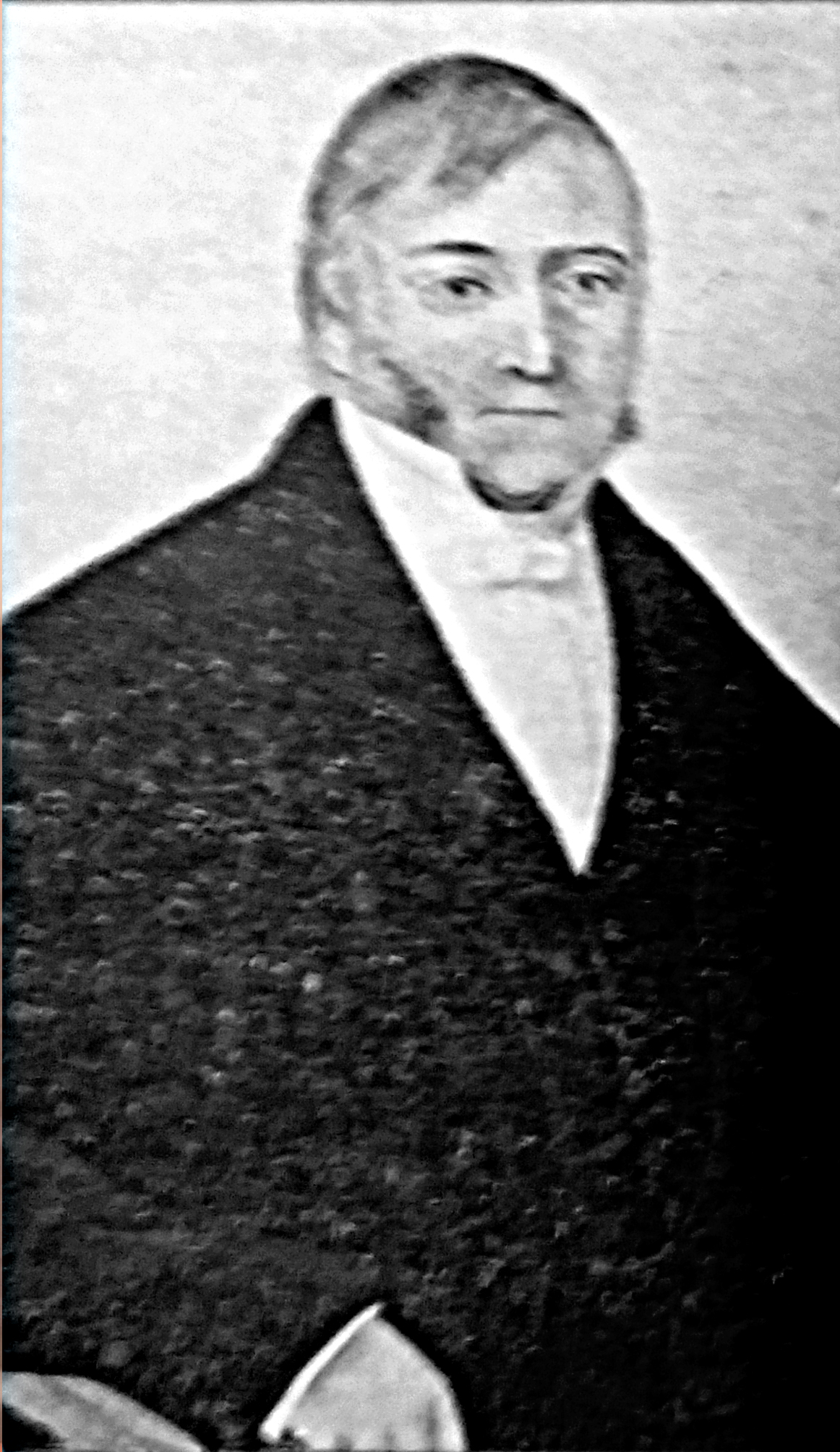
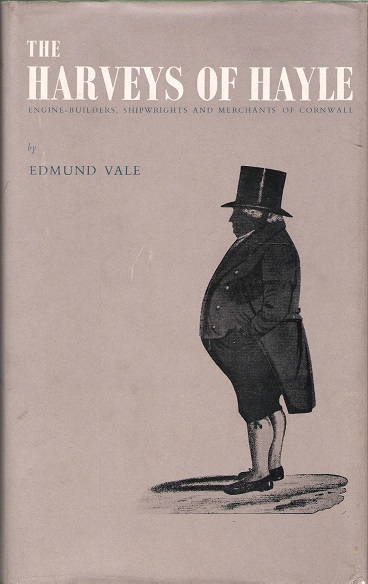
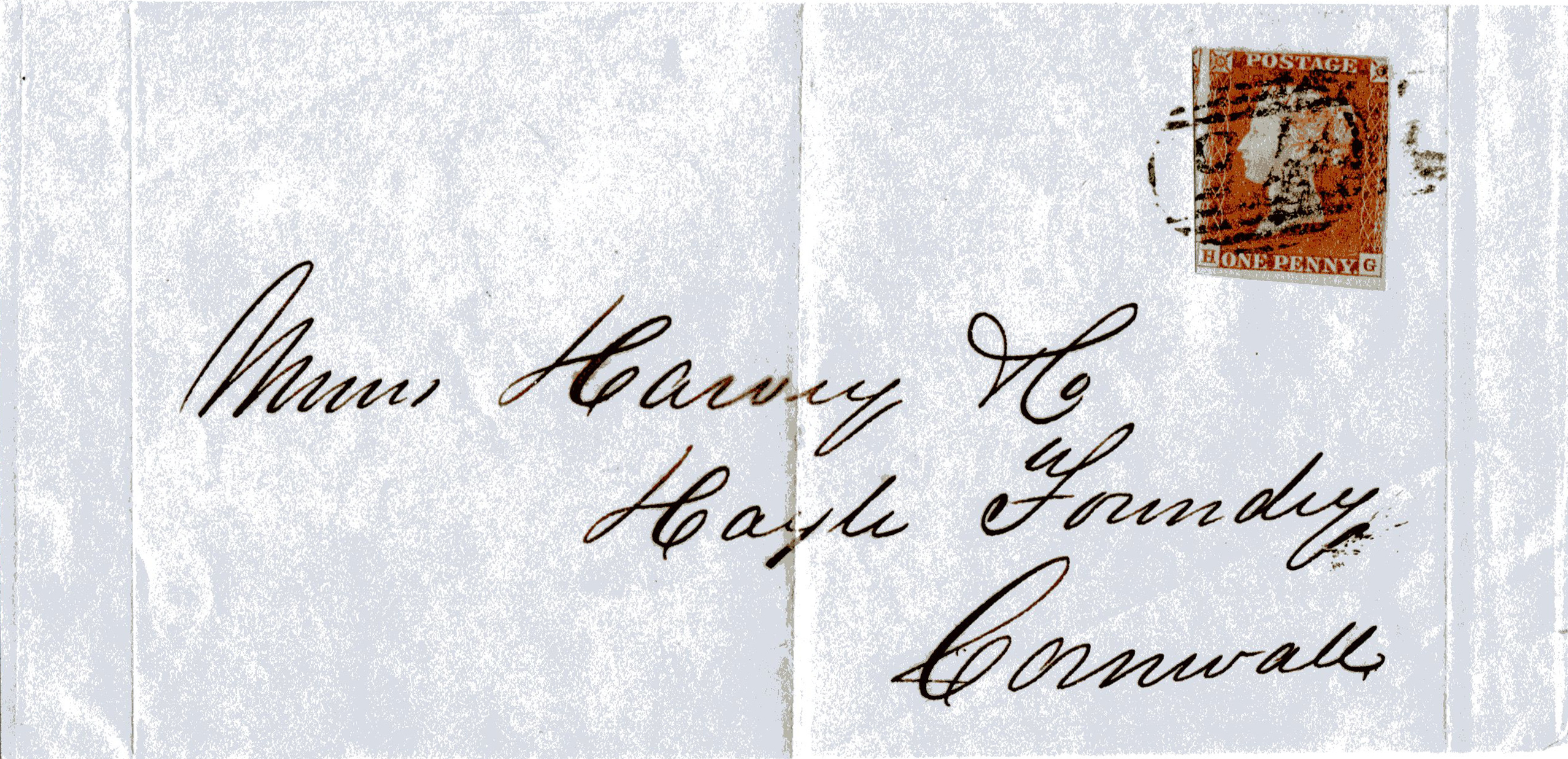
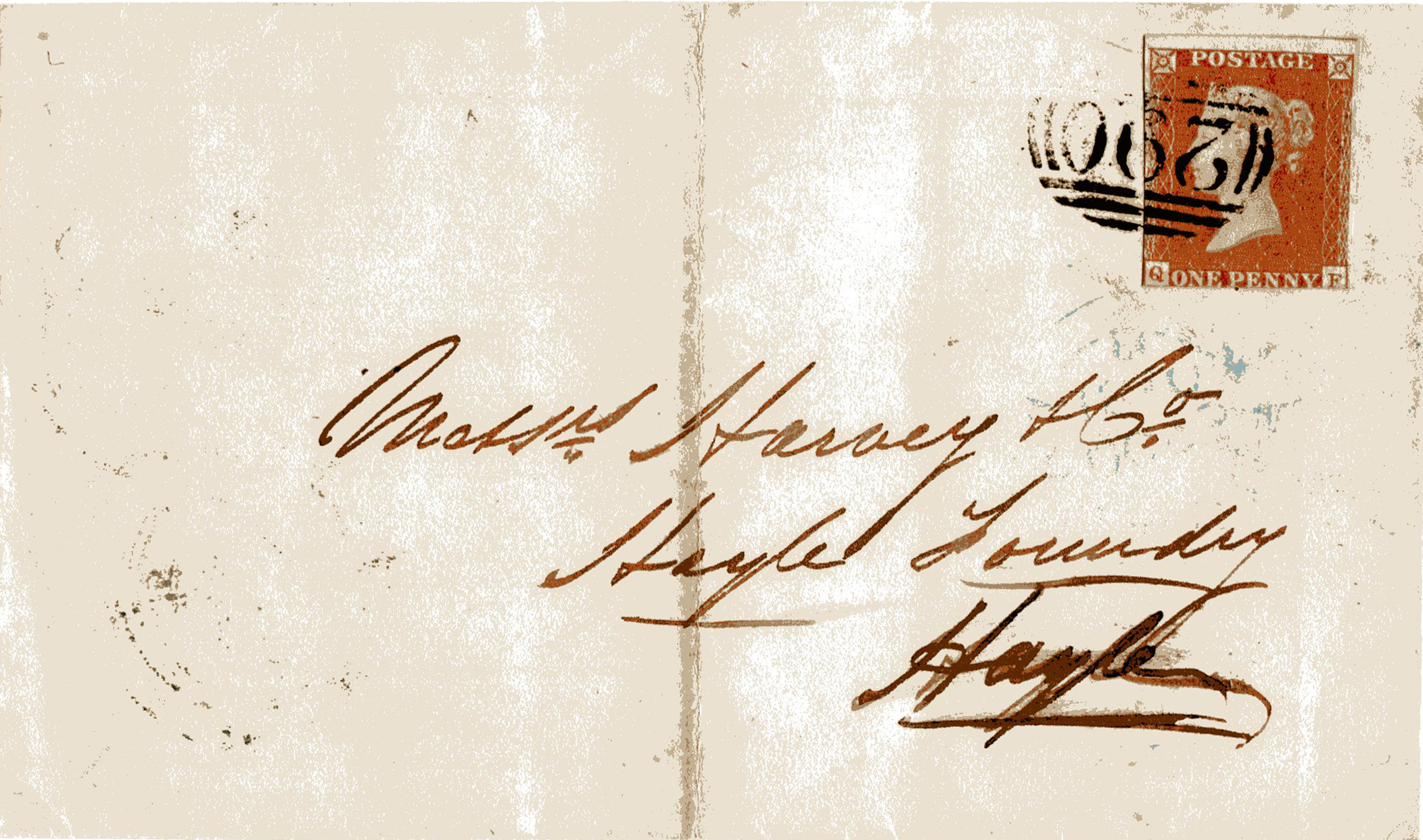
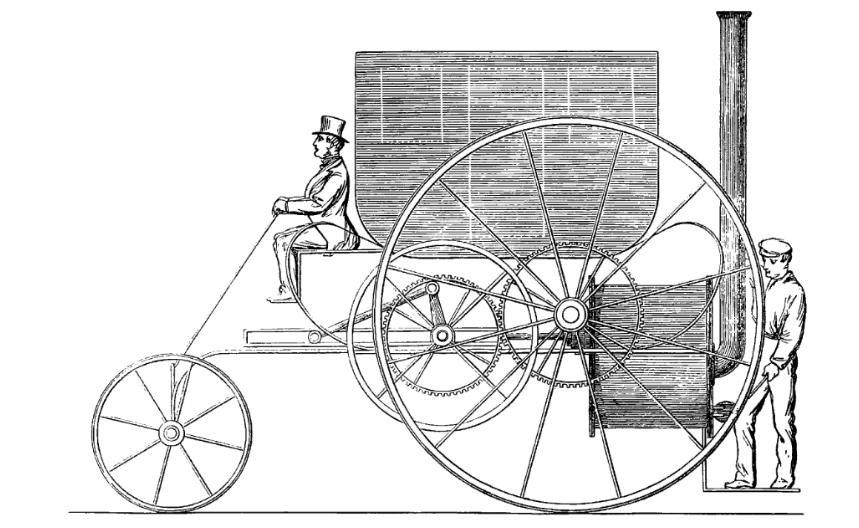
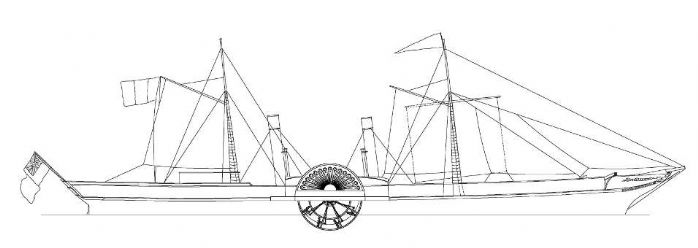
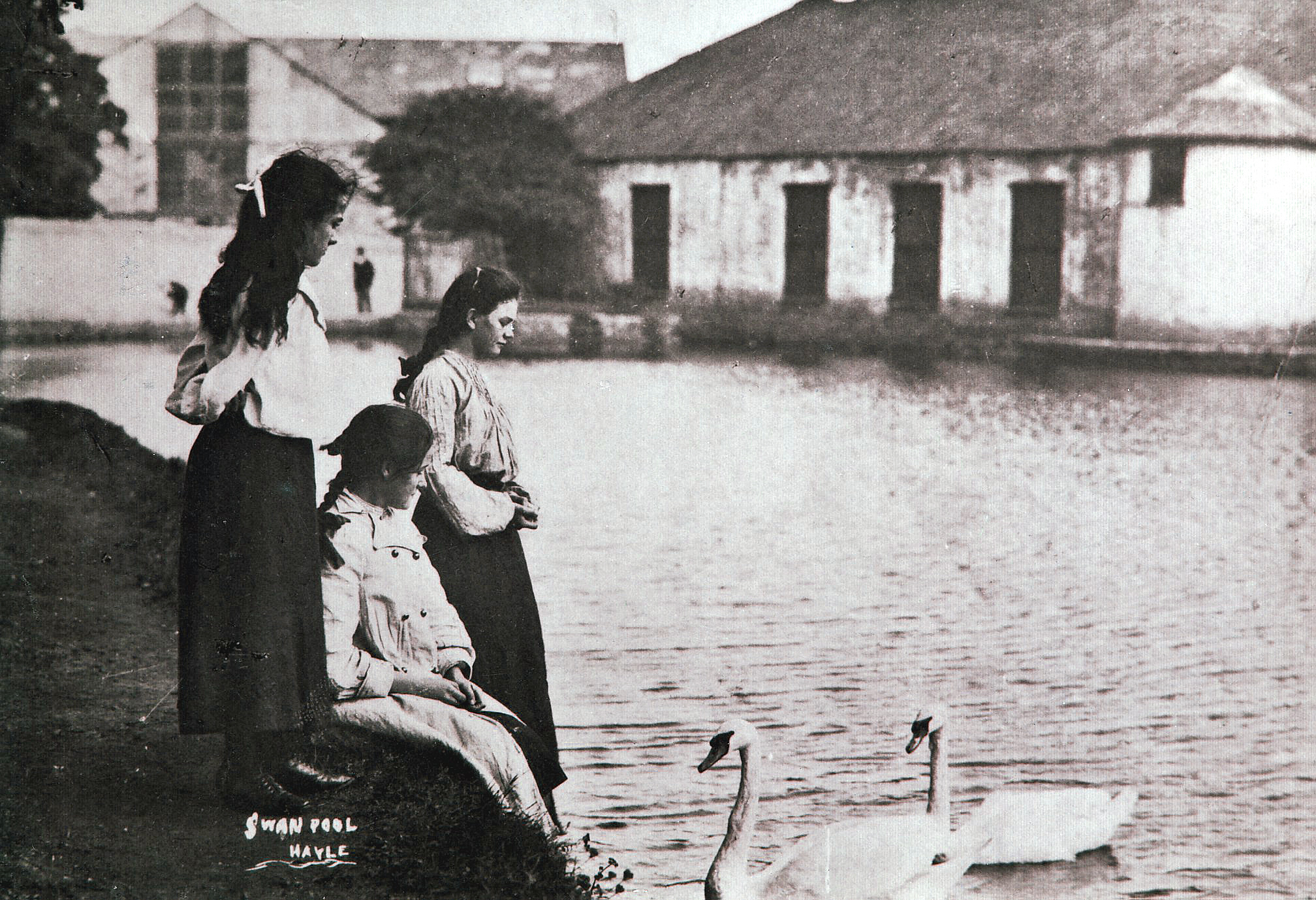
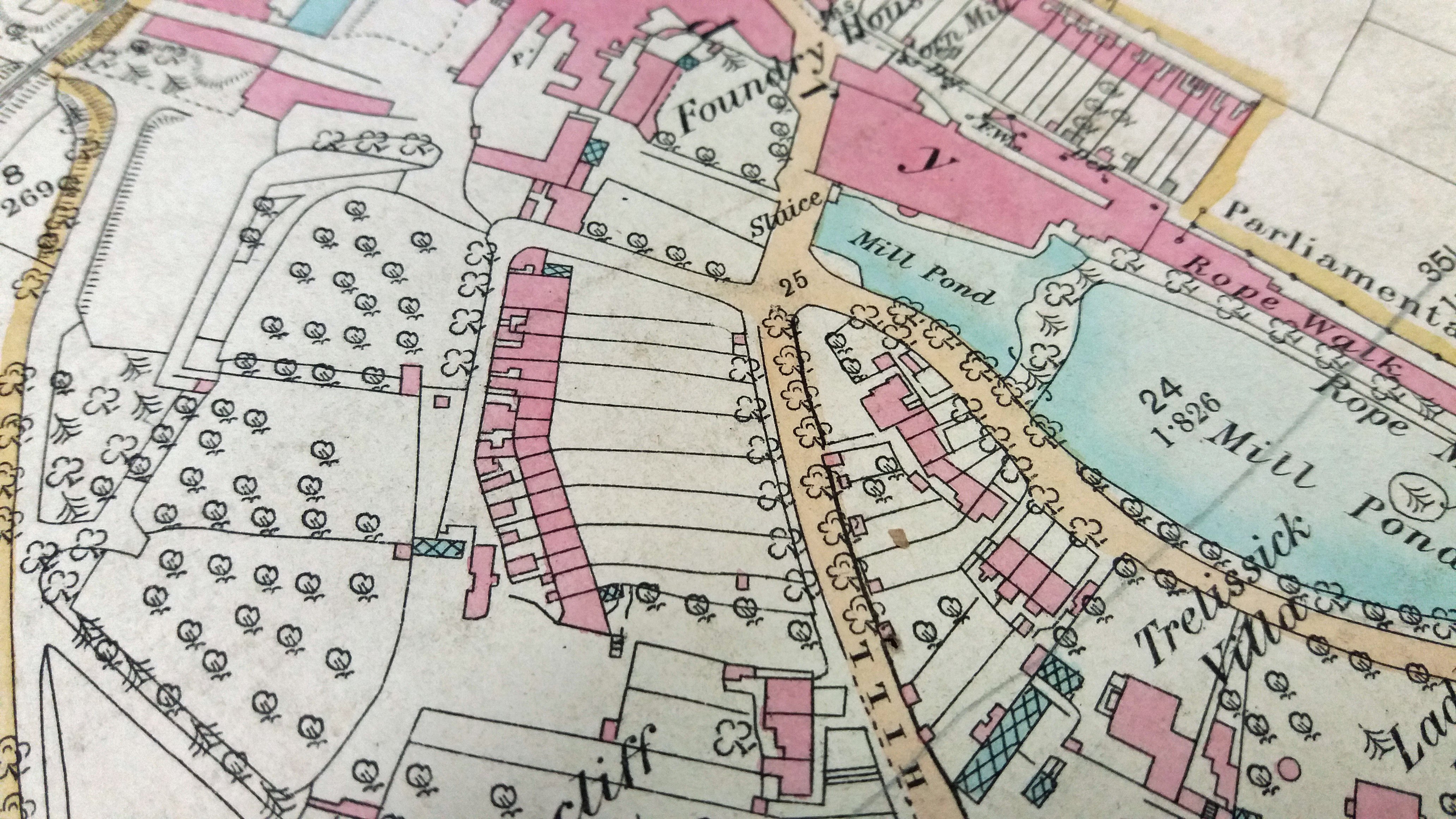
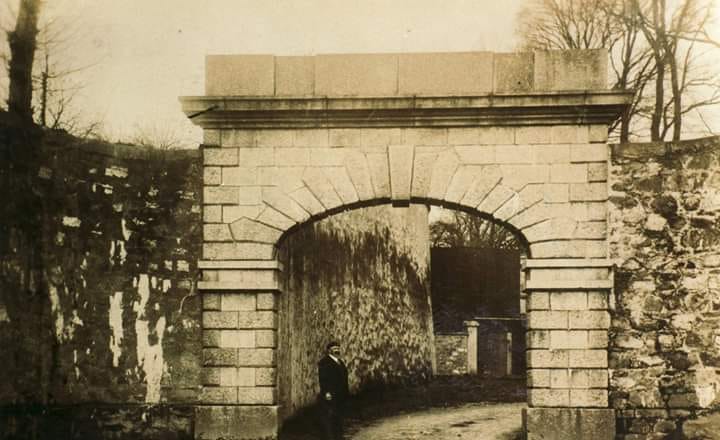
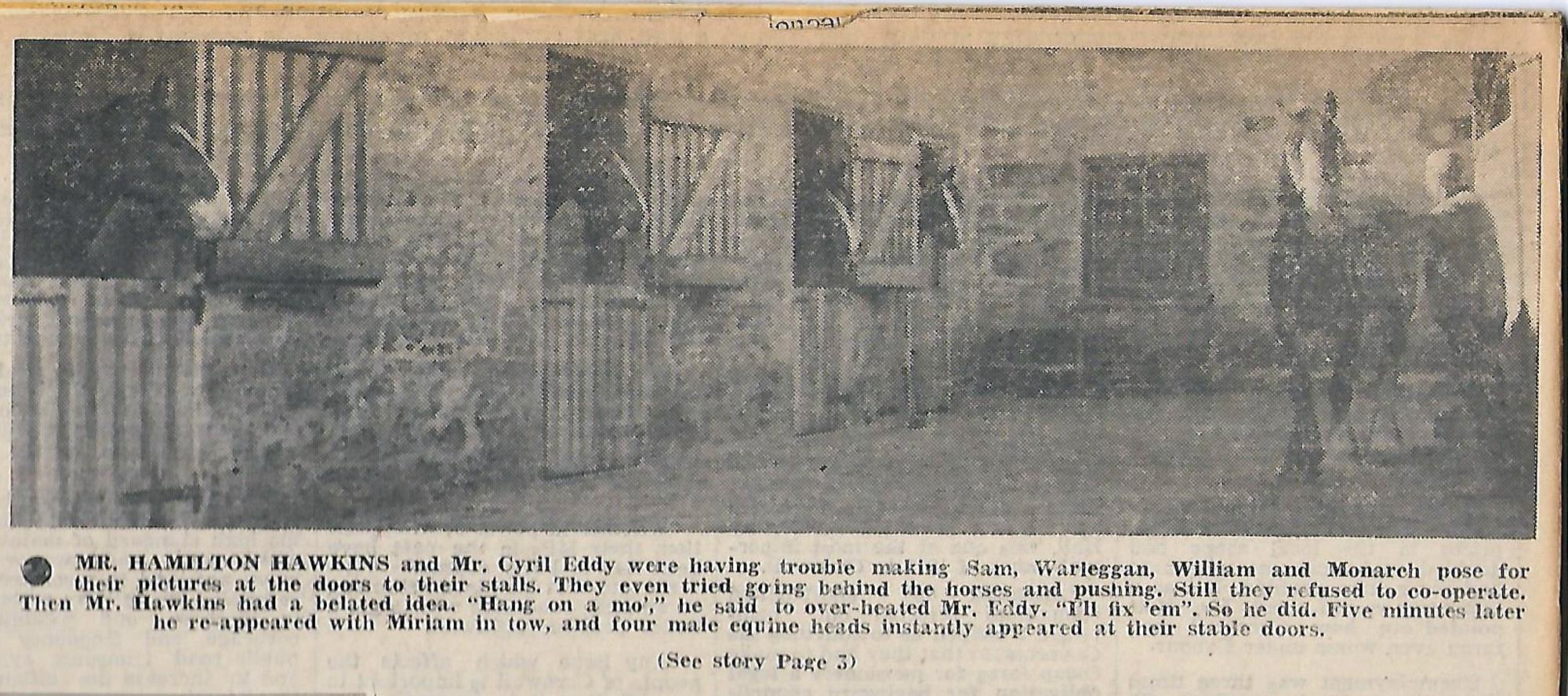 \
\