Towednack parish

churchtown and civil parish in Cornwall; bounded by Zennor in west, Gulval in south, Ludgvan in west and south, and St Ives and Atlantic Ocean in north and east; Towednack parish is a chapelry of Lelant Ancient Parish in Cornwall, other places in parish include: Lady Downs, Nancledra, and Coldharbour

term Location type
Detailed listing
Detailed listing

parish Church since 1902 - St Twinnock; Towednack

Towednack is a chapelry of Lelant Ancient Parish in Cornwall.

Other places in the parish include: Lady Downs, Nancledra, and Coldharbour.
 

Records begin PR BT
Towednack 1676 1597
PR - For more records see Lelant


Wesleyan Methodist is the only identified non-Church of England denomination in Towednack.

Parishes contiguous to Towednack

Place: Towednack
County: Cornwall
Civil Registration District: Penzance
Probate Court: Court of the Bishop (Consistory) of the Archdeaconry of Cornwall
Diocese: Exeter
Rural Deanery: Penwith
Poor Law Union: Penzance
Hundred: Penwith
Province: Canterbury

Towednack (Cornish: Tewydnek)[1][2] is a churchtown and civil parish in Cornwall, England, United Kingdom. The parish is bounded by those of Zennor in the west, Gulval in the south, Ludgvan in the west and south, and St Ives and the Atlantic Ocean in the north and east. The church is about two miles (3 km) from St Ives and six miles (10 km) from Penzance.[3]

Towednack lies within the Cornwall Area of Outstanding Natural Beauty (AONB). Almost a third of Cornwall has AONB designation, with the same status and protection as a National Park.

History

Towednack gold hoard

A Cornish cross in the churchyard
Trevalgan Hill

In December 1931 a hoard of gold ornaments was found in the parish. A sunken lane, known locally as Badger's Lane, leads down from Lady Downs onto the road to Amalveor. Here at SW4794 3759, concealed in an ancient stone hedge, was found a collection of beautiful gold objects, including two twisted neckrings, four armrings and two lengths of unfinished gold rod. One necklet consists of a single twisted strand of gold, and the other consists of three strands loosely twisted together. The gold is very fine, and probably came from Ireland. These ornaments date from the late Bronze Age and they now reside in the British Museum. A replica of the hoard can be seen at the Penlee House Museum in Penzance.[4] In 2007 there were calls in the local Cornish press for the gold hoard to be returned to Cornwall from the British Museum.[citation needed]

Parish church

The church is dedicated to St Tewennocus and did not become parochial until 1902. It was built in the 13th century and has a plain tower. A south aisle was added in the 15th century. The font is of granite, 1720, and stands on a base which is an inverted Norman font.[5] Towednack church is claimed to be the last church in which services were conducted in the Cornish language (in 1678),[citation needed] though the claim is also made for Ludgvan. The parish saint disguised under the name 'Tewennocus' is almost certainly St Winwalo (pet-form: Winnoc), also commemorated at Gunwalloe and Landewednack, as well as Landevennec, Brittany: the place-name being derived from Old Cornish "te-Winnoc" (thy St Winnoc [Winwalo]), now represented as Late Cornish Te Wydnek. The aisle, chancel and nave was restored under the direction of Mr Sedding in 1870 and in 1880 the tower and its roof restored. The cost of the 1880 building work was paid for by money from the weekly offertory. The Cornishman newspaper described the parish thus,[6]

The parish is poor; the people are only a few hundreds; many (probably most) of them are Dissenters who never enter a Church; and the Church itself is small; and yet the offertory has been the means of doing more than Church-rates ever did. When the two broken bells are re-cast (will any rich man do this for poor Towednack?) this parish will process the most thoroughly restored Church in West Cornwall.

One of the bells has the inscription ″Baragwanath″ (wheat bread), a name which was still common in this part of Cornwall at the time of the visit of the Penzance Natural History and Antiquarian Society, in September 1882. They noted, ″a true chancel-arch″, which was described as the church's ″peculiar and rare feature″. Also seen was the benchends and their medallion-portraits of the 1633 bearded and hatted churchwardens. Their inscriptions are ″James Trewhela, warden″ and ″Master Matthew Trenwith, warden″.[7]

Further restoration work was carried out in 1884 with the replacement of the wooden floor of the nave, which was destroyed by dry rot. The new floor was cement, covered with a wooden platform between the benches and red tiles replaced the ″rough″ slate floor of the aisle.[8]

Until 1902 Towednack was a chapelry of Lelant; right of sepulture was only obtained in 1532. The early incised cross on a stone in the porch and the altar slab suggest that the subordination to Lelant only began after the Norman Conquest.[9] The stone in the porch forms a bench; the cross shaft has crosses at both ends.[10] Over the porch is a typical sundial of a wide class of Cornish church dials from 1720. The inscription reads ″Bright Sol and Luna Time and Tide doth hold. Chronodix Humbrale″.[11]

There was a Cornish cross at Tredorwin; it was found in use as a building stone in a cottage at Coldharbour in 1880.[12] It is now in the churchyard (illustrated right).

The Gorsedh Kernow was held in the parish in 1933, and the church was the first to hold a service, in Cornish, in modern times.[13]

Towednack (St. Twinnock)

TOWEDNACK (St. Twinnock), a parish, in the union of Penzance, W. division of the hundred of Penwith and of the county of Cornwall, 3 miles (S. W. by W.) from St. Ives; containing 967 inhabitants. It comprises 2800 acres, of which 1060 are common or waste land. The mine called Wheal Durla is situated here; and in various parts are vast rocks of fine granite. The living is a vicarage, annexed to that of Uny-Lelant: the impropriate tithes have been commuted for £118, and the vicarial for £150. There is a place of worship for Wesleyan Methodists.

Transcribed from A Topographical Dictionary of England, by Samuel Lewis, seventh edition, published 1858.

Towednack Tallying

Discuss topics relating to the parish of Towednack and its families...

Moderator: Zenobia

35 422 Towednak
by donne
Feb 23, 2025 at 8:22pm

Towednack Tallying | Penwith Genealogy

AHP Notes taxonomy

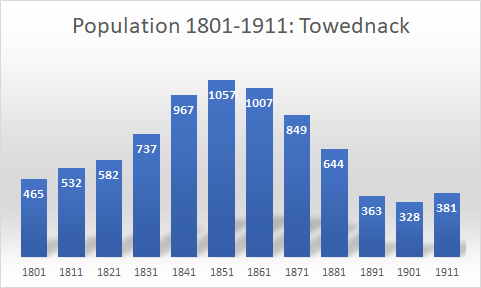
Towednack was an unambiguously mining parish in the middle of the 1800s. Three quarters of the men in the cottages scattered over the downs of this parish south and west of St Ives were employed in the local tin mines. However, when Cornish mining began to catch a cold Towednack suffered a severe bout of flu. Its population plummeted from over 900 in 1861 to fewer than 300 by 1911. This was one of the biggest collapses seen in any Cornish parish over these years and a depopulation on the scale of the contemporary west of Ireland or rural southern Italy.

extract:
Towednack: all gone

https://bernarddeacon.com/2023/03/05/towednack-all-gone/

geofill Leaflet
Off - do not fill

1855 | 11980 | Towednack - Embla Common, Embla Open Common and Embla Common Moor | Cornwall | Cornwall QS/PDA 23

Submitted by webmaster on Sat, 24/02/2024 - 22:58
EXMID : 11980
Year 1855
Category Category not specified or not available
Place Towednack - Embla Common, Embla Open Common and Embla Common Moor
County Cornwall
Library/Record Office reference Cornwall QS/PDA 23
Date map recorded in record office 04.05.1993
Modern form of name Towednack
National grid reference SE481368
Location on Ordnance Survey One-inch NS 351
Valuer William Richards, Penzance, Cornwall, Land Surveyor
Area mapped in acres 43.0
Total acreage of district 2842.033
Nature of coverage X
Map date 1855
Map scale 2
Certification of accuracy or enclosure by agreement Map with certification of accuracy.
Map certification date 20.02.1862
Manuscript or printed Manuscript
Before or after state shown After enclosure, etc, only
Material of map Paper
Dimensions of map in centimetes 119 X 88
Status of map County enrolled copy of map not made under the 1845 Act
Quality of execution of map Good
Lakes and ponds shown by distinctive colour or linework;
Commons or former commons indicated by name;
Landowner or occupier names for locational purposes only;
Road names generally;
Number of map parts 1
Exclusion or inclusion status X
reference term Locations
Extract size
Full extract
Reference
Year Published

1855 | 13742 | Parish | Towednack | Cornwall | PRO MAF 1/571

Submitted by webmaster on Fri, 23/02/2024 - 20:44
EXMID : 13742
Year 1855
Category Parish
Place Towednack
County Cornwall
Library/Record Office reference PRO MAF 1/571
Date map recorded in record office 25.11.1993
Modern form of name Towednack
National grid reference SW481368
Location on Ordnance Survey One-inch NS 351
Valuer William Richards, Penzance, Cornwall, Land Surveyor
Area mapped in acres 43.0
Total acreage of district 2842.033
Nature of coverage X
Map date 1855
Map scale 2
Certification of accuracy or enclosure by agreement Map with certification of accuracy.
Map certification date 20.02.1862
Manuscript or printed Manuscript
Before or after state shown After enclosure, etc, only
Material of map Paper
Dimensions of map in centimetes 121 X 88
Status of map Official copy of map made under the General Enclosure Act, 1845, for Enclosure Commission, now in PRO
Quality of execution of map Good
River and foreshore features direction-of-flow arrows;
Lakes and ponds shown by distinctive colour or linework;
Commons or former commons indicated by name;
Field boundary ownership by asterisks;
Landowner or occupier names for locational purposes only;
Road names generally;
Number of map parts 1
reference term Locations
Extract size
Full extract
Reference
Year Published

Vocabulary name

displayname : {{ user.displayname }} term : {{ content.term }} bundle: {{ content.bundle}} content|without('description'): {{ content|without('description') }} http://history.angarrack.info/admin/structure/taxonomy/manage/location/add
Displaying 1 - 5 of 40
Vocabulary:
Vocabulary:
Vocabulary:
Vocabulary:
Vocabulary: