St Mary's Chapel Penzance

Grade II* listed parish church in Church of England in Penzance, Cornwall; place of worship dates from at least fourteenth century, chapel to parish of Madron - first licensed 1321;  Sir Henry Le Tyes, Knight, Lord of manor of Alverton, founded chantry here in chapel of Our Lady, distant from  Parish Church two miles and a half, endowed with £4 out of lands of said manor, for salary of priest to celebrate there c 1284

Detailed listing
Detailed listing

Sir Henry Le Tyes, Knight, Lord of the manor of Alverton, had founded a chantry here in the chapel of Our Lady, distant from the Parish Church two miles and a half, and endowed it with £4 out of the lands of the said manor, for the salary of a priest to celebrate there. There appears to be some reason for supposing that this chantry was founded about 1284

... we learn that the chapel of St. Mary, or Our Lady, in which a chantry had been founded at an early date, as already mentioned, was licensed on the 15th June, 1397, by Stafford, Bishop of Exeter; possibly in consequence of its having been rebuilt or enlarged, or perhaps simply from being handed over to the public at this time. One Lawrence Trewythgy was then vicar of Madron, to which eventually St. Mary’s became a chapel of ease, but was in modern times destined to be a vicarial church in itself.

...

St Mary's Church, Penzance is a Grade II* listed parish church in the Church of England in Penzance, Cornwall.[1]

History

The site as a place of worship dates from at least the fourteenth century, but was a chapel to the parish of Madron and first licensed in 1321.   The chapel was spared during the Spanish raid in August 1595 because Mass had been celebrated, previously.[2]   Despite enlargements in 1662 to 1672, and 1782 it was severely overcrowded by 1824.   At that time it served a population of circa 7000 and was still a chapel of ease to Madron, two miles inland.[2]

The Reverend Thomas Vyvyan made arrangements to replace it with a new church designed by Charles Hutchens.[3]   The Clerk of Works was John Pope Vibert. £16,000 was raised, mainly from the church's own communion for the new building. A further £800 was raised for the organ, £800 for the bells and £300 for the carillon.[4]   The rebuilt church was consecrated by the Bishop of Exeter, Henry Phillpotts, on 6 September 1836.[5]   A separate parish of Penzance was created in 1871.[1][3]   The churchyard was extended on the southern side in 1883.[6]

A gift of seventeen aloes by Mr Dorrien-Smith of Tresco, Isles of Scilly were planted in the churchyard in 1886.[7]

Arson destroyed the interior of the church in April 1985 and two further arson attempts occurred in November 2018.[1][3][8]

Bells

One of the bells from the previous church was installed in the temporary belfry of St John's Church in 1885. It cost £12 18s 9d when first installed in the steeple of St Mary's in 1667.[9]

The first bell in the present church was inscribed ″PEACE AND GOOD NEIGHBOURHOOD, 1713 JP″ and was moved to St John's Hall in 1865 for use as a fire-bell. Eight new bells were installed that year at a cost of £950. Their size (diameter at mouth), weight and inscriptions are,

  1. 30 inches (760 mm); 6cwt 3qrs 4lbs; ″PEACE AND GOOD NEIGHBOURHOOD A.D. 1865; TAYLOR AND CO., FOUNDERS″,
  2. 30 inches (760 mm); 7cwt 0qrs 10lbs; ″TAYLOR AND CO., FOUNDERS, LOUGHBOROUGH A.D. 1835″,
  3. 34 inches (860 mm); 8cwt 0qrs 10lbs; ″THE GIFT OF PHILIP HEDGELAND M.A., JAMES ALDRINGE DEVENISH, ASSISTANT CURATE, WALTER EDMUNDS, JUN., CHAPELWARDEN, SAMUEL YORK, SIDESMAN A.D. 1865, TAYLOR AND CO., FOUNDERS, LOUGHBOROUGH″,
  4. 30 inches (760 mm); 8cwt 2qrs 10lbs; ″TAYLOR AND CO., FOUNDERS, LOUGHBOROUGH A.D., 1865″,
  5. 38.5 inches (980 mm); 10cwt 1qrs 22lbs; ″THE GIFT OF CAROLINE AND ELIZABETH CATHERINE THOMAS CARNE A.D.1865″,
  6. 40 inches (1,000 mm); 11cwt 1qrs 3lbs; ″TAYLOR AND CO., A.D. 1865″,
  7. 44 inches (1,100 mm); 14cwt 2qrs 17lbs; ″THE GIFT OF THE CORPORATION. FRANCIS BOASE, MAYOR, A.D., 1865, J. TAYLOR AND CO., FOUNDERS, LOUGHBOROUGH, LATE OF OXFORD AND BUCKLAND BREWER, DEVON".
  8. 50 inches (1,300 mm); 20cwt 2qrs 6lbs; ″BOLITHO 1865. J TAYLOR AND CO., FOUNDERS, LOUGHBOROUGH, LEICESTERSHIRE″.[10]

A carillon, costing about £300 and paid for by public subscription, was installed as a memorial to the town clerk and ornithologist, Edward Hearle Rodd. The first to be erected in Cornwall, it was completed by Gillett, Bland & Co on 10 November 1880 and first played at 8.00 pm on Sunday, 28 November 1880. The carillon played fourteen tunes and a tune was played for two weeks, every four hours at 8 am, noon, 4 and 8 pm, midnight and 4 am. The carillon had two barrels and two hammers for each of the bells. The hammers did not interfere with the normal ringing of the eight bells by bell-ringers.[10][11]

Organ

The organ contains casework dating from 1676 originally located in St Mary's Church, Oxford. The organ is by J. W. Walker & Sons Ltd and was moved here from Oxford in 1949. A specification of the organ can be found on the National Pipe Organ Register.[12]

text Snippet

That there was some trace of Penzance, however, in the thirteenth century is certain, for it is recorded, in an inquiry instituted in the second year of the reign of Henry VI. (dated 9th February, 1548-49), that Sir Henry Le Tyes, Knight, Lord of the manor of Alverton, had founded a chantry here in the chapel of Our Lady, distant from the Parish Church two miles and a half, and endowed it with £4 out of the lands of the said manor, for the salary of a priest to celebrate there. There appears to be some reason for supposing that this chantry was founded about 1284. Tradition also speaks of a castle which was erected by one of the Baronial family of Le Tyes, for the defence of the town, and there has been some controversy as to its probable whereabouts, but taking into consideration the style of warfare of those times, no more commanding or more suitable position can be conceived for such a building than the site of the present St. Mary’s church, which has succeeded the chapel of Our Lady of ancient days. At the Quay, a little to the south-east of this spot, is a small thoroughfare called Barbican Lane, and the existence of such a name is suggestive of there having been a fortification of some importance in the vicinity. The modern battery, which is at no great distance, and was built in 1740, can scarcely have given rise to the appellation, which has been in use from time immemorial. The fact of the chantry having been established here by Sir Henry, has in the opinion of some favoured the supposition of a castle having existed at or near the same place; the former probably being included in the precincts of the latter. The name Buriton, too, which is more or less connected with Penzance, has been adduced as a further proof, since it might be understood to mean Castle town. The term “Buriton alias Penzance” has been said by Polwhele1 to occur in the Valor Ecclesiasticus of Henry VIII., but this is questionable. “Buriton” certainly will be found there, but it refers to a rectory in the diocese of Winchester. “Buriton alias Penzance” does occur, however, in a comparatively modern document, viz.—the deed of consecration of St. Mary’s chapel, in 1680, subsequently to the town having been constituted a borough, and it has even been suggested that the word is a mere corruption of Borough town; but there is a dash of antiquity and a flavour of romance about the name, to which doubtless it owes much of the vitality it still possesses.

...

... we learn that the chapel of St. Mary, or Our Lady, in which a chantry had been founded at an early date, as already mentioned, was licensed on the 15th June, 1397, by Stafford, Bishop of Exeter; possibly in consequence of its having been rebuilt or enlarged, or perhaps simply from being handed over to the public at this time. One Lawrence Trewythgy was then vicar of Madron, to which eventually St. Mary’s became a chapel of ease, but was in modern times destined to be a vicarial church in itself.

West Penwith Resources - Penzance: Past and Present (Millett 1)

The first recorded mention of a Christian place of worship on the site of St Mary’s is in the fourteenth century when it was established that Henry de Tyes held the Manor of Alverton plus a chapel where services were held, sited just over 2 miles from the Madron Parish Church. This was the Chapel of Our Lady which was on the site of the present church. Henry de Tyes also endowed a chantry in the chapel.

...

A New Church for Penzance | On this Day | Penwith Local History Group | Penzance, Cornwall, UK

geofill Leaflet
Off - do not fill

Penzance in Context Really useful maps from Rick Parsons

Submitted by webmaster on Sat, 20/04/2024 - 20:16

Penzance in Context

Really useful maps from Rick Parsons

This new map is drawn as accurately as possible (but freehand) with reference to the 1" Ordnance Survey Land’s End sheet 151 revised 1905. The original has the advantage of showing (civil) parish boundaries and being more in tune with your research than modern maps. The features shown are limited to those useful for family history research; at present this is only the coastline, parish boundaries, largish roads and churches. I have had to draw some items with a little imagination. The last half mile up country is off the boundary of the original sheet; the boundaries of the modern parishes (Carbis Bay, Halsetown, Newlyn St. Peter and Pendeen) were not shown; the streets in Penzance were far too complex, this will be the subject of a future map; the National Grid was not defined until 1938, I have added the 5km lines on the main map and 1km lines on the detailed parish maps.

The parish names look like links. One day they will all be connected to more detailed information and parish maps. Only some of them work at the moment [*watch this space*]. These larger scale maps show settlements, mines, lesser roads and the 1km grid lines. I am open to suggestions for useful additions.

Published Maps

Gazetteer


Parish map of West PenwithSt. Buryan parishGulval parishSt. Ives parishSt. Just in Penwith parishLelant parishSt. Levan parishLudgvan parishMadron parishMorvah parishPaul parishPenzanceSancreed parishSennen parishTowednack parishZennor parish

[St. Buryan] [Gulval] [St. Ives] [St. Just in Penwith] [Lelant] [St. Levan] [Ludgvan] [Madron] [Morvah] [Paul] [Penzance] [Sancreed] [Sennen] [Towednack] [Zennor]

©1999–2003 (last updated 27 Mar 2003) Rick Parsons, Bristol, England


Image
Parish Map - drawn as accurately as possible (but freehand) with reference to the 1" Ordnance Survey Land’s End sheet 151 revised 1905
image Credit old
©1999–2003 (last updated 27 Mar 2003) Rick Parsons, Bristol, England; Please feel free to copy bt not for gain or reward
The Town in Context - Parishes Map 1905
reference term Locations
Transcription credit
West Penwith Resources Transcription
term Sources
Reference

A Short History of Piracy: The Barbary Corsairs in Context | Author’s Note | Crossed Bones

Submitted by webmaster on Fri, 01/12/2023 - 11:04
Subtitle
A Short History of Piracy: The Barbary Corsairs in Context
Series Title
Year

Author’s Note

  Crossed Bones is a work of fiction, though it is based on historical fact.

  Seventeenth- and eighteenth-century Barbary corsair raids on the south coasts of England have been increasingly well documented over the past few years, although when I grew up in Cornwall they were never mentioned, and most people are still ignorant of this particular bloody chapter in England’s history. The corsairs of Salé, known in England as the Sallee Rovers, have a particularly fascinating history. Driven by religious fervour, they plundered far and wide to the extent that one corsair fleet

Author’s Note

  Crossed Bones is a work of fiction, though it is based on historical fact.

  Seventeenth- and eighteenth-century Barbary corsair raids on the south coasts of England have been increasingly well documented over the past few years, although when I grew up in Cornwall they were never mentioned, and most people are still ignorant of this particular bloody chapter in England’s history. The corsairs of Salé, known in England as the Sallee Rovers, have a particularly fascinating history. Driven by religious fervour, they plundered far and wide to the extent that one corsair fleet was able to raise its skull-and-crossbones flag over Lundy Island in the Bristol Channel in the early summer of 1625, from which they launched innumerable raids on south-west shipping and coastal towns.

  The historical document prefacing this novel, that is, the letter from the Mayor of Plymouth to the new King’s Privy Council in the spring of 1625, warning of the likelihood not only of corsair raids (which had become a regular summer threat to shipping) but for the first time of attacks on coastal settlements, does not, in the usual bureaucratic fashion, appear to have resulted in raised security.

  The attack I have described on the church in Penzance is based on a reference in the state papers to an event in July 1625 when ‘sixtie men, women and children were taken from the church of Munnigesca in Mounts Bay’ (my italics). No one to this day is sure what ‘Munnigesca’ refers to. Some have speculated that it is the church on St Michael’s Mount, but I cannot believe that to be true, since it would have meant that Sir Arthur Harris, who was the Master of the Mount at the time, and his family would have been among those sixty captives, and they never suffered such a fate. Sir Arthur died at home in 1628 at Kenegie Manor; his last will and testament is included in the local parish papers. The only two large-enough settlements likely to generate such a congregation at the time, according to Carew and Leland, would have been Marazion, then known as Market-Jew (a corruption of Marghasewe), or Penzance. I decided on the church at Penzance, which would have stood where St Mary’s does today – on a promontory overlooking the bay. It would have been clearly seen from sea, thus presenting an attractive target for attack. It is curious that the Mount did not see and fire upon the corsairs (there is no mention in the CSP of any attempted defence); but Sir Arthur Harris had indeed been lobbying for funds to rearm the Mount for several years.

  The smuggling, however, of four cannon destined for the rearmament of Pendennis and St Michael’s Mount by Sir John Killigrew to the Sidi al-Ayyachi is my own invention.

  I am no great expert on embroidery; however, I have researched the methods and styles of the time as well as I can, and am greatly indebted to the works of Caroline Stone, who knows a great deal more about the embroidery of North Africa, and specifically Morocco, than I ever shall.

  It was a great disappointment to me to discover that no records of the captives taken by the Sallee Rovers in 1625 remain in Morocco. A number of first-hand accounts of English captives’ misfortunes and experiences have, however, survived; although few from as early as 1625 and none by a woman of that time. I have read many of these accounts and borrowed details here and there for authenticity; though taken with a healthy pinch of salt, since the temptation for captives to embellish their hardships with lurid detail was great, commercial pressures in the seventeenth century being all too similar to those of the twenty-first.

  I have listed below some of the key texts that proved invaluable to me in my research. I must also thank a number of individuals, without whom I could never have written this novel. First, my mother, for reminding me of this long-buried family legend; secondly, my climbing partner Bruce Kerry, who accompanied me on my first and crucial research visit to Morocco; thirdly, Emma Coode, friend and colleague, who read the text chapter by chapter as I wrote and provided me with both encouragement and the perfect audience. I must also thank my wonderful agents Danny Baror and Russell Galen for their passionate encouragement, my publishers Venetia Butterfield and Allison McCabe for their invaluable support and suggestions, and Jenny Dean and Donna Poppy for their meticulous help in honing and polishing the text. Finally, and most importantly, I want to thank my husband, Abdellatif Bakrim, who has been the most extraordinary source of Berber, Arabic and Moroccan history, culture and language; he has helped me with the translation of foreign texts and provided me with a sounding board for all the Moroccan material. He was also, before I knew him well, the inspiration for the raïs. Since I have come to know him, I cannot imagine him making a ruthless corsair captain or zealot; and for that I am profoundly grateful.
 

A Short History of Piracy: The Barbary Corsairs in Context

  I don’t pretend to be a historian, and so my research for this novel has had to be rather more thorough than if I were already an expert. I spent over two years researching the historical background to Crossed Bones before starting to write the story, and it proved to be a fascinating and eye-opening task. I will attempt to skim a little of the cream off the top of that research here, in order to place the Barbary corsairs in some sort of context, but if you are interested in further detail then please come and visit the Crossed Bones website, www.crossedbones.co.uk.

  Ever since men took to the sea in ships there has been piracy. Sea robbers menaced the trade routes of ancient Greece more than two thousand years ago. Phoenician traders armed themselves against pirates; Roman ships were robbed of their cargoes of olive oil, wine and grain. The Vikings perfected the art, pillaging both sea lanes and coastal settlements. Piracy flourished throughout the medieval period, as well as throughout the fifteenth and sixteenth centuries, finally peaking in the ‘golden age’ of the seventeenth and eighteenth centuries. Wherever there were trade routes and goods and gold to be plundered, there were pirates. Buccaneers were the scourge of Spanish shipping in the Caribbean; and privateers were granted letters of marque by their governments, that turned them into official state pirates. The coffers of Queen Elizabeth I were regularly swelled by the predations upon Spanish treasure ships of such privateers as Sir Francis Drake.

  However, not all piracy was motivated purely by human greed, either personal or royal. For many, piracy was vindicated by religion, and its practitioners were termed ‘corsairs’, rather than pirates, a word that etymologically derives from the Italian word corso, meaning ‘chase’, a corsair being ‘one who gives chase’. Maltese corsairs were granted licence to attack the ships of the Muslim Turks by the Christian Knights Templar, the Knights of St John. And, conversely, the Barbary corsairs, operating out of the North African states of Algiers, Tunis, Tripoli and Morocco, were in turn authorized by their rulers to attack the ships of Christian countries, to kill the infidels and render their goods unto Islam. Barbary corsairs, therefore, were seen as religious warriors and defenders of their faith; they were referred to as al-ghuzat, which was the term used to denote those who had fought beside the Prophet Mohammad.

  The predations of the corsairs operating out of Rabat-Salé, in northern Morocco, were further fuelled by revenge.

  The Moors – originally Berbers from Morocco – had occupied Spain since their general, Tariq ibn-Ziyad, conquered the Iberian peninsula in AD 711. Over the centuries they had become concentrated in Granada (leaving behind them such exquisite creations as the Alhambra palace and hundreds of mosques and public baths). But the rising tide of Catholicism in the sixteenth century resulted in a steady exodus of Moors back to their native North Africa, largely as a result of religious persecution. The crux of this pogrom occurred around 1609, when the Catholic King of Spain, Philip III, decided to expel definitively all those of Moorish extraction from Spanish soil, no matter how long they had been established there, no matter whether they had at any stage converted from Islam to Catholicism. The expulsion was both abrupt and violent, involving the worst brutalities of the Spanish Inquisition.

  Over one million Moors were expelled, with many fetching up on the bleak northern coast of North Africa and in the ruined city of Rabat, a desolate place previously abandoned on account of ‘wild beasts’. Some were now reduced to penury; but some had anticipated the expulsion decrees and managed to smuggle their worldly wealth out of Spain with them. These latter were the Hornacheros – from Hornachos in Estremadura – and they also brought with them a fighting spirit, a ruthless instinct for independence and a determination to re-establish their fortunes and wreak vengeance on those who had insulted and maltreated them.

  They refortified the ruined city of Sale (including the beautiful and now-tranquil Kasbah des Oudaias, which bewitched me on my research trips to Rabat), vowing revenge on Christendom, and specifically on Spain. From their new base, they forged alliances with the pirates of Algiers and Tunis, who had been preying on Christian shipping in the Mediterranean for over a century. All manner of brigands and cut-throats – many of them Europeans turned Turk (having expeditiously converted to Islam) – converged upon New Salé to train the Hornacheros and other expelled Moors in the art of piracy. The refugees learned fast, driven by righteous indignation and jihadi fury. In 1617 a Dutch captain wrote ‘a year ago the Moors didn’t have a single vessel; now they own a quarter of the sea: they will become extremely powerful if we do not take care.’ How prescient he was.
 

The Salé corsairs ranged far and wide, their ambitions limited only by their technology. Galleys and xebecs, the small, shallow-drafted vessels used to raid shipping in the calmer seas of the Mediterranean, soon gave way to the big square-riggers, mastery of which enabled the corsairs to raid along the Atlantic coasts of Spain, Portugal, France and England, and further to Newfoundland, Ireland and Iceland. At first it was only cargoes that were plundered; from 1620 to 1630 Cornwall and Devon lost a fifth of their shipping to corsair attacks. But it was soon realized that the taking of slaves was a far more lucrative option, and during that same period more than a thousand Christians were taken captive. The raid on the church in Mount’s Bay, which forms the basis for Crossed Bones, was the first recorded attack in which captives were taken from English shores.

  From 1627 to 1641 the Sale corsairs had absolute independence, paying neither tithes nor taxes to the Sultan and ploughing all their riches back into what was rapidly becoming a significant business. Their audacity was extraordinary: they established a base of operations on Lundy Island in the Bristol Channel, raising the pirate skull and crossbones over the island and launching raids on the West Country coast. In a single day in 1636 they were to raid two hundred slaves from Plymouth; soon more than three thousand Christian sailors were held in the prisons of Sale. Fewer than a quarter of captives returned home. Many died in transit or in the mazmorras or on war-galleys, from disease or other hard treatment. Others turned Turk and stayed to make their fortunes, often adding their expertise to pirate crews.

  The European maritime nations had no answer to such rapaciousness: the corsairs were swift, ruthless and expert. The West’s attitude to the corsairs, however, could be duplicitous. In public, the predations of the corsairs were loudly deplored, and action was called for in terms that echo modern calls for a war on terror. In private, it was conceded that the larger European powers gained considerable commercial advantage from the corsairs’ actions, since the maritime interests of smaller nations were significantly damaged by such attacks. At one time or another England, France and Holland all made treaties with the Barbary states to gain immunity for their own merchant fleets in their waters. It was a shameful period for England in particular, which until this time had boasted of ruling the seas – a period soon to be conveniently forgotten when history books were written.

  From such a synopsis one might suppose the North African slave trade to be an especially vicious anomaly; but it is worth remembering that the institution of slavery extends back before recorded history and that most of the world’s civilizations had their foundations sunk deep in such human misery. Slavery was well established in Homer’s Greece; the Roman Empire thrived on its slave trade; references to slavery appear in the ancient Babylonian Code of Hammurabi; and slave labour was used in Egypt to build temples and pyramids.

  Slavery went through a particularly savage revolution in the fifteenth and sixteenth centuries. Explorations of the African coast by Portuguese navigators resulted in the taking of thousands upon thousands of African slaves, and for nearly five centuries the predations of slave raiders along the coasts of Africa generated a lucrative and important business carried out with terrible brutality. Yet it was not in Europe that African slavery was eventually to render up the greatest profit but in the Americas. The British, Dutch, French, Spanish and Portuguese all engaged in this trade. Indeed, British ‘heroes’ John Hawkins and his cousin Francis Drake made three trips to Guinea and Sierra Leone, enslaving between them 1,200 and 1,400 Africans. Hawkins (later to be knighted following the defeat of the Spanish Armada) made such a huge profit from selling slaves that Queen Elizabeth I granted him a special coat of arms bearing the image of a bound African slave.

  Which all goes to show that history is a morally murky business. I have tried to be fair-minded in my portrayal of events and characters in Crossed Bones and as faithful as I can be to what pass for historical facts; but four hundred years away from those times, who can know where the real truth lies? In the end we are always left with more questions than answers, and in the gaps between knowledge and ignorance lies plenty of space in which a storyteller may weave a lively tale.

  Source Material and Further Reading

  •   The Tragicall Life and Death of Muley Abdala Melek, John Harrison (Delph, 1633)
  •   The Crescent and the Rose, Samuel C. Chew (New York, 1937)
  •   Les Corsaires de Salé, Roger Coindreau (Paris, 1948)
  •   The Lands of Barbary, Geoffrey Furlong (London, 1966)
  •   The Barbary Slaves, Stephen Clissold (London, 1977)
  •   The Embroideries of North Africa, Caroline Stone (London, 1985)
  •   Corsari nel Mediterraneo, Salvatore Bono (Milan, 1993)
  •   Nine Parts of Desire, Geraldine Brooks (London, 1994)
  •   The Berbers, Michael Brett and Elizabeth Fentress (Oxford, 1996)
  •   Islam in Britain, Nabil Matar (Cambridge, 1998)
  •   Piracy, Slavery and Redemption, ed. Daniel J. Vitkus, intro. Nabil Matar (New York, 2001)
  •   Captives, Linda Colley (London, 2002)
  •   The Pirate Wars, Peter Earle (London, 2003)
  •   ‘Ward the Pirate’, Abdal-Hakim Murad (internet article, 2003)
  •   Infidels, Andrew Wheatcroft (London, 2003)
  •   White Gold, Giles Milton (London, 2004)
  •   The Sermons of Christopher Love (internet sources)
     

Half a Century of Penzance (1825–1875)

Submitted by webmaster on Fri, 20/10/2023 - 18:34

Penzance

Half a Century of Penzance (1825–1875) (part 1)

The following description is lifted directly from [Courtney 1878]. This was written by Louise Courtney based on notes made by her father, J. S. Courtney. It must be read in the context of that date.

Contents

More about Penzance

Half a Century of Penzance

IN September, 1823, I came from Falmouth to Penzance. The only mode of travelling at that time was by mail coach or van. The first was very dear, and the second very slow; consequently when the distance was not long anyone who was able walked from one town to another. At that time the mail coach from Penzance to London went by way of Helston, Falmouth, Truro, and through the middle of the county to Launceston. Letters for Truro and the intermediate districts were conveyed by mail cart. Until after the Hayle Causeway was built (about 1825) the most frequented road to Camborne was through Goldsithney, Relubbus, Gwinear, etc.

In 1825, and for many years after, the houses at Chyandour were very small and dilapidated. The two large houses now occupied by Mrs. Trevithick and Mr. Milton were built about this time; the granite house next to Mrs. Trevithick’s was for many years one of the best lodging houses in this neighbourhood. On the other side of the road opposite the granite house was a good-sized garden, now taken away to make room for the railway. Between these houses and Penzance were on the right hand fields, and on the left a hedge; seaward of the hedge the ground sloped down to the beach.

Penzance town began about the corner of what is

Penzance

Half a Century of Penzance (1825–1875) (part 1)

The following description is lifted directly from [Courtney 1878]. This was written by Louise Courtney based on notes made by her father, J. S. Courtney. It must be read in the context of that date.

Contents

More about Penzance

Half a Century of Penzance

IN September, 1823, I came from Falmouth to Penzance. The only mode of travelling at that time was by mail coach or van. The first was very dear, and the second very slow; consequently when the distance was not long anyone who was able walked from one town to another. At that time the mail coach from Penzance to London went by way of Helston, Falmouth, Truro, and through the middle of the county to Launceston. Letters for Truro and the intermediate districts were conveyed by mail cart. Until after the Hayle Causeway was built (about 1825) the most frequented road to Camborne was through Goldsithney, Relubbus, Gwinear, etc.

In 1825, and for many years after, the houses at Chyandour were very small and dilapidated. The two large houses now occupied by Mrs. Trevithick and Mr. Milton were built about this time; the granite house next to Mrs. Trevithick’s was for many years one of the best lodging houses in this neighbourhood. On the other side of the road opposite the granite house was a good-sized garden, now taken away to make room for the railway. Between these houses and Penzance were on the right hand fields, and on the left a hedge; seaward of the hedge the ground sloped down to the beach.

Penzance town began about the corner of what is now the Railway Hotel; the road was very narrow, just allowing two carts to pass abreast. On the right hand, as the traveller entered the town, was an old dilapidated tan yard, belonging to a Mr. Cunnack, and on the other side some of the pits belonging to the tannery. The tan yard extended nearly to John’s Place (there was only one house between), but at this time I believe it was not worked. The property was afterwards bought by the Messrs. Bolitho, who sold it again in building plots, when the town purchased a slip of the land to make the road wider. From John’s Place to Causewayhead there was but one opening, that which is now called Wood Street. The houses in Market-jew Street with few exceptions were small, and there were no shops of any consequence until you came to the Market Place: north of Market-jew Street there was not a house in Penzance, excepting two in the Back Lane (Bread Street), until you came to Causewayhead, then commonly called Caunsehead.

About the middle of the north side of Market-jew Street, in a house on the site of which Mr. Cunnack, the ironmonger’s shop is built, used to live three maiden sisters named Read. They were due attendants at church; at such times the eldest always came out first, then the second-born, and lastly the youngest. In this order they walked to church, and in the same order they returned. The arrangement of their tea-table was also very peculiar, each sister having a separate tea-pot. Two of them, Joan and Ann, left a sum of money, the income of which was first to be applied to the keeping in order of the family vault, then a certain sum to the clergyman, churchwarden, and sexton of St. Mary’s. The balance of Joan Read’s legacy to be given in bread to the poor on Christmas Eve; that of Ann Read’s in money or otherwise at the discretion of the trustees. Rather further up on the same side of Market-jew Street was the Old Poor House, formerly an Alms House, built in 1660 by Francis Buller, of Shillingham, whose initials were on the front of the house. The front was of granite, of the peculiar kind called Ludgvan stone: some of the stones of the old building are worked into the front of the house that was built on its site. This house was used for a long period as the Poor House, and from twenty-five to thirty-five people received shelter in it. In 1826 it ceased to be the Poor House. Sometime after, the corporation rased it to the ground, and granted a lease of the site for building at £10 : l0s. a year to Mr. H. W. Runnalls, who built thereon two shops now occupied by Mr. James Runnalls and Mr. Kinsman (the second-hand bookseller). The shop occupied by Mr. J. S. Harvey, chemist, was formerly a dwelling-house belonging to the family of Sir Humphry Davy, and was for many years the residence of his sister Miss Kitty Davy, who died there. She at one time lived in a cottage at New Town Lane, on the south side of Market-jew Street. Sir Humphry Davy according to some accounts was born in a house nearer the Market, torn down since 1825, and the shop now occupied by Mr. Oppenheim stands on its site.

The Terrace in Market-jew Street has been much changed since I came to Penzance; it has been cut back and the road widened. Formerly there was a gradual slope, leaving a narrow cartway on the south side: at one time there were trees planted from the Market House until nearly opposite Jenning’s Lane, but they were all gone before my arrival,—indeed the last trees were cut down in 1805. The iron railing on the Terrace is a recent improvement.

On the left hand of Market-jew Street after passing a few old houses one came to Neddy Betty’s Lane, now very much altered and made into Albert Street. At the eastern corner of this lane was an old thatched house, the remains of Betty’s Inn, kept at one time by Edward Betty, from whence came the name of the inn and the lane. At this house the corporation in former times occasionally refreshed themselves. On the opposite corner of Neddy Betty’s Lane was the Long House (so called in the deed of conveyance); both these buildings remained for nearly forty years after my coming to Penzance. From the appearance of Neddy Betty’s Lane it seemed to have been at one time the eastern entrance to the town. A little further up the street was the Independent or Congregational Chapel, on the same site that it now occupies, though it has undergone many alterations. This chapel was built in 1807; before that time the Independents had a chapel which stood on the open space between the present building and the street. In 1825 Mr. Foxell was minister, and this post he held for more than forty years: his portrait is in the Penzance Library, of which institution he was for some years librarian. For nearly a century after the Independents were established here their minister resided with the Pidwell family; this custom was discontinued when Mr. Foxell married Miss Borlase, though Mr. Samuel Pidwell, one of the representatives of the family, still continued to be a great supporter of the chapel. Close to the Independent Chapel came an opening leading to New Town Lane, why so called I could never find out. In this lane were two pretty cottages, one for many years inhabited by Mr. Foxell, the other by the Misses Kitty and Mary Davy, sisters of Sir Humphry Davy; and in this cottage they must have been living at the time of their brother’s death. The building of the Gas Works and the formation of a Ship-building Yard (now the Foundry) destroyed the beauty of this spot. That part of Market-jew Street on the west side of New Town Lane is described in an old deed as Street Mihale. The next thing of interest on this side of Market-jew Street was the Prince of Wales Inn; this inn is part of a large house formerly the property of the Beauchamp family. The next opening was Jenning’s Lane: when first I knew it the left-hand side was entirely built, but there were some vacant spots on the right. At the bottom of the lane was an old dissenting chapel; this was rarely used, and is now a store-house. In the beginning of this century Public Baths were erected close to the beach; they were then open to the sea, but now, when the quay is so enclosed, the building is perfectly useless as a bathing establishment: at no time indeed were they much used. The eating-house in Market-jew Street, at the right-hand corner of Jenning’s Lane, was formerly the house of the Tonkin family, now represented by the Rev. John Tonkin. A short distance up the street was the old portico or balcony of the Star Hotel, under which there were generally to be found two or three people gossiping: this balcony was removed about 1860. There was another at one time in Market-jew Street in front of the “Ship and Castle,” but this had gone before I came to Penzance. These balconies or projecting rooms were very common in Penzance. Besides those named there was one in Chapel Street, the supports of which were knocked down by an ox wain which had become unmanageable, and another was in the Green Market. Of these, says the Rev. C. D. Le Grice,

“Of porticos that used to meet
More than midway in the street,
Forcing horsemen, gigs, and chaises
To whirl through crinkum, crankum mazes,—
Or heavy pent-houses, which frowned
A shadowy horror on the ground,—
No trace remains, but all are bare
And smooth as cheek of lady fair.”

Close to the balcony of the “Star” was a horse block or epping stock. In 1825 the Wesleyan Quarterly Meetings were held in this hotel, and the preachers often dined there. Next came New Street, a thoroughfare that was very little used; there were houses on the left-hand side of the street nearly all the way to the bottom, but on the right were many vacant places. All the populous courts on the left have been built since 1825. On the same side near the bottom was Capt. Cundy’s lodging house, at that time the best in Penzance; this house still stands, but has been much altered, and is now occupied by Mr. Frank Cornish.

Now came the Market Place,—most of the shops were in this quarter. The Market House was a low oblong building with pent-houses on the north and east sides, but it was not sufficient for the trade of the town, and several of the butchers had stalls in the street, placed against the shop now occupied by Mr. F. J. Clarke, the draper, and the two houses above. The upper part of the Market House was used as a corn chamber, in which a large quantity of corn was exposed for sale on market days; and at the west end of this chamber was the Guildhall. At the east end of the Market House was a vacant covered plot where on Thursdays the Pig (carcase) Market was held: this open space was a great thoroughfare, and in it stood the stocks. East of all came the house where Sir H. Davy served his time and made his earliest experiments. Soon after I came to Penzance this house was occupied by Mr. Eva, painter and earthenware dealer, and on market-days he used to expose his wares on a narrow pavement in front of his shop. There was a low shop or two at the north-east end, and some rooms let to John Thomas, conveyancer, usually known as the French king. In a corner in the middle of this group was run up a very narrow house commonly called the bird cage. In the Market House was also the town prison, then called the clink. All these were taken down in 1835, when the New Market was begun under the superintendence of Mr. John Pope Vibert. On market-day many stalls stood around the Market House. The space on the south side was covered by the shoemakers’ stalls and the fisherwomen with their cowals, barely leaving room for a cart to pass: they claimed this as a right until the mayoralty of Mr. J. N. R. Millett, who, in 1839, by sheer force compelled the former to go to the Pork Market. The shoemakers were so numerous that they had a special benefit society, called “The Shoemakers’ Club.” In 1839 there were in the market from thirty to forty stalls, and some would hold over two hundred pairs of boots and shoes: of all these only two remained in 1875. On the north were curriers’ stalls, with leather to sell to the country people for repairing their shoes; at the south-east were the women with butter and eggs; fish stalls with fresh and salted fish, and jars of train oil for supplying lamps used in cottages, were on the pavements both on the south and west. In the corner by Mr. Care’s (then Mr. Small’s) shop stood a dyer, ready to take the knitted woollen stockings to be dyed black and returned in a week or two, having also with him a well-filled basket of worsteds of all colours for knitting and mending purposes. In the spring, trays full of grass seeds were sold by men who were guiltless of any farming knowledge; whilst in front of one at least of the drapers’ shops sat near the door, occupying good part of the pavement, an old woman selling the hessian which formed the coverings of the bales of drapery,—the said bales themselves often completely filling up the footways on both sides of the street near to what is now called Queen Square. This does not half exhaust the different articles exposed for sale on market-day; it seemed as if everyone who had goods to sell, and did not keep a shop, availed himself of this opportunity of coming before the public. Occasionally in the midst of this scene would appear a pack of mules laden with copper ore, threading their way through the crowd and sometimes being a little restive.

Several of the houses in the Market Place dated from 1614, when the corporation purchased from Mr. Daniel a three-cornered plot of ground, on a portion of which the Old Market was built. All these houses have disappeared or been so altered as to show nothing of their former condition. The last to be modernised was the fifth from the Green Market (north side), now in the occupation of Mr. F. J. Clarke, draper; this was one of the largest houses in the town, and when built had an extensive orchard on its eastern side. At the corner of Market Place and Causewayhead was a low shop occupied by Mr. Branwell; this was taken down about 1829, and while being rebuilt the business was carried on in a wooden shed in the Green Market.

On the south-west corner of the Market Place stood as at present a draper’s shop, then occupied by Mr. Broad; this house was rebuilt not long before 1825. At one time there was an old inn on this site, and a granite doorway belonging thereto is built into some of the back premises. Turning towards Chapel Street, still keeping the same side, were some old shops which were purchased by Mr. R. Coulson. In 1827 he built on part of their site what was then considered a very fine shop, but some of the old premises were not torn down for several years after, when Mr. John Coulson, a druggist and grocer (a combination of trades not uncommon in Penzance), built thereon a shop for himself. Both these houses are now united, and form the premises of Messrs. Victor.

At the west side stood what was at one time Common’s Hotel, the hotel of the town; but before my coming to Penzance it had been converted into two shops. There was a level platform in front of this building, terminating towards Chapel Street in a flight of steps: on this platform the gentlemen and tradesmen of the town used to meet and discuss the news. While occupied as the hotel, the band of the old volunteer corps played in front of it. At one time this was the mansion of the Tremenheeres. The platform and the shops were pulled down about 1832, and on the ground stand the premises of Messrs. York and Cornish. Next below was the shop of Mr. John Harvey, druggist; he had not long succeeded his father, who had carried on the business for nearly half a century. The Harvey family still continue to be druggists, and are the oldest in the town, dating from 1772; they are with one exception the only tradesmen who have followed the same occupation for three generations,—the other being the Branwell family. The outside of this building dates from about 1822, but inside the shop remain the old beams in their original state. A year or two after my coming to Penzance Mr. John Harvey became famous as the author of the Canorum Conclave, a very clever and amusing satire on the Wesleyans, who at that time moved the purchase of an organ for their chapel. One of the oddities of the town, Dick Rostrum, was for many years employed by the Harvey family. Many jokes were played on this man, and sometimes the tables were turned on the jokers. When asked by two gentlemen who took him each by the arm whether he was a rogue or a fool, he replied, “I believe I’m betwixt the two,” to the amusement of those standing by. This probably gave rise to the saying, “Betwixt and between, says Dick Rostrum.”

At the corner of what is now Queen Square stood the shop of Mr. Molyneux, draper; this had been a very fine private house at one time, occupied by Mrs. Treweeke, the leader of fashion in Penzance. It was converted into a shop not long before my coming to the town. This was the first instance in Penzance when the lower part of a house was taken away, leaving the upper part standing. It was successfully done by Messrs. James and Edward Harvey, the immense weight being kept up by large girders supported by iron pillars: the operation attracted considerable attention, and the result was the finest shop in the west. The original plan has since been largely changed; at present the shop is in the possession of Mr. Prockter, chemist. A large garden belonged to this house, though not adjoining it, on a portion of which is built the chapel in Parade Street.

From Market Place one passed into the Green Market, some idea of which may be gathered from a view by Skinner Prout, taken in 1828. All the houses in this place have either been rebuilt or much altered. At the corner opposite Messrs. Branwell’s was a shop with a projecting upper story, supported by pillars, which stood some time after the other old houses had gone. Next came the Three Tuns Inn, a long low house with a balcony over the entrance; this was torn down about 1831. At the north-west corner was the Shoulder of Mutton Inn, an extremely low thatched house, and by the side of it, forming part of the entrance to what is now called Bromley’s Square, was the prison of the manor of Conorton. This prison was a most wretched place. In 1775 it was visited by John Howard, who found one prisoner in it in a most distressing state. A description of this visit may be found in Brown’s Memoirs of John Howard. The last person confined here for any length of time was a man from St. Just, and while in the prison a bed was lent to him by a Mrs. Crocker, whose son gave me this information.

The manor of Conorton with many privileges extended from Gwithian, or perhaps farther, around to the Land’s End and Mount’s Bay,—in fact it included nearly the whole of West Penwith. Before the County Court came into existence the lord of the manor held a monthly court for the trial of small cases of debt, trespass, etc., not criminal. This court was for a long time presided over by Mr. Aaron Scobell, solicitor, as the lord’s deputy. The manor of Conorton was for many years held by Mr. Francis Paynter, of Penzance, solicitor. Every butcher in Penzance used to pay annually, at Christmas, to the bailiff of the manor of Conorton a marrow-bone or one shilling; this custom was continued until about thirty years ago.

The granite-fronted house in Bromley’s Square, which seems so strangely out of character with the other buildings, was at first approached from Alverton Street, and was considered a very respectable residence; this entrance was blocked up some time before 1825 by the building of the house now occupied by Mr. Hobley, confectioner.

At the west side of the Green Market where Mr. N. J. Hall’s shop now stands was a large brick house; this house has been much altered and reduced in size, and made narrower to give more room to the entrance to Alverton Street. At one time Mr. Barnaby Lloyd kept a draper’s shop on these premises. A grove of fir trees called Barnaby Lloyd’s Grove, which stood until a few years since at Madron Well, was planted by him.

On the south side stands the one house which has not changed since 1825,—the Commercial, formerly the Fire Engine Inn. This inn was not called after the engine employed to put out fires, but after the steam engines used in mines, which were at first commonly called fire engines.

In 1825, and for many years after, a great part of the Green Market was occupied by stalls of vegetables. Until about 1820 it was the Cattle Market. The pigs for sale were tied to the old cross which then stood where the stone cross is let into the ground. On market-days Mr. Barnaby Lloyd used gallantly to escort his lady customers across the place. On some market-days the space at the west end was filled with earthenware, offered for sale by travelling dealers from the potteries; these men usually stopped at the “Shoulder of Mutton.” An auction for all sorts of odd things was often held near the same place, whilst an itinerant knife grinder would occupy some convenient corner. I do not remember this man’s name, but he was ambitious of having a very long word painted on his machine to announce his trade. This word puzzled me, and I enquired what it meant the man said he did not know, but it was the longest word that could be found—the word was ‘Honorificabilitudinitas.’ He was also a corn doctor, and one of his patients informed me that he was a very skilful operator. From this and the account of Market Place it will be seen that in 1825 the Penzance Markets contained “a little of everything and something more.”

The cross since I have been in Penzance has twice changed its place: in 1825 it stood in the Green Market, then it went to the side of a house at the bottom of Causewayhead on the west side, and finally to a recess at the west end of the Market House. I have been told by the Rev. C. V. Le Grice that when the cross was removed from the Green Market the following inscription, perfectly legible, was found near its base:—“Hic procumbant corpora piorum.” It has been supposed that the cross at one time stood on the top of a pyramidal pile of steps like the one in Buryan church-yard; in this case the inscription would be on a level with the kneeling suppliant.

More about Penzance


Transcription credit
West Penwith Resources Transcription
term Sources

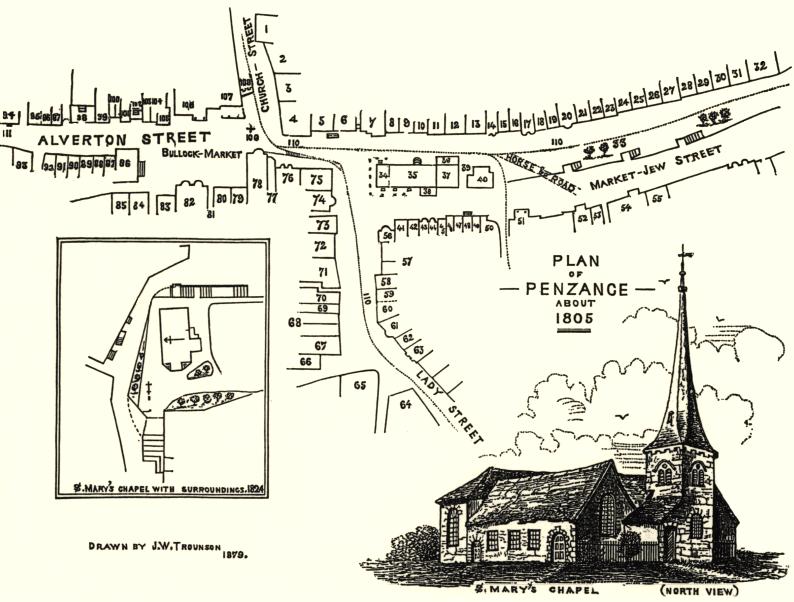
PLAN of PENZANCE about 1805 | Plan of the Centre of Old Penzance | Coulson’s Directory (1864) West Penwith Resources

Submitted by webmaster on Sun, 01/10/2023 - 17:03

Mapt of Penzance showing principal streets in 1805

PLAN of PENZANCE about 1805

Plan of the Centre of Old Penzance

and

Names of some of the several persons who occupied houses and shops shown on the Plan, to which the numbers have reference, from about the commencement of this century to the present time. This List does not pretend to completeness or much accuracy, since alteration of premises sometimes create confusion, but it may be taken for what it is worth as an aid to memory.

[The annotation (thus) is a correlation with Coulson’s Directory (1864) and other sources.]

  1. Church Street (Causewayhead or North Street).
    No. 7
    “The Bunch of Grapes” Inn.
  2. Tregida.
    James, Tailor.
    Pengelly, Grocer.
    Heath, Draper.
    Jones, ditto
    Branwell, Grocer.
  3. Branwell, ditto
  4. Market Place
    No. 28
    Branwell, ditto
  5. Symons.
    Cock, Printer.
    Higgs, Grocer.
    No. 29 Elliott, ditto
  6. No. 30 Rowe, Printer.
    Chirgwin, Grocer.
    Pengelly, ditto
  7. John Dunkin, Ironmonger.
    No. 31 James, ditto
  8. Bodilly, Ralph.
    Vibert, Grocer.
    Richards, Draper.
    No. 32 Field, Draper.
    Clarke, ditto
  9. Lee.
    Boase, Printer.
    Rodda, Butcher.
    No. 33 Rowe, Shoemaker.
    Smith, Fishmonger.
    Mitchell, Hatter.
  10. No. 34 “Golden Lion” Inn.
  11. Chester, Ironmonger.
    Morgan, Grocer
    Lee, Grocer.
    Welch, Ironmonger.
    Clarke & Simpson, Clothiers.
  12. No. 36 Ralph Bodilly, Grocer.
    Clarke & Simpson, Clothiers.
  13. Henry Sampson, Watchmaker.
    Jenkin, Pork Merchant.
    Runnalls.
    Now taken down Carcase Market.
  14. Carne, William, Builder and Grocer.
    Coulson, Rd., China Merchant.
    Flamank, Draper.
    No. 37 Paddon, ditto
    Harris, ditto
    Polglaze, ditto
  15. Dennis, Ironmonger.
    Moyle, ditto
    No. 38 Lanyon, Ironmonger.
    Cock, Chemist.
    Knight, ditto
  16. John Rogers, Tailor (Mercer).
    Scantlebury, Plumber.
    Renfree, Shoemaker.
    Viner, Musician.
    No. 39

Mapt of Penzance showing principal streets in 1805

PLAN of PENZANCE about 1805

Plan of the Centre of Old Penzance

and

Names of some of the several persons who occupied houses and shops shown on the Plan, to which the numbers have reference, from about the commencement of this century to the present time. This List does not pretend to completeness or much accuracy, since alteration of premises sometimes create confusion, but it may be taken for what it is worth as an aid to memory.

[The annotation (thus) is a correlation with Coulson’s Directory (1864) and other sources.]

  1. Church Street (Causewayhead or North Street).
    No. 7
    “The Bunch of Grapes” Inn.
  2. Tregida.
    James, Tailor.
    Pengelly, Grocer.
    Heath, Draper.
    Jones, ditto
    Branwell, Grocer.
  3. Branwell, ditto
  4. Market Place
    No. 28
    Branwell, ditto
  5. Symons.
    Cock, Printer.
    Higgs, Grocer.
    No. 29 Elliott, ditto
  6. No. 30 Rowe, Printer.
    Chirgwin, Grocer.
    Pengelly, ditto
  7. John Dunkin, Ironmonger.
    No. 31 James, ditto
  8. Bodilly, Ralph.
    Vibert, Grocer.
    Richards, Draper.
    No. 32 Field, Draper.
    Clarke, ditto
  9. Lee.
    Boase, Printer.
    Rodda, Butcher.
    No. 33 Rowe, Shoemaker.
    Smith, Fishmonger.
    Mitchell, Hatter.
  10. No. 34 “Golden Lion” Inn.
  11. Chester, Ironmonger.
    Morgan, Grocer
    Lee, Grocer.
    Welch, Ironmonger.
    Clarke & Simpson, Clothiers.
  12. No. 36 Ralph Bodilly, Grocer.
    Clarke & Simpson, Clothiers.
  13. Henry Sampson, Watchmaker.
    Jenkin, Pork Merchant.
    Runnalls.
    Now taken down Carcase Market.
  14. Carne, William, Builder and Grocer.
    Coulson, Rd., China Merchant.
    Flamank, Draper.
    No. 37 Paddon, ditto
    Harris, ditto
    Polglaze, ditto
  15. Dennis, Ironmonger.
    Moyle, ditto
    No. 38 Lanyon, Ironmonger.
    Cock, Chemist.
    Knight, ditto
  16. John Rogers, Tailor (Mercer).
    Scantlebury, Plumber.
    Renfree, Shoemaker.
    Viner, Musician.
    No. 39 Heynes, Grocer.
    Reynolds, Pork Merchant.
  17. Badcock, Grocer.
    Organ, Saddler and Flour Merchant.
    No. 40 Murphy, Serpentine Worker.
  18. Hornblower.
  19. Webb, Currier.
  20. Reynolds, Shoemaker.
    No 41 Coombe, Draper.
    Nicholls, Grocer.
  21. Market Jew Street (north side)
    Solomon Cock ,Mason.
    Symons, Rabbi.
    Baynard, Draper.
    Walters.
    No 1 & 2 Glasson.
    Eva. | Fleming, Cabinet Maker & Upholsterer.
    Cocking.
  22. Corin, Hatter.
    Eva, China Merchant.
    No. 3 Oppenheim, Furniture Broker.
    House where Sir. Humphry Davy was said to have been born (one theory)
  23. Allen, Confectioner.
    Oppenheim, Furniture Broker.
  24. Thomas, Printer.
    No. 5 Joseph, Pawnbroker.
  25. Cummings, Shoemaker.
    Rodd. ditto
    No. 6 Pearce, Hairdresser.
  26. Brown, Currier.
    Hugo.
    Rossiter, Watchmaker.
    No. 7 Perrow, Tailor.
  27. Henry Penneck, Dr. (surgeon)
    Hocking.
    Thomas.
    No. 8 Boynes.
    Oppenheim.
  28. Arthur, Watchmaker.
    Harris, Surgeon.
    Cook, Tailor.
    Gann.
    No. 9 Bolitho’s Bank.
  29. Quick.
    No. 10 Blee, Chemist.
  30. Davy, Miss Kitty (sister of Sir Humphry).
    No. 11 Harvey, Chemist.
  31. Davy.
    Penzance Dispensary (From 1809. Moved in 1813 to Chapel Street).
    No. 12 Dodge, Surgeon.
    Bennett, ditto
  32. The old Alms-house (built 1660 by Francis Buller. Poor house until 1826).
    No. 13 Runnalls. | Kinsman, Second-hand books.
  33. Two Ash Trees, which, being cut down, were the subject of a law suit with the Penzance Corporation, in 1805.
  34. The Guild-hall.
  35. Market House.
  36. Pork Market.
  37. Coinage Hall.
  38. “The Bird’s Cage.” A tall narrow shop
  39. Courtyard.
  40. Tonkin, Dr. Jn.
    Holloway.
    Rowe, Edwd.
    Thomas, M.
    Edmonds.
    Eva, Painter & Earthenware dealer.
    Fell in hand to the Penzance Corporation at the death of Sir. H. Davy in 1829.
  41. Market Place
    Broad, Draper.
    No. 9 Michell, ditto
  42. “King’s Arms” Inn.
  43. Lutey.
    Downing.
    Broad, Thos., jun.
    No. 8 Hawkey, Ironmonger.
    Chirgwin, Grocer.
  44. Harvey, Wm., Grocer.
    Hawke.
    No. 7 Chirgwin, Grocer.
  45. Hosking, Draper.
    Broad, T., jun., Draper.
    Hawke, Baker.
    Rodda, Printer.
  46. Berryman, Nich., Grocer.
    No. 4 Tregarthen.
  47. &
  48. Hart.
    Carne’s Bank.
    Broad, Thos.
    No. 3 Vibert, Jeweller.
    Trounson, ditto
  49. Joseph, Pawnbroker.
    Vibert, F., Printer.
    No. 2 Cornish, Wm., Printer
    James, Frank, Ironmonger.
  50. Cockram, Chemist.
    Hocking, Draper.
    Lavars, ditto
    No. 1 Symons, Chemist.
  51. Market-Jew Street (south side) No. 119 “Star” Inn.
  52. No. 114 “Ship and Castle” Inn.
  53. No. 112 Davy, Wm., Grocer
  54. John[?] Scobell, Collector of Customs.
    Davy.
  55. Beauchamp.
    “Prince of Wales” Inn.
  56. Market Place
    Symons, Old Clothier, &c.
    Coulson, Grocer.
    Sharland, ditto
    Treleavan, Hatter.
    No. 10 Victor, Draper.
  57. Cobley.
    Coulson.
    No. 11 Norton, Ironmonger.
    Victor, Draper.
  58. Stewart, Tinman.
    Bunny.
    No. 12 Benson.
    Bassett, Tobacconist.
  59. Coulson, Watchmaker.
    Coulson, Draper.
    No. 13 & 14 Clark, ditto
    Olver and Symons, Drapers.
  60. Lady (Chapel) Street
    Coulson, Draper.
    Clark, ditto
    Olver and Symons, Drapers.
  61. Coulson, Grocer.
    Hawke, Confectioner.
    Hamlyn, Gilder.
    Uren, ditto
    Bassett, Shoemaker.
    Bastian, Grocer.
  62. Vigurs, Thos., Printer.
    Harris, Jeweller.
    Pascoe, ditto
  63. Roberts, Humph., Constable and Barber.
    Honnychurch, Grocer and Barber.
    Saundry, Butcher.
  64. Phillpotts, Confectioner.
    Hampton, ditto
    Faull, ditto
    Brighton, Butcher.
  65. Market Place (Queen’s Square)
    “Globe” Inn.
  66. Clancey, Confectioner, Baby Linen, &c.
    QS Edmonds, Painter.
    Kinsman, ditto
  67. Treweeke, Mrs.
    Stevens, Capt.
    Molyneux, Draper.
    No. 15 & 16 Prockter, Chemist.
  68. No. 18 Cock, Hatter, &c.
    Carne’s Bank Batten, Carne & Oxnam until 1810.
  69. Lavars, Flour Dealer.
    Marshall, ditto
    Gill, Baker.
    No. 19 Boaden, Draper.
    Paul, ditto
    Sharland, Tailor.
    No. 20 Eastaway, Shoemaker.
  70. Wolf, Lemon, Spirit Merchant (other sources say ref: 69).
    Joseph, Pawnbroker.
    No. 21 Beare, Printer.
  71. Harvey, Chemist and Grocer Est. 1772.
    Pentreath, Grocer.
    No. 22 Edmonds, ditto
  72. Veale.
    Comyn’s (Cummings or Common’s) Hotel.
    Harvey, Watchmaker.
    Long, Draper. | Cornish, Chemist & Grocer.
    No. 23 York, ditto
  73. Thomas Penberthy, Tinman (Brazier).
    No. 25 Small, ditto
    Care, Grocer.
  74. Harvey.
    Allen, Baker.
    No. 26 Tresidder, Baker.
    Chudleigh.
  75. Davy, Draper.
    Martin, Grocer.
    No. 27 Beringer, Jeweller.
    Worth, Chemist.
    Shakerley, ditto
  76. Pidwell, Draper.
    Harry, ditto
    Richards, ditto
    No. 27 Hewett, Tailor.
    Gerry, Grocer.
  77. Pidwell.
    Stevens.
    Weymouth, Hatter.
    Eva, ditto
    No. 27 Rossiter, Jeweller.
  78. Bullock Market (south side)
    Penberthy, Draper.
    York, ditto
    Davy, ditto
  79. Green Market
    “Fire Engine“ Inn. (Commercial Hotel, now White Lion.)
  80. Penberthy, Draper.
    Higgs, Grocer.
    Rowe, ditto
    Allen, Confectioner.
  81. Hill’s Bake-house.
  82. Mabyn.
    Trembath, Ben.
    Stevens, Saddler.
    GM Higgs, Grocer.
    Rowe, ditto
  83. Williams, Relieving Officer.
    GM Ash, Saddler.
  84. Lloyd, Barnaby.
    Polkinghorne, Flour Dealer.
    Stevens, Flour Dealer.
    Eady.
    GM Richards.
  85. Constable Pascoe (one-armed).
  86. Lloyd, Barnaby, Upholsterer (formerly William Ustick, merchant).
    Trembath, Ben., Circulating Library.
    GM Cornish, Grocer.
    Hall, ditto
  87. Alverton Street (south side)
    Bodilly, Tailor.
    Stevens, Watchmaker.
    Lavin, Printer.
    No. 1 “Eagle” Inn.
  88. Bodilly, Glazier.
    Colliver, Hatter.
    No. 2 Richards, Currier.
  89. * Rogers, Tailor.
    Curnow, Gardener.
    Mathews, Shoemaker.
    Shrubbery.
    a) Tonkin, Tinker.
    Mathews, Hairdresser.
    Warren, &c.
  90. Charles Paynter, Solicitor.
    Hosking, Hosier.
    Inn.
    a) No. 7 Beckerleg, Baker.
    No. 9 Cross, Shoemaker, &c.
  91. No. 10 Colenso.
    Noy.
    a) Boase, Fras.
    No. 11 Hosking, Hosier.
    Bowditch, ditto
  92. John Beard, Town Clerk (Mayor 1794 & 1799).
    Gann, Tailor.
    No. 12 “Swan” Inn.
  93. Berryman, Surgeon.
    Cook, Tailor.
  94. Alverton Street (north side)
    Entrance to Park-an-Vounder, the old Fair Field (outside was the ten-mile stone from Land’s End).
  95. Hill, John.
  96. Boase, Honey.
  97. Crocker.
    Vigurs.
  98. “The Uninhabited House.”
    Site of “Western” Hotel and the end of Clarence Street.
  99. Batten, Joseph.
    “Western” Hotel.
  100. Edward Hambleton, Builder.
    Broad, Painter.
    Winnan, Grocer.
    No. 29 Champion, ditto
  101. No. 30 Pascoe (built 1754).
    Jago.
  102. Bromley, Saddler.
    Tregidja, Eating House.
    Wallace, ditto
    Eady, ditto
    Penrose, Butcher.
    Shoulder of Mutton Inn
  103. Green Market (Bromley’s Square)
    Eva, China Merchant.
    GM Carter, Confectioner.
    Hobley, ditto
  104. Bromley, Grocer.
    Hobley, Licensed Victualler
    Harvey, ditto
  105. Green Market
    “Shoulder of Mutton” Inn.
    Bromley, Grocer.
    GM Dennis, Draper.
    Polsue, ditto
  106. GM “Three Tuns” Inn.
    Cornish, Printer.
    Mollard, Dressmaker.
    Jarvis, China Merchant.
  107. Stevens, Pawnbroker.
    Polkinghorne, ditto
    GM Richards, ditto
    Powne and Blight, Drapers.
    Jones, Draper.
    Lavin, ditto
  108. The Town Shoot.
  109. The Market Cross.
  110. Water-courses.
  111. Tenth Mile-stone from the Land’s End.

* A house was taken down here for the sake of the view to the house opposite, but almost all of this side of the street has been so altered and rebuilt that the account must be more or less confused.

† When the corner house was rebuilt, this was for a time the “Shoulder of Mutton” Inn.

More about Penzance


On a former occasion, I had an oportunity of showing a plan of the old chapel as it was in 1674, and now (thanks to Mr. J. W. Trounson) I am able to place before you a plan of the same, dated 1824.

The seating plan of St. Mary’s Chapel—1824
Mrs. Millett Mr. William Davy Mr. Jos. Nicholls The Communion. Sir Rose Price, Bart. Corporation
Mrs. Millett Rev. W. Veale
Miss Gwavas Mr. Richard Moyle Borlase’s family Aldermen Rev. George Treweek Miss Scobell
Mr. William Harvey Mr. Fras. Cock Pulpit
Desk
Mayor Miss Gwavas Mr. Thomas Pidwell
Mr. Luke Mrs. Morgan Little Aldermen James Pascoe, Esq.
Mr. Thomas John Mrs. Caroline Borlase, Abbey
Mrs. Roberts John Jones Pearce, Esq. Cunnack and Gluyas Mrs. Linzee
John Jones Pearce Mr. Orchd. Bullock Lecturer Geo. John, Esq.
Joan and Ann Read Capt. Thomas Hosken Corporation John Batten, Esq. Mrs. Scobell Tremenheere family
Mr. Thomas Pascoe Margaret Williams Capt. John Stevens
Mr. Thomas Read Mr. Edward Williams Rev. C. V. Le Grice and Geo. D. John, Esq. Mrs. Mathews Mrs. Bains and Hichens Mr. Robert Richards
Walter Pidwell’s family Mr. Richard Edwards Rev. C. V. Le Grice and Rev. M. N. Peters Aaron Scobell, Esq. Mrs. Pearce, Gulval Mr. R. M. Branwell and Mr. Joseph Branwell
Mr. Joseph Bullock Alexander Woolcock Mr. John Vigurs Mrs. B. Branwell John Batten, Esq. and Mr. C. M. Vibert
Mr. William Richards Mrs. Vigurs
John Read and Vibert Richard Cunnack John Batten Esq. Rev. M. N. Peters Mr. Thomas Woodis Rev. Uriah Tonkin
Constables John Hambleton Mr. John Boase Rev. M. N. Peters Mr. John Wallis Mr. Henry Sampson
Mr. James Broad Mr. John Tonkin Mrs. Morgan Mr. John Luke and Thomas Vigurs Mr. Peter Symons Miss Stone
Servants Font Seat Font Ann Stone
Michael Vibert
John Fleming
Sincock’s family Mrs. Eve Mr. John Mathews
Servants Servants
Servants Servants

A gallery occupied the western end of the chapel, and extended along the north and south sides, nearly to the eastern end. Sittings were alloted in it after the manner shown in the following rough plan, which (like the foregoing) pretends only to give a general idea of the relative position of seats, without attempting exact proportion or the accuracy of detail set forth in the originals.

Mrs. Bryant Mrs. Cock
Richard Oats John Cornish
James Cobley Ed. Hambleton and Jonathan Higgs
M. A. Davy Rev. C. V. Le Grice
W. Stevens and Hampton Mrs. Bryant
Rt. Stevens and Jos. Sutherland John Batten, Esq.
James Read Mrs. Branwell
Phillip Rowe Free Seat Free Seat Rev. W. Tremenheere
Jane Vibert and Mrs. Davy Organ W. Mathews and Jon. Higgs
Sarah Trezise and Birch School Children
Stairs Free Seats

There are a few old Monumental tablets, and some relics of the old chapel, such as the Poor Box, dated 1612, and the small Free-stone Font.

https://archive.ph/4EuJ7

term Sources
Reference

Penzance | Towns and Cities of Cornwall

Submitted by webmaster on Sun, 01/10/2023 - 16:55

Penzance; town, a chapelry, a sub-district, and a district, in Cornwall; the town is in Madron parish; stands at the head of Mounts bay, and at the terminus of the West Cornwall railway, 9 miles NE of Lands-End, and 26 SW of Truro; derives its name, signifying “holy-headland,” from a chapel of St. Anthony, which stood on a point adjoining the pier; is said to have had a castle on a site at the Barbican, near the quay; was burnt by the Spaniards in 1595, and plundered by Fairfax in 1646; was a coinage-town from the time of Charles II.till 1838, when the tin dues were abolished; witnessed the wreck of an Algerine corsair in its vicinity in 1760; was the birthplace of Lord Exmouth, Davies Gilbert, and Sir Humphrey Davy; received a charter of incorporation from James I.; is governed, under the new act, by a mayor, 6 aldermen, and 18 councillors; is a seat of petty sessions, a polling-place, a coast-guard station, and a head-port;

1284 Penzance is first mentioned in history

1332 Penzance is given a charter (a document granting the people certain rights). Penzance becomes a small but busy market town. It also has an annual fair.

1404 Penzance is given 2 weekly markets and 3 annual fairs

1512 Henry VIII gives Penzance the right to keep the harbour dues

1578 Penzance suffers an outbreak of plague

1595 The Spanish sack and burn Penzance

1614 Penzance is given a mayor and a corporation

1647 Penzance has another outbreak of plague

1648 Penzance is plundered by soldiers again

1663 King Charles I makes Penzance a coinage town, where tin is weighed and taxed

1740 A battery of guns is built to defend Penzance against attack

1743 Penzance gains its first fire engine

1768 The first Jewish Synagogue is built in Penzance

1770 Penzance has

Penzance; town, a chapelry, a sub-district, and a district, in Cornwall; the town is in Madron parish; stands at the head of Mounts bay, and at the terminus of the West Cornwall railway, 9 miles NE of Lands-End, and 26 SW of Truro; derives its name, signifying “holy-headland,” from a chapel of St. Anthony, which stood on a point adjoining the pier; is said to have had a castle on a site at the Barbican, near the quay; was burnt by the Spaniards in 1595, and plundered by Fairfax in 1646; was a coinage-town from the time of Charles II.till 1838, when the tin dues were abolished; witnessed the wreck of an Algerine corsair in its vicinity in 1760; was the birthplace of Lord Exmouth, Davies Gilbert, and Sir Humphrey Davy; received a charter of incorporation from James I.; is governed, under the new act, by a mayor, 6 aldermen, and 18 councillors; is a seat of petty sessions, a polling-place, a coast-guard station, and a head-port;

1284 Penzance is first mentioned in history

1332 Penzance is given a charter (a document granting the people certain rights). Penzance becomes a small but busy market town. It also has an annual fair.

1404 Penzance is given 2 weekly markets and 3 annual fairs

1512 Henry VIII gives Penzance the right to keep the harbour dues

1578 Penzance suffers an outbreak of plague

1595 The Spanish sack and burn Penzance

1614 Penzance is given a mayor and a corporation

1647 Penzance has another outbreak of plague

1648 Penzance is plundered by soldiers again

1663 King Charles I makes Penzance a coinage town, where tin is weighed and taxed

1740 A battery of guns is built to defend Penzance against attack

1743 Penzance gains its first fire engine

1768 The first Jewish Synagogue is built in Penzance

1770 Penzance has a population of about 3,000

1779 A grammar school is founded in Penzance

1797 The first bank opens in Penzance

1801 Penzance has a population of 3,382

1826 North Parade is built

1827 Clarence Street is built

1829 Victoria Place is built

1830 Penzance gains gas street light. Penzance gains a piped water supply

1835 Adelaide Street is built

1838 The Egyptian House is built

1839 Regent Square is built. Penzance gains its first newspaper

1847 The Albert Pier is built

1852 The railway reaches Penzance

1866 Wharf Road is built

1873 An infirmary opens in Penzance

1884 A floating dock is built

1889 Morrab Gardens opens

1893 Princess Mary Recreation Ground opens

1901 Penzance has a population of 13,136

1903 Alexandra Grounds opens

1901 Penzance gains electric street lights. Penzance gains its first cinema.

1926 The Winter Gardens open

1933 St Anthonys Gardens open

1949 Penlee House opens to the public

1991 A National Lighthouse Museum opens

1999 Wharfside Shopping Centre opens

A history of Penzance

A Timeline of Penzance

Reference

Vocabulary name

displayname : {{ user.displayname }} term : {{ content.term }} bundle: {{ content.bundle}} content|without('description'): {{ content|without('description') }} http://history.angarrack.info/admin/structure/taxonomy/manage/location/add
Displaying 1 - 5 of 5