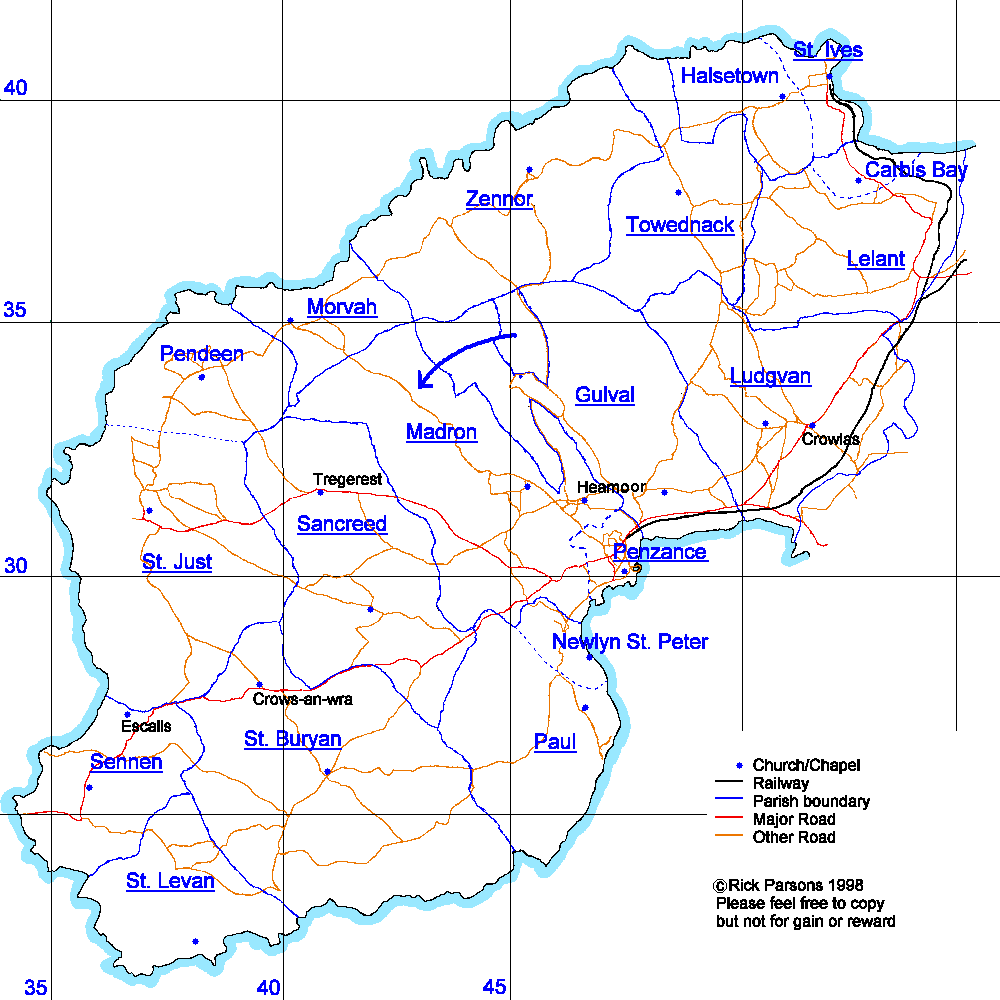
Penzance; town, a chapelry, a sub-district, and a district, in Cornwall; the town is in Madron parish; stands at the head of Mounts bay, and at the terminus of the West Cornwall railway, 9 miles NE of Lands-End, and 26 SW of Truro; derives its name, signifying “holy-headland,” from a chapel of St. Anthony, which stood on a point adjoining the pier; is said to have had a castle on a site at the Barbican, near the quay; was burnt by the Spaniards in 1595, and plundered by Fairfax in 1646; was a coinage-town from the time of Charles II.till 1838, when the tin dues were abolished; witnessed the wreck of an Algerine corsair in its vicinity in 1760; was the birthplace of Lord Exmouth, Davies Gilbert, and Sir Humphrey Davy; received a charter of incorporation from James I.; is governed, under the new act, by a mayor, 6 aldermen, and 18 councillors; is a seat of petty sessions, a polling-place, a coast-guard station, and a head-port;
1284 Penzance is first mentioned in history
1332 Penzance is given a charter (a document granting the people certain rights). Penzance becomes a small but busy market town. It also has an annual fair.
1404 Penzance is given 2 weekly markets and 3 annual fairs
1512 Henry VIII gives Penzance the right to keep the harbour dues
1578 Penzance suffers an outbreak of plague
1595 The Spanish sack and burn Penzance
1614 Penzance is given a mayor and a corporation
1647 Penzance has another outbreak of plague
1648 Penzance is plundered by soldiers again
1663 King Charles I makes Penzance a coinage town, where tin is weighed and taxed
1740 A battery of guns is built to defend Penzance against attack
1743 Penzance gains its first fire engine
1768 The first Jewish Synagogue is built in Penzance
1770 Penzance has a population of about 3,000
1779 A grammar school is founded in Penzance
1797 The first bank opens in Penzance
1801 Penzance has a population of 3,382
1826 North Parade is built
1827 Clarence Street is built
1829 Victoria Place is built
1830 Penzance gains gas street light. Penzance gains a piped water supply
1835 Adelaide Street is built
1838 The Egyptian House is built
1839 Regent Square is built. Penzance gains its first newspaper
1847 The Albert Pier is built
1852 The railway reaches Penzance
1866 Wharf Road is built
1873 An infirmary opens in Penzance
1884 A floating dock is built
1889 Morrab Gardens opens
1893 Princess Mary Recreation Ground opens
1901 Penzance has a population of 13,136
1903 Alexandra Grounds opens
1901 Penzance gains electric street lights. Penzance gains its first cinema.
1926 The Winter Gardens open
1933 St Anthonys Gardens open
1949 Penlee House opens to the public
1991 A National Lighthouse Museum opens
1999 Wharfside Shopping Centre opens
Snippets
A BRIEF HISTORY OF PENZANCE, CORNWALL, ENGLAND
By Tim Lambert
Dedicated to Josephine Merriman
PENZANCE IN THE MIDDLE AGES
Penzance began as a small fishing village. It is not mentioned in the Domesday Book of 1086. There may have been a settlement at that time that was too small to warrant a mention or it may have grown up later.
The name Penzance is derived from the Cornish words Penn Sans meaning holy headland. It is believed the name comes from a chapel built upon the western headland. It first appeared in writing in 1284.
In the 14th century Penzance grew from a village into a town (albeit a very small town by today's standards). In 1332 it was given a charter (a document granting the inhabitants certain rights). They were allowed a weekly market and an annual fair lasting 7 days. (In the Middle Ages fairs were like markets but were held only once a year. People would come from all over Cornwall to buy and sell at a Penzance fair).
Medieval Penzance was a small but busy little port. In 1404 it was allowed 2 weekly markets and 3 annual fairs.
PENZANCE IN THE 16TH CENTURY AND 17TH CENTURY
In 1512 Henry VIII granted the people of Penzance the right to keep the harbour dues, a sign of the towns growing importance. About 1540 a man named John Leland described Penzance: (I have 'modernised' his words to make them easier to read) Penzance about 2 miles from Mousehole, standing fast in the shore of Mounts Bay is the most western market town of all Cornwall and has no haven for boats of ships except a man made pier or quay.'
Like all Tudor towns Penzance suffered from outbreaks of plague. There was an epidemic in 1578. A further epidemic occurred in 1647. A worse disaster overtook the town in 1595 when it was sacked and burned by the Spanish. Penzance took years to recover.
However in 1614 Penzance was given a new charter. This time Penzance was given a mayor and corporation. Penzance was now a 'proper' town. It was also strategically important. The preamble to the charter said 'Penzance is an ancient town and port both populous and of great force and strength to resist the enemies that shall invade there and to defend the adjoining country.' The charter also allowed Penzance 2 weekly markets and a total of 7 fairs.
In 1642 came civil war between king and parliament. The people of Penzance resolutely supported the king. When the civil war ended in 1646, Penzance was plundered by parliamentary soldiers. In 1648 an uprising occurred in Penzance. Men volunteered to fight for the king but they were quickly defeated by parliamentary soldiers (who then plundered the town again!).
However in 1663 King Charles I made Penzance a coinage town, where tin was weighed and taxed.
PENZANCE IN THE 18TH CENTURY
During the 18th century Penzance continued to be a busy little port and market town. During the 18th century the tin industry in Cornwall boomed and tin became the main export from Penzance. Other exports were grain and smoked pilchards.
Penzance gained its first fire engine in 1743 although it was only a hand pump with a leather hose drawn by horses.
Meanwhile in 1739 a war began with Spain. In 1740 fearing a Spanish attack the corporation built a battery of guns to defend Penzance.
In 1769 Penzance was described as a 'place of considerable note'. Many of the Cornish gentry had second houses in the town. The streets of Penzance were paved (unlike many towns at that time) and it had about 600 houses. So it probably had a population of around 3,000.
The first Jewish Synagogue in Penzance was built in 1768 and a grammar school was founded in 1779. The first theatre in Penzance opened in 1789 and in 1791 Assembly Rooms were built were balls were attended and card games could be played. The first bank in Penzance opened in 1797.
Meanwhile Sir Humphrey Davy (1778-1829) was born in Penzance. In 1815 he invented the miners safety lamp.
PENZANCE IN THE 19TH CENTURY
In 1801 Penzance had a population of 3,382. In the early 19th century it began to grow rapidly. By 1851 the population of Penzance had reached 9,214. Penzance has an unusually mild climate and it grew as a health resort. Many new streets were built including North Parade in 1826. (South Parade was built earlier, in 1790). Clarence Street was built in 1827. Victoria Place followed in 1829. Adelaide Street was built in 1835 and Regent Square in 1839.Perhaps the most famous house in Penzance is the 'Egyptian House' which was built in 1838. (It really is nothing like anything in Egypt!). The Market House was built in 1838 so was a new Guildhall.
In 1852 a railway from Penzance to Redruth was opened. It was later extended all the way to London. That made it easier to transport tin and fish from Penzance to the capital.
The port of Penzance continued to boom. Tin was still the main export. The Albert Pier was built in 1847. In 1853 the old pier was extended and in 1855 a lighthouse was built on the end. Wharf Road was built in 1866. Ross Bridge was built in 1881 to connect the piers to the railway station. A floating dock was built in 1884.
There was also a shipbuilding industry in Penzance in the 19th century. However at the end of the 19th century the old tin industry went into steep decline.
In 1809 a dispensary opened in Penzance where the poor could obtain free medicines. In 1830 Penzance gained gas street lighting. Also in 1830 Penzance gained a piped water supply. At first it was supplied by a private company but the corporation took it over in 1852. Also in the 1850s a network of sewers was created. Penzance gained its first newspaper in 1839.
A promenade was built in Penzance in 1844 and after the railway arrived tourism became increasingly important.
In the 19th century amenities in Penzance improved rapidly. The first cemetery in Penzance opened in 1856. A modern fire brigade was formed in 1860 and an infirmary opened in Penzance in 1873. Morrab Gardens opened in 1889 and Princess Mary Recreation Ground opened in 1893.
PENZANCE IN THE 20TH CENTURY
In 1901 Penzance had a population of 13,136 and in the 20th century Penzance continued to develop as a resort. Alexandra Grounds opened in 1903. In 1912 Penzance gained electric street lights. Also in 1912 Penzance gained its first cinema. A war memorial was erected in Penzance in 1922. The Winter Gardens opened in 1926. St Anthonys Gardens opened in 1933.
In 1934 the boundaries of Penzance were extended and Jubilee Bathing Pool opened in 1935. Furthermore during the 1920s and 1930s Penzance council began the work of slum clearance and the first council houses were built.
During World War II 16 people were killed in Penzance by German bombing.
Penlee Memorial Park was purchased by the corporation in 1946. Penlee House opened to the public in 1949.
After 1945 many more council houses were built in Penzance including the estate at Alverton.
Today tourism is a very important industry in Penzance. A National Lighthouse Museum opened in 1991. Furthermore Wharfside Shopping Centre opened in 1999. Today the population of Penzance is 16,000.
Penzance St Mary is an Ecclesiastical Parish and a market town in the county of Cornwall, created in 1741 from a chapelry in Madron Ancient Parish.
Other places in the parish include: Sheffield and Tredavoe.
Alternative names:
- Buriton
- Burriton
Parish church:
Parish registers begin:
- Parish registers: 1789
- Bishop’s Transcripts: None
Nonconformists include: Baptist, Bible Christian Methodist, Church of Jesus Christ of Latter-day Saints, Independent/Congregational, Jewish, Methodist, Methodist New Connexion, Presbyterian, Primitive Methodist, Roman Catholic, Society of Friends/Quaker, Unitarian, Wesleyan Methodist, and Wesleyan Methodist Association.
Table of Contents
Adjacent Parishes
Parish History
The Imperial Gazetteer of England & Wales 1870
PENZANCE, a town, a chapelry, a sub-district, and a district, in Cornwall. The town is in Madron parish; stands at the head of Mounts bay, and at the terminus of the West Cornwall railway, 9 miles NE of Lands-End, and 26 SW of Truro; derives its name, signifying “holy-headland,” from a chapel of St. Anthony, which stood on a point adjoining the pier; is said to have had a castle on a site at the Barbican, near the quay; was burnt by the Spaniards in 1595, and plundered by Fairfax in 1646; was a coinage-town from the time of Charles II.till 1838, when the tin dues were abolished; witnessed the wreck of an Algerine corsair in its vicinity in 1760; was the birthplace of Lord Exmouth, Davies Gilbert, and Sir Humphrey Davy; received a charter of incorporation from James I.; is governed, under the new act, by a mayor, 6 aldermen, and 18 councillors; is a seat of petty sessions, a polling-place, a coast-guard station, and a head-port; enjoys a charming climate, delightful environs, and good bathing appliances; attracts multitudes of strangers, both as summer residents, and as visitors of hundreds of rich scenes and interesting antiquities for miles all around it; presents, both in itself, and in combination with Mounts bay and St. Michael’s mount, a picturesque appearance; consists chiefly of several well-built streets, meeting in a market-place; underwent important street improvements in 1865-7; includes two esplanades, one of them the best in the W of England, 23½ feet above the railway, overlooking all Mounts bay, and designed, in 1867, to be lengthened 300 feet and otherwise improved; and has a head post-office, a railway-station with telegraph, three banking offices, six chief inns, a town hall and corn-market, an ancient market-cross, a public hall, a police station, a borough-jail, a custom-house, a magnificent pier, assembly and billiard-rooms, two churches, nine dissenting chapels, a Roman Catholic chapel, public libraries and reading-rooms, a literary institute, a geological society and museum, a natural history society and museum, a school of art, a free school, alms-houses, and charities £28.
The market house was erected in 1838; and is a granite structure, with tetra style Ionic portico and a dome. The public buildings were built in 1866, at a cost of £15,000; and contain an organ much larger than that in St. James great hall, in London. The borough-jail has capacity for 9 male and 9 female prisoners. The pier is 600 feet long; was constructed in 1745-72, at a cost of more than £30,000; has an E arm, added in 1845; is protected from the sea by a cyclopean granite wall; abuts upon the railway -terminus; stands in a depth of from 9 to 13 feet of water; and has a lighthouse, erected in 1817, and showing a fixed light 29 feet high. A battery is on arising-ground, opposite the pier, and was completed in 1858. St. Mary’s church was rebuilt in 1832; is in the later English style; has a lofty tower, to which a good peal of bells was added in 1865; and contains about 2,000 sittings. St. Paul’s church was built in 1835, at a cost of £5,000; is in the early English style; and has transepts, an open roof, and excellent stained-glass windows. The Roman Catholic chapel was built in 1859; and is a fine structure, in the decorated English style. The house in which Davy was born still stands; and, though new-fronted, is otherwise unaltered.
Markets are held on Tuesdays and Thursdays; fairs are held on 25 March, Trinity Thursday, 8 Sept., and the Thursday before Advent; a weekly paper is published on Wednesday; races are held on the sands of the E Green in autumn; and a large trade is carried on in the import of timber, iron, tallow, hemp, and other commodities, and in the export of potatoes, early vegetables, tin, and pilchards. The vessels belonging to the port, at the beginning of 1864, were 18 small sailing-vessels, of aggregately 507 tons; 73 large sailing-vessels, of aggregately 8,689 tons, and 2 steam vessels, of jointly 216tons. The vessels which entered, in 1863, were 12 British sailing-vessels, of aggregately 2,808 tons, from British colonies; 60 sailing-vessels, of aggregately 4,170 tons, from foreign countries; 87 foreign sailing-vessels, of aggregately 12,297 tons, from foreign countries; 1 British steam-vessel, of 22 tons, from British colonies; 2,160 sailing-vessels, of aggregately 184,885 tons, coastwise; and 302 steam-vessels, of aggregately 49,658 tons, coast-wise. The vessels which cleared, in 1863, were 16 British sailing-vessels, of aggregately 2,492 tons, to British colonies; 45 British sailing-vessels, of aggregately 3,642 tons, to foreign countries; 56 foreign sailing-vessels, of aggregately 9,298 tons, to foreign countries; 793 sailing-vessels, of aggregately 68,393 tons, coastwise; and 200 steam-vessels, of aggregately 22,846 tons, coastwise. The amount of customs in 1862 was £12,947. Steamers sail regularly to Scilly, to Liverpool, and to Falmonth, Plymouth, and London. Acres of the borough, 486; of which 85 are water. Real property in 1860, £31,999; of which £4,300 were in the railway, and £175 in gas-works. Pop. in 1851, 9,214; in 1861, 9,414. Houses, 1,941.
The chapelry is conterminate with the borough; and includes both the charge of St. Mary and that of St.Paul. The livings are p. curacies in the diocese of Exeter. Value of St. M., £300; of St. P., £120. Patron of St. M., the Bishop of Exeter; of St. P., Mrs. H. Batten The sub-district contains the parishes of Madron, Gulval, and Paul. Acres, 13,971. Pop., 18,741. Houses, 3,849. The district comprehends also the sub-district of Marazion, containing the parishes of St. Hilary and Perranuthnoe, and the extra-parochial tract of St. Michael’s Mount; the sub-district of St. Ives, containing the parishes of St. Ives, Zennor, and Towednack; the sub-district of Uny-Lelant, containing the parishes of Uny-Lelant, Ludgvan, and St. Erth; the sub-district of St. Just-in-Penwith, containing the parishes of St. Just-in-Penwith, Sancreed, and Morvah; and the sub-district of St. Buryan, containing the parishes of St. Buryan, St. Levan, and Sennen. Acres, 65,092. Poor-rates in 1863, £7,975. Pop. in 1851, 53,517; in 1861, 54,554. Houses, 10,806. Marriages in 1863, 496; births, 2,069, of which 109 were illegitimate; deaths, 1,504, of which 808 were at ages under 5 years, and 28 at ages above 85. Marriages in the ten years 1851-60, 4,314; births, 18,129; deaths, 11,134. The places of worship, in 1851, were 22 of the Church of England, with 11,780 sittings; 3 of Independents, with 630 s.; 4 of Baptists, with 1,045 s.; 2 of Quakers, with 280 s.; 1 of Unitarians, with 100 s.; 68 of Wesleyans, with 17,912 s.; 10 of Primitive Methodists, with 2,595s.; 15 of Bible Christians, with 2,677 s.; 2 of the Wesleyan Association, with 640 s.; 2 of Lady Huntingdon’s Connexion, with 600 s.; 2 undefined, with 200 s.; 1 of Roman Catholics, with 320 s.; and 1 of Jews, with 36. The schools were 27 public day-schools, with 2,493 scholars; 146 private day-schools, with 4,170 s.; 77 Sunday schools, with 8,903 s.; and 2 evening schools for adults. with 20 s. The workhouse is in the rural part of Madron parish; has accommodation for 400 persons; and, at the Census of 1861, had 147 inmates.
Source: The Imperial Gazetteer of England & Wales [Wilson, John M]. A. Fullarton & Co. N. d. c. [1870-72].
Penzance St Mary Cornwall Family History Guide - Parishmouse
related Media