

Notes
Joll
INTRODUCTION 1
JOLL FAMILY CORNISH ORIGIN 2 – 6
VOYAGE OF THE “TIMANDRA” 6 – 7
SETTLING IN TARANAKI 7 – 9
THE FAMILY OF SAMUEL AND ELIZABETH JOLL IN NEW ZEALAND 11
ANN JOLL – WILLS 11
SAMUEL JOLL OF WAITARA 12 – 17
SARAH JOLL – GILMOUR 18
ELIZA JOLL – HAWKEN 19
SAMSON JOLL 20
THOMAS JOLL 21
MARY JOLL – BALLANTINE 22
ELIZABETH JOLL – DRILLER 23
DAVID JOLL 24
JOHN JOLL OF PUKAHU 25 – 37
JOHN HENRY JOLL OF HAVELOCK NORTH 38 -45
THE FAMILY OF JOSIAH JOLL OF CALSTOCK CORNWALL 46
MARY JOLL – WALDRON 46
TOMSIN JOLL – HARRIS 46 – 48
RICHARD JOLL 48 – 51
JANE ANN JOLL 51
JOHN CORY JOLL 51
ELIZABETH JOLL 51
EMMA JOLL 51
DAVID JOSIAH JOLL 52
BENJAMIN JOLL 52 – 53
INFORMATION FROM THE FAMILY BIBLE 54 – 56
JOHN JOLL OF SALTASH CORNWALL 57 – 65
DIGORY JOLL 66
FAMILY REUNION 1990 67 – 69
MISCELLANEOUS 70 -74
Page 1
This Joll Family History is a limited edition of copies published by the Joll Family Reunion Committee 1990.
INTRODUCTION
The history of any family involves people, and an attempt has been made to rekindle and record memories of the past, for the future generations. For with our past, we better understand who we are in the present. Our people left their imprint. They ventured and we glimpse their pioneer spirit.
Sadly as so often happens, very little early history was well recorded and some is entirely unknown. Accordingly some areas of the overall picture are rich in detail and others have faded away.
The following pages are dedicated with respect and gratitude to the Founders of our Family.
Esmene Chatterton (nee Joll)
ACKNOWLEDGEMENTS
Sincere thanks to Sydney Joll, who is the eldest living member of the Hawkes Bay branch of the Family. His research and writings from earlier years, and his continuing interest have been an invaluable source of information and inspiration.
The late Roy Joll also visited Cornwall confirming and adding further details. His writings form a part of this Family History.
Many other Family members have offered memorabilia and photographs which have strengthened links of knowledge spanning the years. Thank you.
Phyllis Lomas (nee Joll)
Page 2
“BEDHEUGH BYNYTHA KERNEWIC”
“Be Forever Cornish”
This story of the Joll Family has been gathered from various sources. It is by no means complete but it contains a good deal of information which might have been lost with the passing of the older generation.
In gathering the material set out in these pages. Cornish Records and Parish Registers in Truro, Exetor [Exeter], Somerset House and the British Museum, have been consulted. Many quiet little villages around the edge of Bodmin Moor, where the family was seated from time immemorial have been visited.
In the Parish Registers of Alternun, Egloskerry, Lewannick, Warbstow and Calstock, the name frequently appears ever since the Records were first compiled in the sixteenth century.
Cornish the name is and ancient without doubt, but whether the present form is the original one or what forms it has appeared in over the ages. it is hard to say for certain.
Cornish family names are notoriously difficult to follow throughout the years, as in common with other English names they were subject to many variations of spelling, as the spread of education became general. Even during the last century or so, the same person might appear in the Parish Register as Joll, Jole, Jolles or Jolly, Joule or Jowle.
Authorities on the subject of British Family names, have suggested that names such as Jaul, Judhel, Juyl, Jeyl all come from the same stock. but Baring Gould is more specific and states that the name in the form of Jaul, was found in Cornwall before the Norman Conquest.
It is also of interest to note that the ancient Celtic name for the devil is “Joll”. and many Cornish people of the older generation gave holders of the name a certain amount of superstitious respect, if not a wide berth.
According to Lysons, family members were noted for their longevity “and strength”. In the folio pedigree VII Parochial History of Cornwall is found the name of John Joll of Altarnun, who died on 31st January 1783 aged 98 years, and his daughter Catherine, who died in 1814 aged 93 years, another daughter Mary, who died in 1826 aged 93 years and a third daughter Honor, died in 1825 aged 90 years. What a tragic little drama lay behind these entries. As if to suggest that even the advanced years attained by these old ladies was not enough to establish the family’s reputation for longevity, it is recorded that Honor, died from the effects of a fall downstairs and Mary, died of injuries the result of an attack by a ram.
The writer Hals, and later quoting him Baring Gould, mentions Peter Joll, Deacon in Altarnun Church, who died in the time of Charles II, aged 150 years. When he was 100 years of age, according to these writers, new black hair sprung from his head and new teeth grew in place of those he had lost. Perhaps it was not only because of his name that this old gentleman was popularly known as “Peter the Devil”.
Page 3
In the case of families like ours, whose roots are so firmly embedded in the land, the younger sons were continually branching out from their native Parishes and taking up land for themselves in other parts of Cornwall. It would appear that they kept as near as possible to the ancient home however, and until the eighteenth century at least they could usually be found within a few miles of Egloskerry, Wardstow, Altarnun, Lewannick and Calstock.
Like all Celtic peoples, Cornwall landowners were identified by the names of their lands and we thus find members of the clan described in Wills as “William Joll of Tredawle”, “William Joll of Hurden in Altarnun” etc.
An interesting point is that the Jolls were unusual in Cornish Society in the periods before industrialisation, for they appear to be literate. Jolls were often clerks or clergymen in charge of church property – the order of services and church legal matters, supporting the fact that they could read and write at a time when few others could. At Warleggan there is a plaque mentioning John Joll, clerk, at the time the tower was rebuilt at the end of the 18th century.
A few years later the same man presumably is described in the register in a footnote as “an impudent, vain, foolish fellow who denied the Vicar the key to the church door”. Obviously Vicar and clerk had had a disagreement.
In the Visitations of Cornwall there is a table showing Royal descent of a number of Cornish families, one of which is that of George Joll of Altarnun, who married Margaret Dowrish, in 1675. Margaret was heiress to Lewis Dowrish of Sandford in Devon, and when she died in 1694 she was buried at Altarnun as “Dame Margaret Joll”.
Whether we are descended from this branch of the family has not been established, though the use of the same names in our families in N.Z. suggests that this might be the case. An entry in the roll of Alumni of Exetor [Exeter] College Oxford, shows that George Joll, a grandson of George and Margaret, matriculated in 1718. In this roll is also shown the name of Thomas Joll, Secular Chaplain who graduated B.A. 1518.
As regards Josiah Joll of Calstock. whose Will was proved in Bodmin Registry in 1764, the following is an extract.
“– I leave to my daughter Ann, wife of William Knight £10, to my daughter Sarah Joll, £20 when she attains 21. Residue unto my wife Thomzin Joll and my son Samuel Joll, my Executors.” The son Samuel married on 6 December 1796, Sarah Bowhay, member of a well known Callington family, and according to the 1840 census he owned besides Tumple Farm, certain customary lands and houses. It is understood that these houses comprised quite a part of the village of Calstock.
Twice a day the tide surges up the channel into Plymouth Sound and swings left up the valley of the Tamar River. Near the end of its run on the Cornish side of the valley stands Calstock Town.
Anciently the boats of Phoenecian traders rode the tides to trade with the natives for the stream tin of the valley bottoms round Bodmin Moor, which they alloyed with the copper of Cyprus and sold at a handsome profit round the Mediteranean [Mediterranean] Sea.
Having bought as much tin as was available up to a full load, they bought from the riverside farmers what grain and meat they needed for the run home.
Page 4
Here near Calstock the Romans forded the river and on the Hingston Downs above the town fought the Britons of Cornwall. In turn the Romans left Britain, and the Saxons filled the void usurping what land they fancied along the river. They in turn had to submit to the Norman Conqueror and it is then that the written history of the area began.
Before that time monks and nuns from Ireland filled with missionary zeal had crossed to Wales and Cornwall. and setting up crosses and chapels preached very successfully a saving Christ. They defied the Ghoulies and Ghosties of the old religion and got away with it. They did sundry miraculous things.Save for the odd witch and magician the whole land was converted to Christianity, even if the old evil ones might prudently be still respected. Many of these monks or at least some of them kept records and fragments of their services.
With the Norman Conquest however, a new system was imposed. The Saxon Earls were replaced in most cases by Norman Overlords, whose holdings were theirs just as long as they did the King’s bidding and paid their feudal dues. Nothing was left to chance, for the King’s Domesday Book recorded their estates to the finest details – freeholders and tenants, vassals and serfs, oxen and ploughs, woodland arable and grazing, and just how many Spearmen and Bowmen must be supplied at the King’s demand.
Calstock district was entered in the same detail as the rest of England, and one early Joll ancestor, a Yeoman, was listed with all his landholding, stock and chattels, who must have considered himself fortunate that he was not dispossessed like so many of his kind. When succeeding Kings called up their levies for the recurring wars, mercenary freemen or adventurous sons were supplied to fulfil feudal obligations.
Over the years Joll fortunes waxed and waned as generations succeeded generations. His holdings expanded when wives brought dowries or inheritances, and when prosperous times enabled him to buy.
By Stewart times his fortune was at its peak. The family owned lands in Calstock, Egloskerry, Lewannick and Altarnun, as well as “customary lands” and shared grazing rights on Bodmin Moor. The old home farm now supported a stone Mansion called Harewood house. which possibly predated the Hareward of North. Joll aspired to the rank of Gentleman with all the privileges that that entailed, but his application to the Council of Attainment was not upheld. It was conceded that he had the necessary qualifications and would be promoted almost anywhere else in England. Here in Eastern Cornwall there were more “Gentlemen” than the area could conveniently sustain. He did however, win his appeal to the Bishop of the day, when someone tried to usurp his pew up front in Calstock Church. About this time the Parish clerk was also the Parish Tailor, and he found the vellum on which the records were kept a good source for the stiffening material in gentlemen’s coats. The result is there is a long gap in the family story, but the fact that Jolls held Tumple Farm in the Domesday Book and both before and after the gap in Parish records, seems to point to continuous occupation.
An example of the values of the day.
From the History Of Trigg Minor by Sir John Maclean “
Vol. 3. page 87. Subsidy Roll
Photo caption –
CALSTOCK CHURCH.
St. ANDREWS.

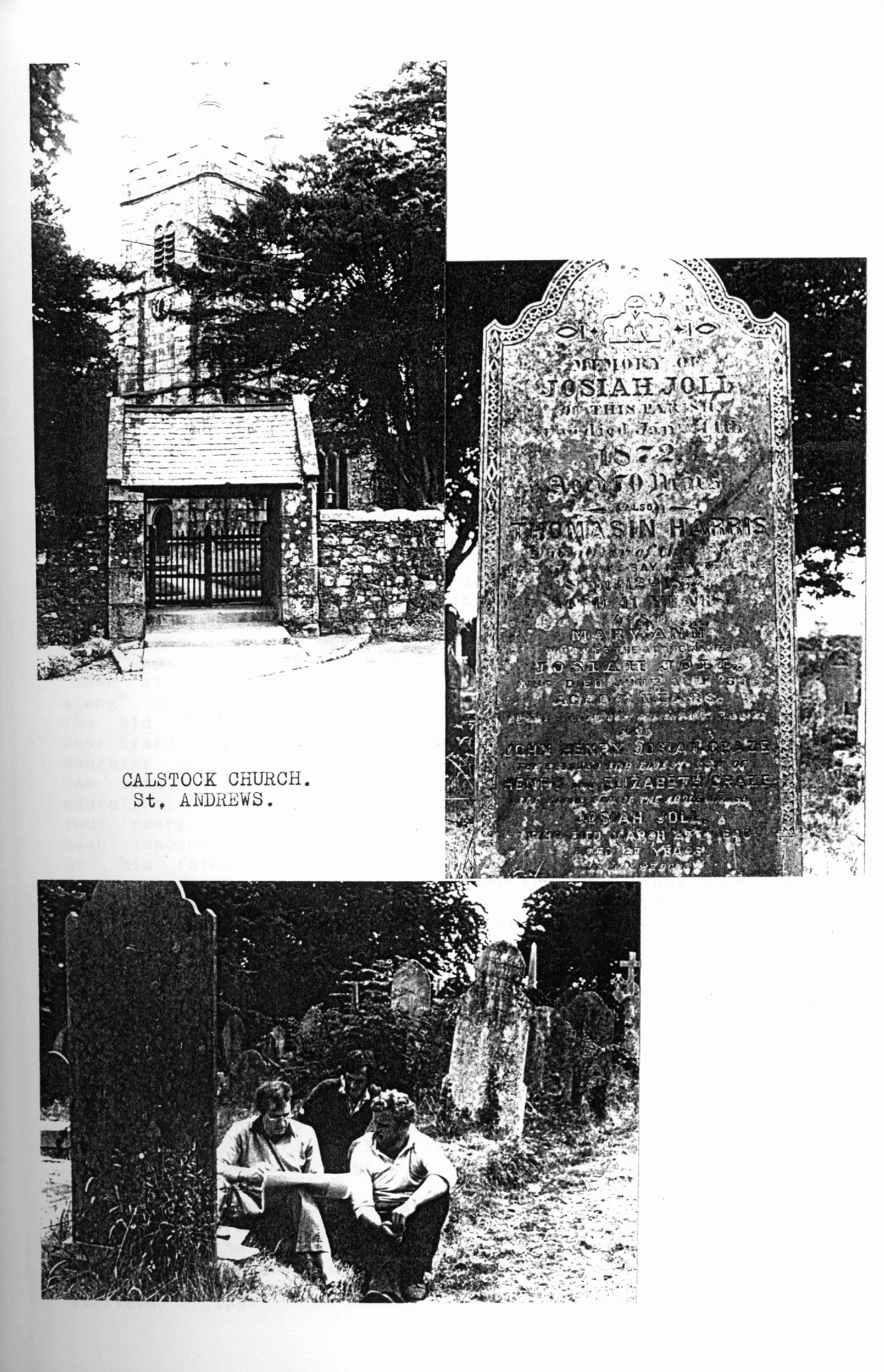
Page 5
35 Henry 8th. 1543-1544 St Minver Parish
Nyclas Joll. In bonis (Goods)
20 shillings and 11 pence tax.
List Coin, stock, goods, plate, corn, merchandise: after deduction of debts, clothing for himself and family a levy of .. up to £5 – 4 pence.
£5 to £10 – 8 pence
£10 to £20 – 1 shilling and 4 pence.
Over £20 – 2 shillings
Real Estate charged at the same rate up to £20
Over £20 – 3 shillings.
So Nyclas’s assets were about £100 per annum, quite a wealthy man at that time.
When the stream tin was largely exhausted, shafts had been dug into the seams of tin and copper and arsenic, found throughout Cornwall, including the Downs and Valleys about Calstock. Miners came to the district and feeding them brought prosperity to the farmers. A shipyard developed on the riverbank, busy with converting the woods of these parts into fishing boats and coasters. Succeeding wars made great demands on the metals and victuals the land supplied, bringing great prosperity. Conversely peace brought recession and misery, especially so after Waterloo brought an end to the Napoleonic wars.
That seems to be the beginning of the end. Samuel, who died in 1807 and his Wife Sarah Bowhay who died in 1849, had retired “down along” to their house in the town, leaving a Manager “up along” on the farm near the old Norman Church above the valley. The old man’s tombstone now leaning against the wall of the churchyard, describes him as Yeoman of Calstock Town. His one daughter Anne, married one E. Brooming, and it is told that old Sam spent much more than he could afford on her children’s education. Not true of him however, for Anne Brooming was only four years old when he died. More than likely the estate had been impoverished by supplying dowries for Sam’s three sisters by his father Josiah, or even by Josiah’s father John, fragmenting the property in providing for four other sons and a daughter. No doubt Sarah, widowed at 33 with three young children and big with a fourth when her husband died, was grateful in later years that the post Waterloo depression did not strike Cornwall till her family were out of her care.
Samuel, the son named after his father, had married a daughter of a neighbouring farmer, Elizabeth Vanderband Treliving, and suffered with the family the frustration of the depression and the submission to his older brother’s authority. Perhaps the submission was the hardest to bear and perhaps he had a case. When one day Josiah, clouted him with a bridle he cried “Enough”.
“Where be e going on?” asked the brother.
“I be going to Plymouth,” said Sam. “to buy a farm in New Zealand Land Company”. Which he proceeded to do.
Agriculture was at a low ebb and the energetic or ambitious sons of the soil were desperately seeking for land in which to settle and support their families. The spirit of adventure was in the air, and rumours of lands awaiting settlement were on everybody’s lips.
Page 5
35 Henry 8th. 1543-1544 St Minver Parish
Nyclas Joll. In bonis (Goods)
20 shillings and 11 pence tax.
List Coin, stock, goods, plate, corn, merchandise: after deduction of debts, clothing for himself and family a levy of .. up to £5 – 4 pence.
£5 to £10 – 8 pence
£10 to £20 – 1 shilling and 4 pence.
Over £20 – 2 shillings
Real Estate charged at the same rate up to £20
Over £20 – 3 shillings.
So Nyclas’s assets were about £100 per annum, quite a wealthy man at that time.
When the stream tin was largely exhausted, shafts had been dug into the seams of tin and copper and arsenic, found throughout Cornwall, including the Downs and Valleys about Calstock. Miners came to the district and feeding them brought prosperity to the farmers. A shipyard developed on the riverbank, busy with converting the woods of these parts into fishing boats and coasters. Succeeding wars made great demands on the metals and victuals the land supplied, bringing great prosperity. Conversely peace brought recession and misery, especially so after Waterloo brought an end to the Napoleonic wars.
That seems to be the beginning of the end. Samuel, who died in 1807 and his Wife Sarah Bowhay who died in 1849, had retired “down along” to their house in the town, leaving a Manager “up along” on the farm near the old Norman Church above the valley. The old man’s tombstone now leaning against the wall of the churchyard, describes him as Yeoman of Calstock Town. His one daughter Anne, married one E. Brooming, and it is told that old Sam spent much more than he could afford on her children’s education. Not true of him however, for Anne Brooming was only four years old when he died. More than likely the estate had been impoverished by supplying dowries for Sam’s three sisters by his father Josiah, or even by Josiah’s father John, fragmenting the property in providing for four other sons and a daughter. No doubt Sarah, widowed at 33 with three young children and big with a fourth when her husband died, was grateful in later years that the post Waterloo depression did not strike Cornwall till her family were out of her care.
Samuel, the son named after his father, had married a daughter of a neighbouring farmer, Elizabeth Vanderband Treliving, and suffered with the family the frustration of the depression and the submission to his older brother’s authority. Perhaps the submission was the hardest to bear and perhaps he had a case. When one day Josiah, clouted him with a bridle he cried “Enough”.
“Where be e going on?” asked the brother.
“I be going to Plymouth,” said Sam. “to buy a farm in New Zealand Land Company”. Which he proceeded to do.
Agriculture was at a low ebb and the energetic or ambitious sons of the soil were desperately seeking for land in which to settle and support their families. The spirit of adventure was in the air, and rumours of lands awaiting settlement were on everybody’s lips.
Page 11
THE FIRST GENERATION IN NEW ZEALAND
Although the five oldest children of Samuel and Elizabeth were born in England, they arrived in New Zealand at such an early age that, together with their five younger brothers and sisters, they might reasonably be passed as first generation New Zealanders.
The family left Plymouth on 2nd November 1841, their five children at the time being Anne aged 11 years, Samuel aged 9 years, Sarah aged 7 years, John aged 3 years and Eliza aged 1 year .
Subsequent to the parents settling in New Zealand Samson was born in 1843, Thomas in 1845, Mary in 1847, Elizabeth in 1850 and David in 1852.
Anne Joll the eldest daughter born 1830, Calstock. Cornwall, married Albert Wills, 26th December 1850. Albert had arrived in New Zealand with his parents at the same time as the Joll family aboard the “Timandra”. Albert’s occupation was farming. The first 10 years together were spent in Taranaki where 7 children were born. A move was then made to Motueka, Nelson, presumably farming and 5 more births recorded. Sadly two of these were lost in infancy.
One son John, worked in Hawke’s Bay for his Uncle John Joll. He later entered the Church of England and for some time taught at Te Aute College. He was a fluent Maori speaker and eventually became Principal of Otaki Maori College. In 1893 the Rev. Thomas John Wills was curate of Ormondville and Makotuku.
A daughter Elizabeth married Franklin Martin about 1880.
Anne died aged 68 years at Motueka.
Photo captions –
ELIZABETH & FRANKLIN MARTIN
Page 12
SAMUEL JOLL OF WAITARA and Family … Samuel the eldest son was born at Calstock in 1832 and commenced working for his father as soon as they arrived in New Plymouth. In those days. a boy was considered old enough to work as soon as he was big enough to be useful. Samuel assisted his father with his stevedoring and carrying activities in the early days of the settlement and in clearing the bush and carting the timber when the family land was being improved. Like all young men of his generation in Taranaki he became an expert bushman and bullock driver and when the Maori wars broke out, he immediately enlisted in the Taranaki Bushrangers. He served all through the Taranaki war and was awarded the Queen’s medal.
At the news of discovery of gold at Ballarat and Bendigo in Australia, Samuel decided to try his luck. but he very soon decided that the lure of gold was a very precarious job. He accordingly procured a wagon and team of bullocks and did a roaring business transporting supplies to the “diggers” on the goldfields themselves.
When he had amassed a considerable sum, he returned home and took up the property at Waitara which became one of the finest farms in the district. He named it Riverdale.
Samuel married Elizabeth Langdon Jonas whose parents also came to New Zealand in the forties and there were thirteen children of the marriage. Samuel died in 1899 at Waitara.
Their eldest son Harry was born on his father’s farm at Waitara and as the large and historic Manukariki Pa was right next door, he soon was virtually bi-lingual. He spent the early years engaged in the usual pursuits open to healthy youths and became noted for his ability to handle teams of horses.
Harry, when married to Alison Shearer, took up land first at Waitara and then near Hawera where they spent some years, then returned to New Plymouth and finally settled in Auckland where he managed a business for Hellabys until his death.
Harry and Alison had twelve children and their descendants are settled in many parts of New Zealand. Three of the sons served overseas in the 1914-18 war and one was decorated for conspicuous gallantry. (See Colonel Weston’s book regarding the event).
Harry’s eldest son Shearer married Gwldys Boscawen, a member of the historic Cornish family of that name and had a family of 7. Shearer served in France in W.W.I.
Their son Harry did not marry and was drowned in Auckland Harbour in 1963.
Harry and Alison’s youngest son John, was born and educated in New Plymouth. He saw service in France during the World War I and on his return from overseas joined the firm of Newton King Ltd. John married A.M. Davidson and had one son and two daughters. His eldest daughter Sydney married A Lambourne who was employed by Burns Phelp and Co. in Suva, Fiji. and subsequently in London.
John’s son John enlisted in the Air Force at the age of 19 and had a distinguished record. He was awarded the D.F.M. and the D.F.C. and took part in many bombing raids over Germany during W.W.2. He retired with the rank of Squadron Leader.
Page 18
SARAH JOLL… Samuel Senior and Elizabeth’s second daughter Sarah, born in Calstock 1834, married Robert Gilmour and settled in Raglan. Robert, was the founder and senior partner in the large coach building business of Gilmour, Joll and Williams.
Sarah had 12 children, with many now having descendants throughout New Zealand. In 1866 one of their children, Jean, at 5 years of age was a foundation pupil at the Raglan School. She married Rev. William Slade in the mid 1880’s. He was prominent in the Methodist Church, serving in Onehunga, Dunedin and Fiji. The Slade family consisted of Gilmour, William (who was also a Methodist Minister), Eileen (well known as a concert pianist in Auckland, and accompanying Gladys Moncrieff on one of her tours).
Eileen, married Tony Valentine. Another daughter Natalie, married Clive Johns, who was a partner in a flourishing Radio business still in existence in Auckland. Natalie was the only one to continue the line with two sons and a daughter. William did marry and had a daughter (Brenda Shore). She has no issue. The youngest of the Slade family was Marjorie.
Sarah Gilmour. at 53 years became ill with cancer. She went from Raglan to Auckland, perhaps in the hope of treatment. She died there but was shipped back to Raglan accompanied by two sons Alan and Charles, a daughter and a brother. She died 4.7.1887.
Photo captions –
SARAH JOLL
Page 25
JOHN JOLL of Pukahu was born at Calstock in 1838 and accompanied his parents to New Zealand in the S.S.”Timandra”, arriving in New Plymouth in 1842.
John spent his childhood in New Plymouth and in common with his brothers soon became an experienced bushman and teamster. He also obtained a thorough grounding in farming as it had been carriedPhotos – on for centuries by his forbears in the old land, and of the Maori language and customs.
As soon as he was old enough to branch out for himself John began to look around for a suitable place to settle, and what better could he choose than Hawke’s Bay where Sir Donald McLean whom he no doubt saw, if not met in Taranaki, had recently purchased the Te Mata Heretaunga Block. Accordingly about 1860 we find this young man with a team of bullocks engaged in road construction and bush clearing works at Te Aute.
Hawke’s Bay was a wild and lawless place at this time and many a time “Taranaki Jack” must have been glad of his intimate knowledge of the Maoris and their customs and of his reputation for strength and ability to look after himself. when the necessity arose.
The Maoris in Hawke’s Bay at that time were more or less friendly though they were already beginning to wonder whether they had been a little too anxious to dispose of their lands to the Pakeha a few years before.
The principal chiefs in Hawke’s Bay, at that time were Pareha, Moananui, Karaitiana, Karauria, Hapuka and Tomoana and they had sold Heretaunga to Thos. Jensen and others, Maraekakaho to McLean, Te Mata to Chambers, Te Mahunga to Douglas and areas at Te Aute to Williams. Many of these sales were to the Government in the first instance but no matter what the circumstances were, the purchase price was soon dissipated and the Maoris started to complain that they had been cheated. Thos. Tanner was to receive the brunt of these complaints and though a Royal Commission of Enquiry into the sale of the Heretaunga Block found that he had dealt fairly in the circumstances it was many years before some of the claims were settled.
One of the most influential of the chiefs were mentioned. Te Hapuku had been very active in selling the tribal lands without always consulting other owners and in 1857, Te Moananui, Karaitiana and others had a pitched battle with him near Mangateretere and forced him to leave his Pa at Pakowai and live with his hapu at Te Hauke a few miles inland. His close relative Puhara was killed.
When John arrived in Hawke’s Bay, Hapuku had established himself near Poukawa Lake and had already granted a block of land at Te Aute for the establishment of a Maori College. This land was then being farmed by the Rev. Samuel Williams and it was here that the young man from Taranaki commenced his life in Hawke’s Bay. A life which ended tragically while full of promise a few short years later.
At this time the hills behind Poukawa and Te Aute were covered with heavy bush and the first task of the settlers was to provide road access to their holdings. Bridle tracks and rough bullock tracks were already in existence in places and John’s first job was a contract for road construction between Hapuku’s Pa at Te Hauke and Te Aute in Pukehou as the delivery station is called. Hapuku was not at all happy about the way things were shaping and as the road work progressed and more and more pakehas came into the district he began to have second thoughts about the wisdom of his former land selling activities.
C:\Personal\Data\Genealogy\Genealogy\zAngarrack\= Families of Cornwall\Joll\Joll.JonesG872_HistoryOfJollFamily.pdf
Page 48
Polly married Bill Reardon.
Joseph Henry was the father of Sir Lou [Lew] Harris, a Hawke’s Bay identity knighted for his services in philanthropic works.
Josiah went to sea. In 1922 Josiah returned to New Zealand in dramatic circumstances. He was Captain or First Officer of a sailing ship, the Helen B. Stirling, which foundered, in the Pacific. The crew were rescued by the H.M.A.S. Australia and brought to New Zealand. He returned to Canada after visiting his brothers in Hastings and contact has been lost with him and his descendants, if any.
Sarah Jane married Andrew Alexander Gilmour. One hundred and twenty years since the arrival of Joseph and Thomazine Harris in N.Z. their descendants, fifth generation New Zealanders live in this land of opportunity.
RICHARD JOLL was born at Calstock. It was on July 30, 1838. Monday morning by 6 o’clock, as recorded in the family Bible. On reaching 22 years of age Richard decided to migrate to N.Z. The fact that his Uncle Samuel was one of the pioneers of the New Plymouth settlement would, he no doubt reasoned, give him a head start in his new life.
With good connections and steady employment first as a carpenter, then as a builder – Richard appears to have become a citizen of substance. The N.Z. Registry of Electors for 1882 shows Richard Joll, Carpenter, of Manukau County, Auckland, as being entitled to vote by reason of owning 40 acres there, worth 50 pounds and property valued at 360 pounds in the Auckland Borough.
When gold was found at Thames, south-east of Auckland, Richard Joll joined the rush, and when it petered out, shifted farther south to Waihi. Here he followed the calling of mining carpenter with the Waihi Goldmining Company.
Photo caption –
ANDREW GILMOUR – SARAH (nee HARRIS).
Nina, Isobel, Eileen.
Page 52
DAVID JOSIAH JOLL “was born September 19, 1851 Friday morning 8 o’clock.” David was 14 years old when he sailed from Calstock for New Zealand July 18 1865. The journey took just under 3 months, arriving October 12, 1865.
David Josiah made his way to Hastings in H.B. where he worked for J.N. Williams at Frimley. This eventually brought him in contact with the young lady who was to become his bride. Mary Jane Ebbett of County Cavan, Ireland, had journeyed out with her family and joined the Williams as nurse to their children. Mary Jane and David Josiah Joll were married December 25th, 1873 at her parent’s residence in Oak Avenue, Hastings. At the time of their marriage, they purchased land from the Williams. They called their home “Herewood” after the Joll family homestead at Calstock on Tamar, Cornwall.
Six children were born to them, forming the base for a thriving family of five generations.
David Josiah’s life was not a long one, his parents Bible records that he died 27th January 1887, in New Zealand. aged 35 years. He is buried at Havelock North.
Mary Jane remarried Edwin James Whibley. She died 15th July 1930, aged 81 years.
DAVID JOLL – MARY JANE (nee EBBETT)
BENJAMIN JOLL.
BENJAMIN born March 1862.
It is noted in the Bible, that Benjamin was 16 years and 4 months old when he sailed for New Zealand, aboard the ship City of Auckland, on a Thursday, 25th July, 4 O’clock in the morning.
After a 3 month voyage and nearly at their destination at 9pm the evening of the 22nd October they ran into bad weather. The Captain, mistaking Kapiti Island for Durville Island turned as though to go through Cook Strait and ran aground.
Page 55
Josiah Harries was born 20 June 1865.
In New Zealand.
1865
David J. Joll Sailed for New Zealand.
July 18
David arrived October 12, 1865 Ship Ez ———?
Josiah Joll Died Jan. 14, 1872.
Burried 18. next.
Age 71 in Feb. coming.
John C Joll Married Sept.23, 1873.
In America.
C Joll married August 18 at Calstock Church 1873.
David Joll was married 25. of December 1873.
John Hennrey Josiah Craze Born 17, February.
Tues Night at 5 o’clock 1874.
Mary Hannah. Daughter of Jon & E Joll was Born in America.
Sept. 18. 1874. Friday Morning.
Half Past 8 in the morning.
Philip Josiah Joll son of John & E Joll.
Was Born Sept. 20, 1876 in America.
9 months old when he lost his Mother.
Elizabeth the Wife of J C Joll Died in America.
1877 June 17. Sunday night.
Thamzine Harries Died 1877.
in Hastings, New Zealand.
Sept. 12 Wednesday Morning half past 9.
Age 41 yrs. 7 months.
John Waldron. Departed this life by an Accident.
A laden waggon going over his chest.
18 Dec. 1877 in New Zealand.
1878 Benjamine Joll. Sailed for New Zealand.
July 25 Thursday Morning 4 o’clock.
Ship City of Auckland.
16 yrs. 4 months.
Wrecked Oct. 22. at 9 at night at Otaki.
Arrived on the Hinemoa at Hawke’s Bay.
26th Oct. Middle of the day.
Sarah Jane Harries 8 yrs. old Sept.23, 1878.
Sarah Married Nov. 7. 1878 in New Zealand.
Page 68
In the early days of 88,
Two Kiwi Grans said, “Twas not too late.”
To travel the world our roots to find,
With Norway, Calstock and York in mind.
We travelled all Britain, taking in Plymouth and Poole.
St. Ives. Drake’s Way, – on all we can drool.
To Cambourne now to see Joll relations,
Found William and Pauline, who’s lots of citations,
Cornish legends and history – were loth to leave,
Can’t wait for the postman, copies to receive.
Now, Brian Lessiter – to meet him – what fun!
He took the Joll family Bible to N.Z. (found by his son.)
Brian, such an enthusiastic, cheerful great guy.
Was competing in Disabled Olympics in Korea bye and bye.
Goodbye “Sweethearts” as he kissed us Goodbye.
Brian! Come to N.Z. sometime Heremai and Kai!
(1990 Brian and Celia made their way.
To celebrate the Joll reunion in the Bay.
And what a thrill it is to see
Their names honorary upon the Family Tree.)
To Calstock, where Joll’s came from, we went by slow train.
A winding cobble-stoned street off a lane,
My Great Greats came to Waitara in early days.
I puffed up the mountainous hill – took photos of graves.
Breathtaking views from the church so old,
Baptised, married, buried there – Jolls from the fold.
Such delight, my nostalgia was complete,
To see six Bellringers playing church bells – what a treat.
If all our ancestors, we could visualise,
Sams, Johns, Digory, Josiah and Giles,[M]
Of all their deeds, would we be proud?
Or would we put them under a cloud?
In ’41, “Timandra” Ship got under weigh,
From Plymouth to New Plymouth – 14 weeks I’d say!
Of Samuel Joll, I’d like to think,
Of his courage and nerve, we could share a link.
Samuel objected to lime in his berth.
But Chief Mate sprinkled it for all he’s worth.
“Give the bucket to me.” Sam said.
The bucket fell down, but the lime was spread.
A scuffle took place!
Who was going to save face?
Sam, struck down Thompson – the Chief Mate.
The Captain spoke “It’s irons for you Joll – it is your fate! ”
Sam said “I’d rather die, than call a holt.”
The emigrants didn’t want Sam in bolts.
So later, Sam acknowledged his faults.
Page 72
. .1840 John Joll, Coal Dealer, 23 Arundel Cres. Plymouth
17.03.1866 John Henry Joll Baptised St. Peters. Plymouth
17.03.1870 Nathaniel Joll Baptised St. Peters. Plymouth
25.12.1890 John Joll To Eliza Sara Falmouth
Children of The Above … Birth – Death
Ada Aurial 1893-1972 Falmouth
John Melville 1895-1969 Falmouth
Frederick Cecil 1896-1976 Falmouth
Clementine Pretoria -1937 Falmouth
William Horace 1902-1957 Falmouth
Francis Reginald 1904-1904 Falmouth
CORNWALL COUNTY COUNCIL
Cornwall record Office
County Hall Truro TR1 3AY
Tel Truro (0872) 73698 & 74282
Telex 45491 CWLLCC
Fax Truro (0872) 70340
CERTIFIED COPY OF PARISH REGISTER ENTRY
MARRIAGES solemnized in the Parish of Calstock in the County of Cornwall in the Year 1829
Samuel Joll of this Parish and Elizabeth Vanderbunt Treliving of this Parish were married in this Church by Banns with Consent of – this 16th Day of May in the Year One thousand eight hundred and 29
By me William Moorhead[?] Curate
This Marriage was solemnized between us Samuel Joll
Elizabeth Vanderbunt Treliving
In the Presence of Samuel Treliving
Amelia [Amb?]
No. 273
Page 73
LIST OF WILLS REGISTERED IN CORNWALL. FROM THE TRURO RECORDS OFFICE.
NAME PLACE DATE
Charles JOLL Warlstow 1699
Degory JOLL Warlstow 1643
Degory JOLL Warlstow 1684
Degory JOLL St. Gennys 1687
Elizabeth JOLL Laneast 1676
Ezekiel JOLL Altarnun 1665
George JOLL Altarnun 1692
John JOLL Warlstow 1587
John (or Adam) JOLL St. Minver 1597
John JOLL Lewannick 1624
John JOLL Egloskerry 1629
John JOLL Warlstow 1629
John JOLL Otterham 1678
John JOLL Altarnun 1695
Leonard JOLL Altarnun 1615
Leonard JOLL Altarnun 1689
Mary JOLL St. Stephen-by-Launceston 1664
Richard JOLL Altarnun 1699
Robert JOLL Warlstow 1618
Stephen JOLL St. Juliot 1623
Thomas JOLL Egloskerry 1628
Thomas JOLL Warlstow 1638
William JOLL Lewannick 1585
William JOLL Altarnun 1646
William JOLL Calstock 1685
Priscilla JOLL Altarnun 1703
George JOLL Truro 1709
John JOLL Poundstook 1712
Mary JOLL Lewannick 1714
Joan JOLL Lewannick 1723
George JOLL Altarnun 1731
Josiah JOLL Calstock 1784
John JOLL Warleggan 1786
John JOLL Lewannick 1786
William JOLL Calstock 1796
Francis (Innkeeper) Bodmin 1802
Digory (Farmer) Callington 1806
Page 74
Samuel JOLL (yeoman) Calstock 1807
Elizabeth (Widow) Callington 1809
Mary (Widow) Calstock 1810
Elizabeth (Widow) St. Clements 1829
George (Yeoman) Stratton 1837
OF GENERAL INTEREST ONLY.
No Research has been entered into which would authenticate the claims of this Historiography.
This historiography was prepared individually for the Joll surname on November 26, 1973 at the request of
Mr. Steven R. Joll
The coat-of-arms illustrated left was drawn by a heraldic artist based upon information about the Joll surname and its association with heraldry. In the language of the ancient heralds, the arms are described as follows:
“Quartered: 1st, or; the letter “J” sa.; 2nd and 3rd qu.; a sea-horse sejant vert; 4th, sa.; an orle or. Charged with a small inner shield arq.”
The Joll arms is translated:
Divided into quarters: 1st quarter, gold background; a black initial “J”, 2nd and 3rd quarters, red background; a green sea-horse sitting erect; 4th quarter, black background; a gold inner border. A small silver inner shield placed over all.
A sea-horse symbolizes naval pursuits, dominion. Seven vivid colors were chosen for use on shields of armor-clad knights to easily identify them at a distance. The heraldic colors gold, silver, purple, blue, green, black, and red were preserved on colorless drawings by dot and line symbols. The Joll Coat-of-Arms incorporated silver. The metal silver represents serenity and nobility.
Information available indicates that in 1972 there were less than 300 households in the U.S. with the old and distinguished Joll name. In comparison, some family names represent over 400,000 households in the United States.
This report does not represent individual lineage of the Joll family tree and no genealogical representation is intended or implied.
C:\Personal\Data\Genealogy\Genealogy\zAngarrack\= Families of Cornwall\Joll\Joll.JonesG872_HistoryOfJollFamily.pdf