

.jpg)


Blackheath
» Place: Blackheath 1 2 Next» » Slide Show
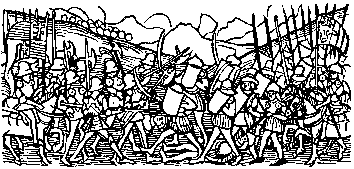
Battle of Blackheath (22 June 1497) [Cornish Rebellion; Battle of Deptford Bridge] 22 June 1497

|
In 1497, Perkin Warbeck, a pretender to the English throne, arrived in Scotland, where James IV
received him. The Scots made a brief incursion into England, which gave Henry VII the perfect excuse to levy taxes. This, however,
incited much ill-will and caused a Cornish uprising, headed by Michael Joseph (An Gof, "The Smith"), and Thomas Flamank, a lawyer. —AJ. |
The people of Cornwall, considering themselves over-taxed by Henry to
meet the expenses of the war, rose in open rebellion, and crying for the
execution
of the Archbishop Morton, chancellor and chief minister, and of Sir Reginald Grey, they poured into Devonshire to the number
of 16,000 men. From Devonshire they advanced into Somersetshire, where they were joined by the Lord Audley, and many other
persons of less note. They then marched through Wiltshire, Hampshire, and Surrey, into Kent, and encamped on Blackheath. Henry,
whose great sagacity did not preserve him from superstition, believed
that Saturday was his lucky day; and, accordingly, he ordered battle to
be given on
a Saturday. While the Lord Daubeney moved from London to attack in
front, the Earl of Oxford
made a circuit to attack in rear;
and the king, with a great body of reserve and most of the artillery,
kept his person out of danger at St. George's Fields, in the suburbs of
Loudon. Lord
Daubeney, after a sharp conflict, in which the Cornish archers did great
execution, drove in the advance post of the insurgents at Deptford
Strand, carried
the bridge, ascended the hill, and established himself on the heath. At
the same time, Oxford showed himself in their rear. Though without horse
or artillery,
or any good officers to command them, the Cornish men fought bravely,
until 2000 of them were slain. Fifteen hundred were taken with arms in
their hands; and
among the prisoners were Lord Audley
and Flammock, an attorney, and Joseph, a blacksmith. The Lord Audley
was beheaded at Tower Hill;
Flammock and Joseph were hanged, drawn, and quartered, at Tyburn. The
blacksmith died like a hero. All the rest were pardoned by proclamation.
MacFarlane, Charles, and Thomas Thomson. The Comprehensive History of England. Vol I.
London: Blackie & Son, 1876. 730.

|
In 1497, Perkin Warbeck, a pretender to the English throne, arrived in Scotland, where James IV
received him. The Scots made a brief incursion into England, which gave Henry VII the perfect excuse to levy taxes. This, however,
incited much ill-will and caused a Cornish uprising, headed by Michael Joseph (An Gof, "The Smith"), and Thomas Flamank, a lawyer. —AJ. |
The people of Cornwall, considering themselves over-taxed by Henry to
meet the expenses of the war, rose in open rebellion, and crying for the
execution
of the Archbishop Morton, chancellor and chief minister, and of Sir Reginald Grey, they poured into Devonshire to the number
of 16,000 men. From Devonshire they advanced into Somersetshire, where they were joined by the Lord Audley, and many other
persons of less note. They then marched through Wiltshire, Hampshire, and Surrey, into Kent, and encamped on Blackheath. Henry,
whose great sagacity did not preserve him from superstition, believed
that Saturday was his lucky day; and, accordingly, he ordered battle to
be given on
a Saturday. While the Lord Daubeney moved from London to attack in
front, the Earl of Oxford
made a circuit to attack in rear;
and the king, with a great body of reserve and most of the artillery,
kept his person out of danger at St. George's Fields, in the suburbs of
Loudon. Lord
Daubeney, after a sharp conflict, in which the Cornish archers did great
execution, drove in the advance post of the insurgents at Deptford
Strand, carried
the bridge, ascended the hill, and established himself on the heath. At
the same time, Oxford showed himself in their rear. Though without horse
or artillery,
or any good officers to command them, the Cornish men fought bravely,
until 2000 of them were slain. Fifteen hundred were taken with arms in
their hands; and
among the prisoners were Lord Audley
and Flammock, an attorney, and Joseph, a blacksmith. The Lord Audley
was beheaded at Tower Hill;
Flammock and Joseph were hanged, drawn, and quartered, at Tyburn. The
blacksmith died like a hero. All the rest were pardoned by proclamation.
MacFarlane, Charles, and Thomas Thomson. The Comprehensive History of England. Vol I.
London: Blackie & Son, 1876. 730.
Other Local Resources:
The Battle of Blackheath on the Web:
- An Gof and the Cornish rebels in Deptford, 1497 - Seán Mac Mathúna
via https://web.archive.org/web/20260111131812/https://www.luminarium.org/encyclopedia/blackheath.htm
| Owner of original | Luminarium Encyclopedia |
| Date | 22 Jun 1497 |
| File name | vL.o.battle.gif |
| File Size | 6.77k |
| Dimensions | 354 x 169 |
| Linked to | [Battles] The Battle of Blackheath, also known as the Battle of Deptford Bridge 17 June 1497, Jun 1497-1499 Cornish Rebellion and Perkin Warbeck ; [Role] to put down Cornish revolt of 1497, Jun 1497-1499 Cornish Rebellion and Perkin Warbeck; [Event] Second Cornish uprising of 1497 (Perkin Warbeck abt 7 Sep-4 Oct), Cornwall; [Event] Cornish rebellion of 1497, Jun 1497-1499 Cornish Rebellion and Perkin Warbeck; Blackheath; King Henry VII, also known as Henry Tudor; Perkin Warbeck, pretender to the English throne claiming to be Richard of Shrewsbury, Duke of York |
» Place: Blackheath 1 2 Next» » Slide Show