

.jpg)


manor of Lelant and Trevetho, Lelant, Cornwall
» Place: manor of Lelant and Trevetho, Lelant, Cornwall «Prev «1 ... 4 5 6 7 8 9 10 Next» » Slide Show
Manor of Lelant and Trevethoe (Trevethow) – Tracing the descent
Manor of Lelant and Trevethoe (Trevethow) – Tracing the descent
The early origins of this manor can be traced to around the 1200s, when the land was in the ownership of the Bottreaux family. In the 1400s, with the male line extinct, the family estate was passed to successive female heir Mary Hungerford, Baroness Boteuax, who married Sir Edward Hastings. Hastings was given the peerage of Earl of Huntingdon by Henry VIII and the manor was later sold in part by the Earls of Huntingdon.
We can next trace part of the manor to the Earl of Bedford in 1560, and by 1583 half the manor was sold to the Robartes family of Lanhydrock; it was still in their possession in circa 1656 when John, 2nd Baron Robartes, later the Earl of Radnor, held part of the manor.
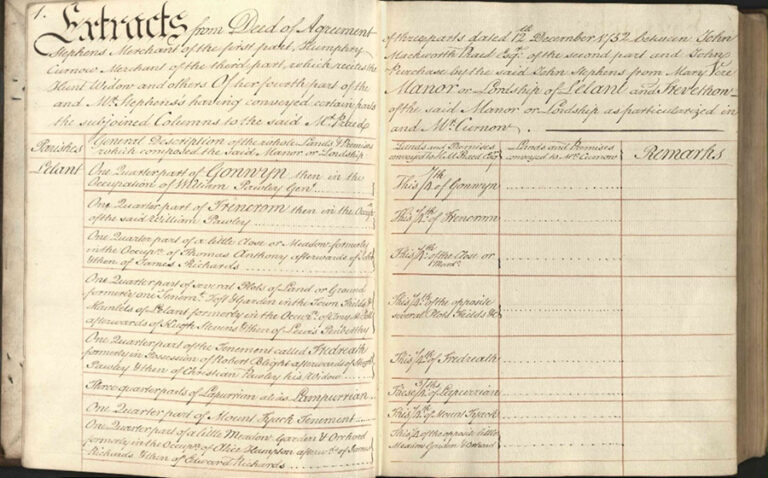
In 1749, Mary Vere Robartes sold her part of the manor to John Stephens, esq of St Ives. A survey dated 1752 (shown below) divides the land between three parties: Stephens, Praed and Curnow. An earlier account of rents dated 1678-1701 for the Praed family includes the manor 7.
In the mid-1770s, the manor by descent was in the hands of Humphry Mackworth-Praed, esq. William Praed, esq married Miss Backwell of Tyringham and the manor passed by descent to William Backwell-Tyringham, esq. In 1939, Roger William Gifford Tyringham, esq was noted as lord of the manor.
The Praeds, and later the Tyringhams, certainly owed much of their wealth throughout the 18th and 19th centuries to their mining interests. Two mines in the district reflect this better than perhaps anything else could, by taking their very names: Wheal Tyringham on the southern slopes of Rosewall Hill, and Praed Consols, in a similar position as the former but on Trencrom Hill.
Today, these once bustling industrial communities are very much silent and the country has been designated an Area of Outstanding Natural Beauty (AONB) 8. Much archaeology besides the district’s mining heritage is also to be seen, such as the pre-historic embankments and burial remains of Trencrom Hill. These may have given Trevethow its name, given that Trevethow roughly translates to the ‘place of graves’ in Cornish 9.
Below is an example the Praed family’s record-keeping of their estate interests; the book is a copy, in exquisite 18th century hand, of various deeds and conveyances and it records the interest acquired or exchanged for each of the parties. If land was business, manors were run much like companies today, with lords and ladies as shareholders or interested parties. The fortunes of many families relied on land and, with the changes to the Land Tax Act in 1914, the old ways of manorial income ceased to be sustainable. Many of the great landed estates in Cornwall were sold about this time, with the Tyringhams selling some 6,000 acres of freehold by public auction in 1920 10, although the mineral rights were reserved.
» Place: manor of Lelant and Trevetho, Lelant, Cornwall «Prev «1 ... 4 5 6 7 8 9 10 Next» » Slide Show